CISF Restructuring 2026: Why India's Industrial Security Force Is Moving to Sector-Wise Commands
The CISF guards airports, the Delhi Metro, nuclear and space plants, steel mills, coal mines and, since 2024, Parliament itself. From 1 November 2026 it will be organised by what it protects, not by where it is. Here is what changes, the law behind the force, and why it matters for India's internal security.
What the CISF announced
The Central Industrial Security Force (CISF) said the Ministry of Home Affairs has approved a new structure that takes effect on 1 November 2026. Until now its field units were grouped by geography (North, East, Central and so on). Now units guarding the same kind of facility will sit under one command, wherever they are in India.
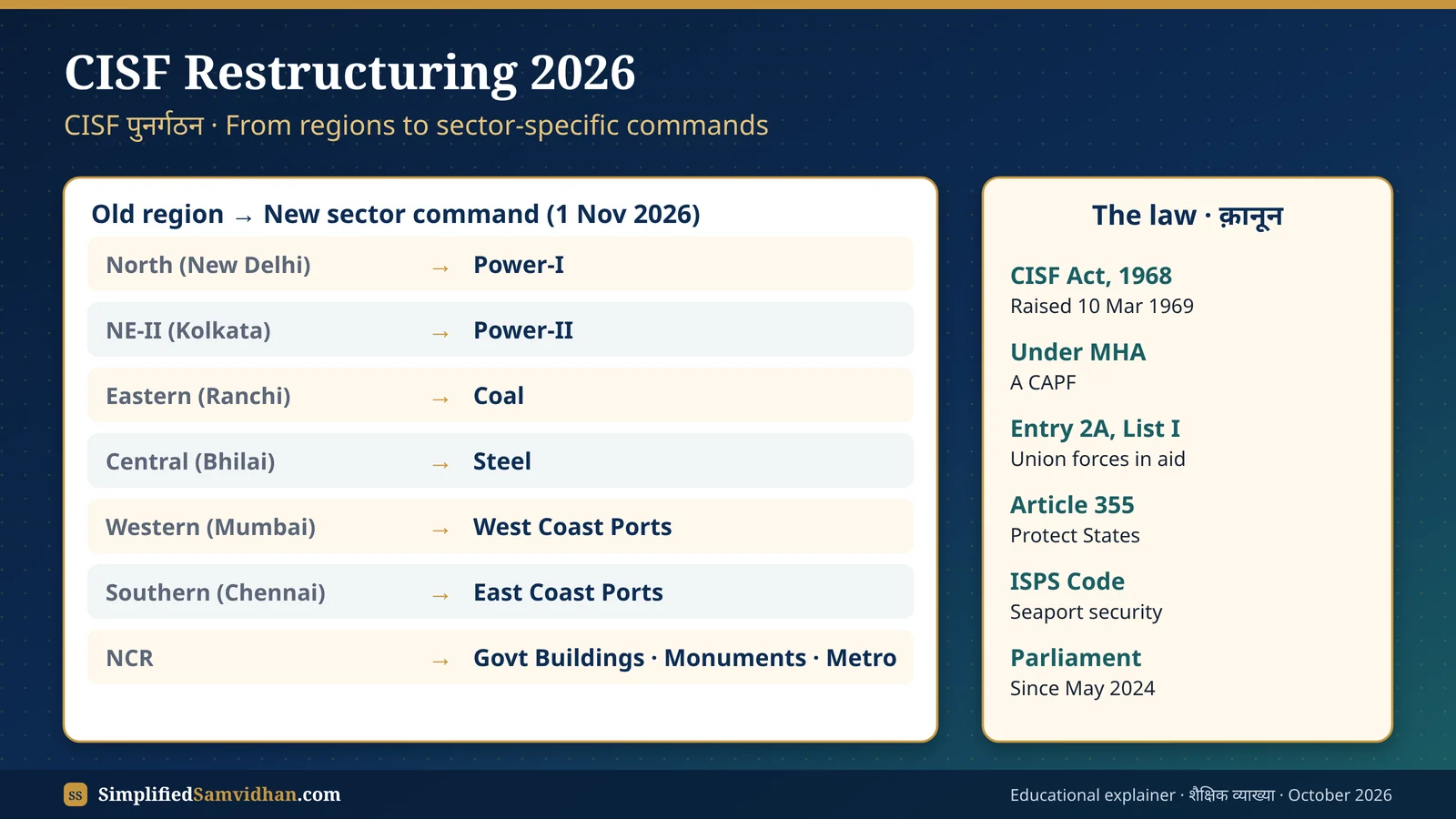
Eight of the force's eleven sectors are being realigned. The North Sector (New Delhi) becomes Power-I and North Eastern Sector-II (Kolkata) becomes Power-II; the Eastern Sector (Ranchi) becomes the Coal Sector; the Central Sector (Bhilai) becomes the Steel Sector; the Western (Mumbai) and Southern (Chennai) sectors become the West Coast and East Coast Port Sectors, covering about 250 ports; and the NCR Sector becomes the Government Buildings, Museums and Monuments and Mass Rapid Transit Sector. The Atomic Energy and Space sector and the two Airport sectors keep their existing set-up.
The ChangeCISF Restructuring: From Regional Sectors to Sector-Specific Commands
| Old sector (headquarters) | New command from 1 Nov 2026 |
|---|---|
| North Sector (New Delhi) | Power-I |
| North Eastern Sector-II (Kolkata) | Power-II |
| Eastern Sector (Ranchi) | Coal Sector |
| Central Sector (Bhilai) | Steel Sector |
| Western Sector (Mumbai) | West Coast Port Sector |
| Southern Sector (Chennai) | East Coast Port Sector |
| NCR Sector | Government Buildings, Museums and Monuments and MRTS Sector |
| DAE and DoS Sector (Bengaluru); Airport Sectors I and II | Unchanged |
Earlier, one regional boss looked after a coal mine, a museum and a port just because they were in the same region. Each needs very different skills. Now the people who guard ports will specialise in ports, those who guard power plants in power plants, and so on. Training, drills, equipment and threat analysis can then be shared across the whole sector.
🏠 Everyday analogy
A big hospital does not group doctors by the floor they work on; it groups them into cardiology, orthopaedics and neurology. The CISF is now doing the same with security.
🇮🇳 Real Indian example
A port guard in Kandla and one in Paradip will now follow one port-security command, share the same drills against smuggling and drones, and be inspected against the same international port security code.
Official TextCISF Act 1968, Union List Entry 2A and Article 355: The Legal Basis
Constitution of India, Seventh Schedule, List I (Union List), Entry 2A (inserted by the 42nd Amendment, 1976).
Deployment of any armed force of the Union or any other force subject to the control of the Union or any contingent or unit thereof in any State in aid of the civil power; powers, jurisdiction, privileges and liabilities of the members of such forces while on such deployment.
Article 355. Duty of the Union to protect States against external aggression and internal disturbance.
It shall be the duty of the Union to protect every State against external aggression and internal disturbance and to ensure that the government of every State is carried on in accordance with the provisions of this Constitution.
Police and public order are State subjects (List II, Entries 1 and 2), so how can a central force guard a steel plant in Chhattisgarh? Two answers. First, the CISF is created by Parliament under the CISF Act, 1968 to protect industrial undertakings and installations, most of which are central undertakings. Second, Entry 2A of the Union List lets the Centre deploy its forces in a State in aid of the civil power, and Article 355 makes protecting States against internal disturbance a duty of the Union.
Know the ForceCentral Industrial Security Force: Key Facts, Laws and Roles
- 11968
Parliament passes the CISF Act; the force is raised on 10 March 1969 (celebrated as CISF Raising Day).
- 21983
An amendment makes the CISF an armed force of the Union.
- 32000 onwards
After the IC-814 hijack, the CISF begins taking over airport security; it later guards the Delhi Metro (2007).
- 42009
The Act is amended so that the CISF can also protect private industrial undertakings on payment.
- 52024
After the December 2023 security breach, the CISF takes over security of the Parliament complex in May 2024.
- 62025-26
Named the Recognised Security Organisation for seaports under the ISPS Code; sector-specific commands from 1 November 2026.
SeaportsCISF and Seaport Security: The ISPS Code and the New Port Sectors
- ISPS Code: the International Ship and Port Facility Security Code of the International Maritime Organization, in force since 2004, is the mandatory security regime for ships and port facilities in international trade.
- Recognised Security Organisation: the Ministry of Ports, Shipping and Waterways designated the CISF as the RSO for Indian seaports, a role earlier handled through the Indian Register of Shipping under the Directorate General of Shipping.
- Why it matters: many private and minor ports had no sovereign security agency; smuggling, drug trafficking and coastal terror threats (the 2008 Mumbai attackers came by sea) make port security a national issue.
- New port sectors: the West Coast and East Coast Port Sectors will bring about 250 major and minor ports under two specialised commands.
Benefits of sector commands
- Specialised training and equipment
- Uniform drills and audits
- Faster sharing of threat information
- Better link with sector ministries
Challenges
- Large distances under one command
- Coordination with State police
- Manpower shortage at ports
- Cost of deployment for undertakings
UPSC CornerCISF Restructuring and Internal Security for UPSC Prelims and Mains
- Prelims fact: The CISF was set up under the CISF Act, 1968 and works under the Ministry of Home Affairs.
- Prelims fact: Entry 2A of the Union List (deployment of Union forces in aid of civil power) was added by the 42nd Amendment, 1976.
- Prelims fact: Article 355 places a duty on the Union to protect every State against external aggression and internal disturbance.
- Prelims fact: 'Police' and 'public order' are in the State List (List II, Entries 2 and 1).
- Prelims fact: The ISPS Code is adopted by the International Maritime Organization under the SOLAS Convention.
- Mains (150 words): "Securing critical infrastructure needs specialisation, not just more personnel." Discuss with reference to the 2026 restructuring of the CISF.
Practice MCQTest Yourself: CISF Moves to Sector Commands
Consider the following statements about the Central Industrial Security Force (CISF): (1) It was set up under an Act of Parliament passed in 1968. (2) It works under the Ministry of Defence. (3) It can also provide security to private industrial undertakings. Which of the statements given above is/are correct?
Doubts ClearedFrequently Asked Questions
What is the CISF restructuring of 2026?
From 1 November 2026 the CISF will replace its geography-based field sectors with sector-specific commands. Units guarding similar facilities, such as power plants, coal mines, steel plants, ports or government buildings and metro systems, will come under one command irrespective of location. The Ministry of Home Affairs approved the change.
Which new CISF sectors are being created?
Power-I (from the North Sector), Power-II (from North Eastern Sector-II), Coal (from the Eastern Sector, Ranchi), Steel (from the Central Sector, Bhilai), West Coast Port and East Coast Port (from the Western and Southern sectors), and a Government Buildings, Museums and Monuments and MRTS Sector (from the NCR Sector). The Atomic Energy and Space sector and the Airport sectors are unchanged.
Under which law does the CISF work?
The Central Industrial Security Force Act, 1968. The force was raised on 10 March 1969, became an armed force of the Union in 1983, and works under the Ministry of Home Affairs.
Can a central force guard places in a State when police is a State subject?
Yes. Entry 2A of the Union List allows deployment of Union forces in a State in aid of the civil power, and Article 355 makes it the Union's duty to protect States against internal disturbance. The CISF mainly protects central undertakings and installations, which also fall within Union powers.
Does the CISF guard Parliament?
Yes. After the security breach of 13 December 2023, the CISF took over security of the Parliament complex in May 2024.
Sources and further readingSources We Checked
News facts on this page were checked against the reports below on 19 October 2026. The full official list of new sector headquarters may differ in detail; check the CISF or MHA statement. Constitutional text is quoted from the Constitution of India.
- The Week: CISF to undergo major overhaul from November 1. Here's what will change and why
- GKToday: CISF to introduce sector-based commands from November 1
- Legacy IAS: The Hindu UPSC News Analysis for 19 October 2026
- The Tribune: Govt designates CISF as main security organisation for India's 250 seaports
- Central Industrial Security Force Act, 1968 (India Code)
- Constitution of India (Legislative Department)