Religious Conversion and Reservation: Supreme Court on Backward Class Status After Conversion
Does a person carry their old caste with them when they change religion? On 15 October 2026 the Supreme Court said: not automatically. It upheld a Madras High Court ruling that a man who converted from Hinduism to Islam cannot claim Tamil Nadu's Backward Class (Muslim) quota just because of the caste he was born into. Here is the case, the Articles behind it, and what it means for reservation after religious conversion.
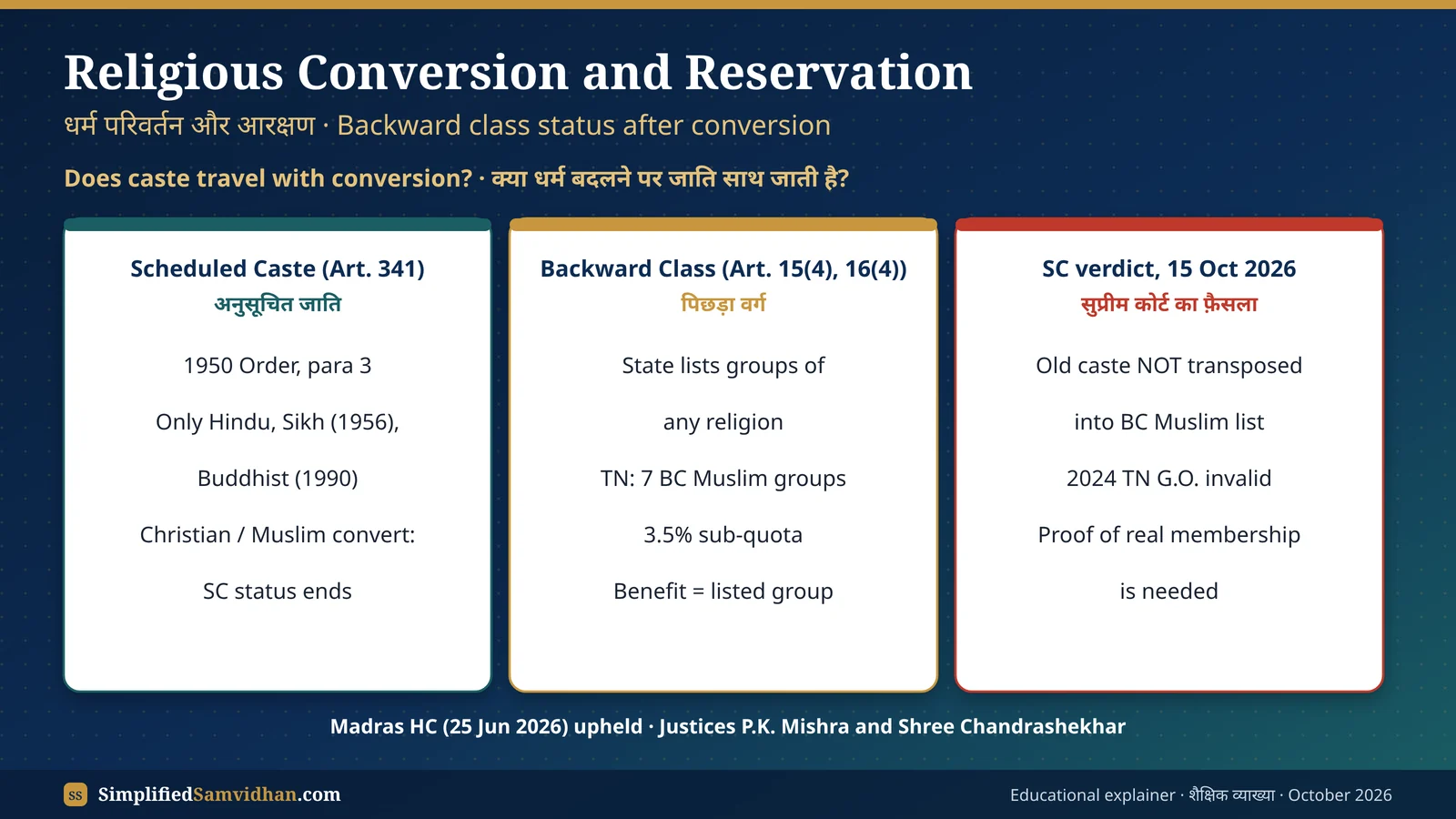
What the Supreme Court decided on 15 October 2026
On 15 October 2026 a bench of Justices Prashant Kumar Mishra and Shree Chandrashekhar of the Supreme Court dismissed Tamil Nadu's appeal and upheld the Madras High Court. The Court held that a person who converts from Hinduism to Islam cannot automatically claim reservation in the Backward Class (Muslim) category only on the basis of his pre-conversion caste.
The facts: Sameer Ahamed (earlier named Paramasivam) was born Hindu and converted to Islam in 2015. He applied for a community certificate as a Muslim Lebbai, one of the seven Muslim groups listed as Backward Class Muslims in Tamil Nadu. The Tahsildar refused. A Tamil Nadu Government Order of 9 March 2024 had allowed converts from BC, MBC, Denotified Community and SC backgrounds to be certified under one of the seven Muslim groups. On 25 June 2026 a Division Bench of Justices G.R. Swaminathan and P.B. Balaji upheld the refusal and struck down that Government Order. The Supreme Court has now confirmed this, saying the old caste cannot be transposed into the Muslim backward class list, and a private religious body cannot conclusively decide who gets a statutory benefit like reservation.
BackgroundReligious Conversion and Reservation: Timeline of the Tamil Nadu Case
| Date | What happened |
|---|---|
| 2007 | Tamil Nadu gives a separate 3.5% sub-quota to Backward Class Muslims within its Backward Class reservation. |
| 2015 | Paramasivam, born Hindu, converts to Islam and becomes Sameer Ahamed. |
| Later | He applies for a community certificate as a Muslim Lebbai (a Backward Class Muslim group). The Tahsildar rejects it. |
| 9 Mar 2024 | Tamil Nadu issues a Government Order allowing converts from BC, MBC, DNC and SC backgrounds to be certified under one of the seven BC Muslim groups. |
| 25 Jun 2026 | Madras High Court (Justices G.R. Swaminathan and P.B. Balaji) upholds the rejection and strikes down the 2024 Government Order. |
| 15 Oct 2026 | Supreme Court (Justices Prashant Kumar Mishra and Shree Chandrashekhar) dismisses Tamil Nadu's appeal. |
The seven Backward Class Muslim groups in Tamil Nadu are Ansar, Dekkani Muslims, Dudekula, Labbais (including Rowthar and Marakayar), Mappilla, Sheik and Syed. Reservation here is for these specific communities, not for every Muslim, and not for anyone who simply joins the faith.
Official TextArticle 15(4) and Article 16(4): The Basis of Backward Class Reservation
15. Prohibition of discrimination on grounds of religion, race, caste, sex or place of birth.
(4) Nothing in this article or in clause (2) of article 29 shall prevent the State from making any special provision for the advancement of any socially and educationally backward classes of citizens or for the Scheduled Castes and the Scheduled Tribes.
16. Equality of opportunity in matters of public employment.
(4) Nothing in this article shall prevent the State from making any provision for the reservation of appointments or posts in favour of any backward class of citizens which, in the opinion of the State, is not adequately represented in the services under the State.
Article 15(4) lets the State make special provisions (like seats in colleges) for socially and educationally backward classes, SCs and STs. Article 16(4) lets it reserve government jobs for a backward class that is not adequately represented. Notice the words: the benefit is for a class of citizens that is backward, not for an individual who chooses a label. The question in this case was: when you change religion, do you still belong to the class that was backward?
🏠 Everyday analogy
Think of a scholarship given to students of one particular village school because that school has no lab and few teachers. If a student moves to a different school in the city, he cannot carry the village-school scholarship with him just by saying "I studied there once". He must show he belongs to the group the scheme was made for.
🇮🇳 Real Indian example
A Hindu from a Backward Class family converts to Islam. To get the BC (Muslim) quota in Tamil Nadu he must show he is actually part of one of the seven listed Muslim communities, with its social life and links. A certificate saying only that he converted is not enough.
Official TextArticle 341 and the 1950 Order: Scheduled Caste Status After Conversion
341. Scheduled Castes.
(1) The President may with respect to any State or Union territory, and where it is a State, after consultation with the Governor thereof, by public notification, specify the castes, races or tribes or parts of or groups within castes, races or tribes which shall for the purposes of this Constitution be deemed to be Scheduled Castes in relation to that State or Union territory, as the case may be.
The Constitution (Scheduled Castes) Order, 1950, paragraph 3
Notwithstanding anything contained in paragraph 2, no person who professes a religion different from the Hindu, the Sikh or the Buddhist religion shall be deemed to be a member of a Scheduled Caste.
25. Freedom of conscience and free profession, practice and propagation of religion.
(1) Subject to public order, morality and health and to the other provisions of this Part, all persons are equally entitled to freedom of conscience and the right freely to profess, practise and propagate religion.
Scheduled Caste status works differently from Backward Class status. Under the 1950 Presidential Order, only Hindus could be SC at first; Sikhs were added in 1956 and Buddhists in 1990. So a Dalit who becomes Christian or Muslim loses SC status under the Order, though such communities may be listed as Backward Classes by the States.
Scheduled Caste (SC) status
- Listed by the President under Article 341
- Religion bar in para 3 of the 1950 Order: only Hindu, Sikh, Buddhist
- Converting to Christianity or Islam ends SC status
- Reconversion can revive it if the caste accepts the person back
Backward Class (BC/OBC) status
- Identified by the State (and the Centre for central lists)
- Can include groups from any religion (Mandal list had Muslim and Christian groups)
- Benefit goes to the listed community, not to the religion as a whole
- 15 Oct 2026: old caste does not automatically move into the new religion's list
Key JudgmentsCaste After Conversion: Supreme Court Cases on Religious Conversion and Reservation
| Case | What the Court said |
|---|---|
| G. Michael v. S. Venkateswaran (Madras HC, 1952) | A person's place in the new religion's society is not decided by the caste he had before conversion. Relied on by the High Court in 2026. |
| Kailash Sonkar v. Maya Devi (1984) | If a person reconverts to Hinduism and the caste community accepts him back, his old caste can revive. |
| Soosai v. Union of India (1985) | Upheld para 3 of the 1950 Order. A Christian convert cannot claim SC benefits without proof that the same disabilities continue. |
| Indra Sawhney v. Union of India (1992) | Caste can be a starting point to identify backward classes; backward groups can be found among non-Hindus too. |
| K.P. Manu v. Chairman, Scrutiny Committee (2015) | Reconversion plus acceptance by the community restores SC status. |
| C. Selvarani v. Special Secretary-cum-District Collector (2024) | Converting only to get reservation benefits, without real faith, is a fraud on the Constitution. |
| Sameer Ahamed case, Tamil Nadu's appeal (Supreme Court, 15 Oct 2026) | Pre-conversion caste cannot be automatically transposed into the BC Muslim list; the 2024 G.O. was an artificial route to reservation. |
Put together, the cases say one thing clearly: reservation follows real social backwardness of a listed group, not a label. Courts accept that caste can survive conversion in social life, but the person must prove it with facts. A shortcut, like a government order that treats every convert as a member of a backward Muslim group, skips that proof, so the courts struck it down.
The DebateReligious Conversion and Reservation: Arguments on Both Sides
Tamil Nadu's side (for the 2024 G.O.)
- Discrimination does not vanish when a person changes religion
- Converts from backward castes often remain poor and socially excluded
- Article 25 protects the freedom to change religion; losing benefits can be a penalty on that choice
- The State has power under Articles 15(4) and 16(4) to decide who is backward
Courts' reasoning (against the G.O.)
- Reservation is for a listed community, not for individuals who join it
- No study or data showed converts become part of the seven Muslim groups
- A jamaat or religious body's letter cannot decide a constitutional benefit
- An executive order cannot create an "artificial" door into a quota
Still open: Whether Dalit Christians and Dalit Muslims should get SC status is a separate question. Petitions on it have been pending in the Supreme Court for years, and the Centre set up the Justice K.G. Balakrishnan Commission in October 2022 to study it. The 15 October 2026 ruling is about Backward Class Muslim status in Tamil Nadu, not about the SC Order.
For CitizensBackward Class Status After Conversion: What This Means for You
- 1Your old certificate does not move with you
A BC or SC certificate issued before conversion does not automatically become a certificate in the new religion's category.
- 2Belonging must be proved
To claim a backward group in the new religion (like Muslim Lebbai), you need proof of actual membership: family, marriage, community life, acceptance. A conversion certificate alone is not proof.
- 3SC status has its own rule
Under the 1950 Order, SC status is only for Hindus, Sikhs and Buddhists. Conversion to another religion ends it; genuine reconversion with community acceptance can revive it.
- 4Fake conversion is punishable
Converting only to grab a quota is a fraud on the Constitution (C. Selvarani, 2024). A false caste certificate can be cancelled and may lead to prosecution.
- 5Where to go
Community certificates are issued by the Tahsildar or Revenue Officer. A refusal can be appealed to the District-level authority and then challenged in the High Court under Article 226.
In simple words: changing religion is your fundamental right, but reservation is not a ticket you carry in your pocket from one religion to another. It belongs to the group that the State has found backward, and you must show you are truly part of that group.
UPSC CornerReligious Conversion and Reservation for UPSC Prelims and Mains
- Prelims fact: Article 341 = President notifies Scheduled Castes (after consulting the Governor); Article 342 = Scheduled Tribes; Article 342A = socially and educationally backward classes (102nd Amendment, 2018; 105th Amendment, 2021 restored States' power to make their own lists).
- Prelims fact: Para 3 of the Constitution (Scheduled Castes) Order, 1950: only Hindu, Sikh (added 1956) and Buddhist (added 1990) can be SC. No religion bar for Scheduled Tribes.
- Prelims fact: Tamil Nadu gives a 3.5% sub-quota to Backward Class Muslims; its total reservation of 69% is protected by the Ninth Schedule (76th Amendment, 1994).
- Prelims fact: Justice K.G. Balakrishnan Commission (2022) studies SC status for converts to religions other than Hinduism, Sikhism and Buddhism.
- Mains (250 words): "Social disabilities of caste often survive religious conversion, yet reservation is tied to listed communities." Discuss in the light of the Supreme Court's October 2026 ruling on Backward Class Muslim status.
- Mains (150 words): Distinguish between the basis of Scheduled Caste status and Backward Class status under the Constitution.
- Ethics angle: Is conversion only for a quota a fraud on the Constitution, or should the State look at actual disadvantage instead of religion?
Practice MCQTest Yourself: Religious Conversion and Reservation
With reference to reservation and religious conversion in India, consider the following statements: (1) Under the Constitution (Scheduled Castes) Order, 1950, a Buddhist can be a member of a Scheduled Caste. (2) Scheduled Castes are specified by the President under Article 341. (3) In October 2026, the Supreme Court held that a convert to Islam automatically gets the backward class status of his pre-conversion caste. Which of the statements given above is/are correct?
Doubts ClearedFrequently Asked Questions
Can a person get reservation after religious conversion?
It depends on the category. Scheduled Caste status is only for Hindus, Sikhs and Buddhists under the 1950 Order, so conversion to Christianity or Islam ends it. Backward Class lists can include groups from any religion, but on 15 October 2026 the Supreme Court held that a convert does not automatically get the backward status of his old caste; he must actually belong to the listed group.
What did the Supreme Court decide on 15 October 2026?
A bench of Justices Prashant Kumar Mishra and Shree Chandrashekhar dismissed Tamil Nadu's appeal and upheld the Madras High Court. It held that Sameer Ahamed, who converted from Hinduism to Islam in 2015, could not claim the Muslim Lebbai (Backward Class Muslim) certificate only on the basis of his pre-conversion caste, and that the 2024 Government Order allowing this was not valid.
What was the Tamil Nadu Government Order of 9 March 2024?
It allowed people from Backward Class, Most Backward Class, Denotified Community and Scheduled Caste backgrounds who converted to Islam to be certified under one of the seven Backward Class Muslim groups. The Madras High Court struck it down on 25 June 2026 and the Supreme Court upheld that decision.
Do Dalit Christians and Dalit Muslims get SC status?
No, not under the present Constitution (Scheduled Castes) Order, 1950, which limits SC status to Hindus, Sikhs and Buddhists. Petitions seeking SC status for them are pending in the Supreme Court, and the Justice K.G. Balakrishnan Commission was set up in October 2022 to study the issue.
Does a person get back SC status after reconverting to Hinduism?
Yes, if the reconversion is genuine and the caste community accepts the person back. The Supreme Court said so in Kailash Sonkar v. Maya Devi (1984) and K.P. Manu (2015).
Sources and further readingSources We Checked
News facts on this page were checked against the reports below on 17 October 2026. The full text of the Supreme Court judgment was not available to us when this page was written; read the judgment before relying on exact wording.
- Verdictum, 15 Oct 2026: Conversion alone doesn't confer membership in Backward Class Muslim communities; Supreme Court upholds HC
- ThePrint: Backward class Hindus who convert can't claim backward status under new faith, says SC
- The Federal: SC bars converted Muslims from claiming TN's 3.5 pc BC(M) sub-quota, upholds Madras HC order
- LawChakra: Convert to Islam cannot claim Backward Class Muslim status, Supreme Court rejects Tamil Nadu appeal
- Legislative Department, Government of India: The Constitution of India