Right to Internet for Children: Supreme Court Says No Blanket Ban, Protect Children Instead
Should children simply be kept off the internet to keep them safe? The Supreme Court has said no. On 15 October 2026 it held that access to the internet is a fundamental right of every person, children included, and told the government to go after the harmful material and the people behind it instead. It also ordered a national database to remove child sexual abuse material and asked schools to teach safe and unsafe touch from the primary stage.
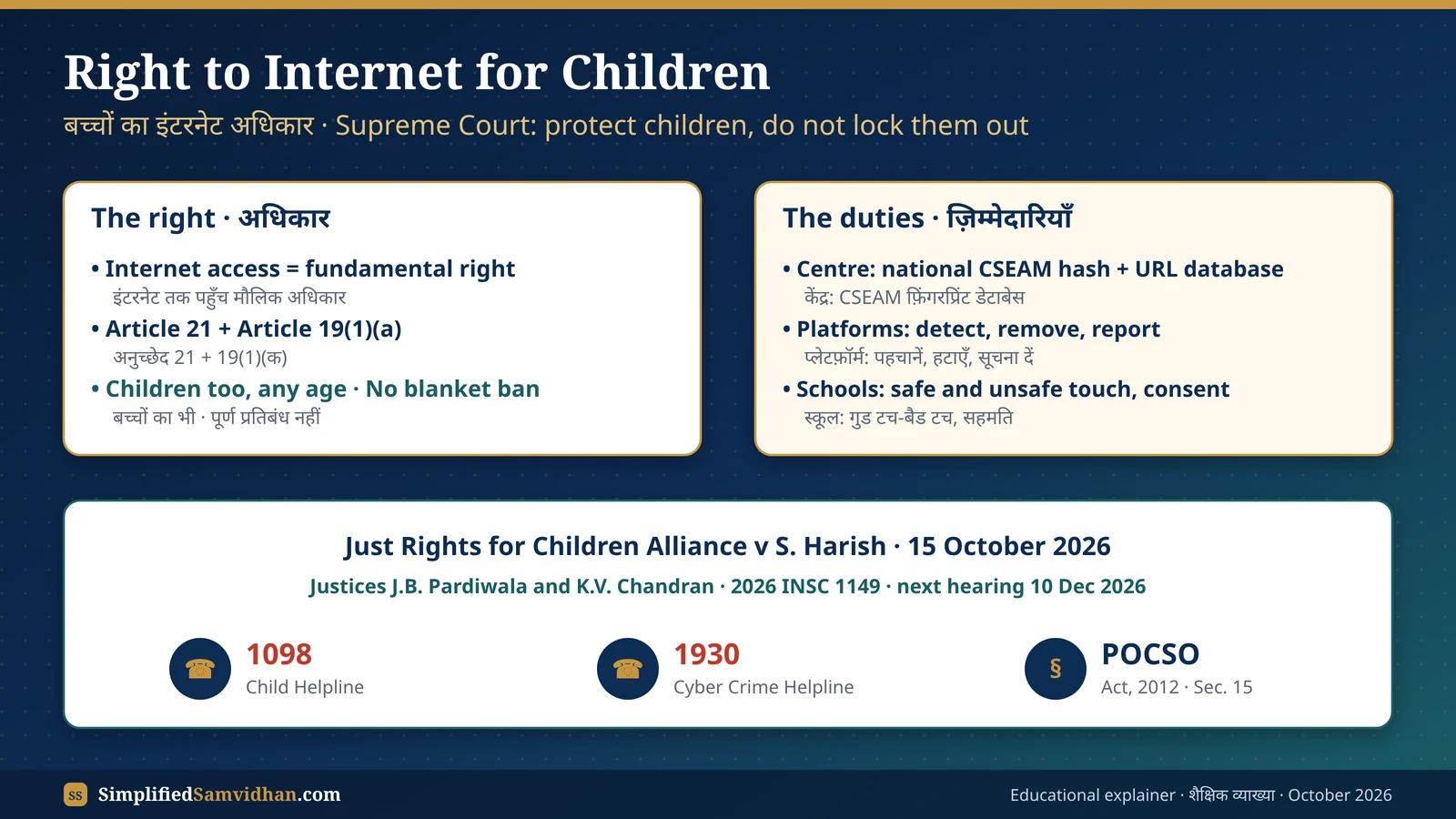
What the Supreme Court decided on 15 October 2026
In Just Rights for Children Alliance v S. Harish (2026 INSC 1149), a bench of Justices J.B. Pardiwala and K.V. Chandran held on 15 October 2026 that the right to access and use the internet is a fundamental right under Article 21 read with Article 19(1)(a), and that it belongs to children irrespective of their age. Protecting children from online harm, the Court said, cannot be a reason for a blanket ban; the State must target the harmful content and the offenders.
The Court directed the Union to set up a national hash and URL database of confirmed child sexual exploitation and abuse material (CSEAM), with every entry checked by at least three trained human analysts, and to frame guidelines making platforms detect and remove such material. Schools must teach safe and unsafe touch and consent from the primary stage and display Child Helpline 1098 and Cyber Crime Helpline 1930. The Centre must file a compliance affidavit before the next hearing on 10 December 2026.
The VerdictRight to Internet as a Fundamental Right: What the Supreme Court Held for Children
- A right, not a privilege: access to the internet is part of the right to life (Article 21) and free expression (Article 19(1)(a)). Today a child studies, finds information and speaks through the internet.
- Children are rights-holders too: the right does not start at 18. A blanket age-based ban would punish every child for what a few offenders do.
- Target the harm: the State may still block categories of content that are inherently harmful to children, such as adult websites, and use proportionate safety tools.
- Safety by design: the Court suggested private-by-default accounts for children, limits on messages from unknown adults, and moderation of ads and content shown to children, with reasonable ways to verify parental consent.
- Follows the 2024 ruling: on 23 September 2024 the Court, in the same case, held that watching or storing child sexual abuse material can be an offence under Section 15 of the POCSO Act and asked everyone to use the term CSEAM instead of "child pornography".
Think of a busy road. The answer to accidents is not to stop children from ever stepping outside; it is zebra crossings, speed limits, traffic police and road-safety lessons. The Supreme Court said the same about the internet: make the road safe and catch the rash drivers, but do not lock the child inside.
🏠 Everyday analogy
A school does not ban the library because one book is unsuitable. It removes that book and teaches students how to choose good ones.
🇮🇳 Real Indian example
A Class 8 student in a village in Jharkhand watches free online lessons for a scholarship exam. A blanket under-16 ban would shut that door; the Court's approach keeps it open while blocking abusers.
Official TextArticle 21, Article 19(1)(a) and Article 21A: The Constitutional Basis of the Right to Internet
Constitution of India, Article 19(1)(a). Protection of certain rights regarding freedom of speech, etc.
(1) All citizens shall have the right—
(a) to freedom of speech and expression;
Article 21. Protection of life and personal liberty.
No person shall be deprived of his life or personal liberty except according to procedure established by law.
Article 21A. Right to education.
The State shall provide free and compulsory education to all children of the age of six to fourteen years in such manner as the State may, by law, determine.
None of these Articles mentions the word "internet". The Supreme Court reads them as living words: if speech today happens on phones, the freedom of speech must cover the phone too. In Anuradha Bhasin v Union of India (2020) the Court said speech and trade through the internet are protected by Article 19. In Faheema Shirin v State of Kerala (2019) the Kerala High Court linked internet access to the right to education and privacy. The 2026 ruling goes a step further and calls access itself a fundamental right.
Note: Article 19 rights belong to citizens; Article 21 protects every person. Like other rights, this one can be limited by a fair law with reasonable restrictions.
Who Must Do WhatCSEAM Database, POCSO Act and Platform Duties: Directions to Centre, Platforms and Schools
| Who | What the Court asked | Law behind it |
|---|---|---|
| Union (MeitY, Law Ministry) | Build a national hash and URL database of confirmed CSEAM (inside the Sahyog portal or separately), used only to detect and remove such material; frame guidelines and SOPs; amend the IT Act or Rules if needed; file a compliance affidavit | Section 79 IT Act (safe harbour) and IT Rules, 2021, Rule 3(1)(b) |
| Social media platforms | Use tools like perceptual hash-matching and URL lists to find and take down CSEAM, and report it to the police | POCSO Act Section 15 and 19-20; Rule 11 POCSO Rules; IT Act Section 67B |
| Schools and teachers | Teach body safety, safe and unsafe touch and consent from the primary stage; train teachers to spot grooming and online harassment; display 1098, 1930 and the cyber-crime portal in classrooms, hostels, libraries and computer labs and on school websites | Article 21A, POCSO Act Section 19 (duty to report) |
| NCERT and SCERTs | Put digital safety and age-appropriate sex education into the core curriculum with child psychologists and educators | National Education Policy 2020 (life skills) |
Key words: CSEAM = Child Sexual Exploitation and Abuse Material. A hash is a digital fingerprint of a photo or video; platforms can match fingerprints without anyone viewing the material again.
The database works like a "most wanted" list of fingerprints. Once one expert team confirms a video is abuse material, its fingerprint goes on the list and every platform can block copies of it automatically, so the victim is not harmed again each time it is re-uploaded.
Two ViewsSocial Media Ban for Children vs Safety by Design: India's Choice
Why some want an age ban
- Australia's law keeps under-16s off major social media (in force from 10 December 2025)
- Grooming, sextortion and addiction are rising
- Parents find it hard to supervise phones
Why the Court chose safety by design
- A ban cuts off learning, information and expression for all children
- Children often bypass bans with fake ages
- Remove the harmful material and punish offenders instead
- DPDP Act, 2023 (Section 9): a platform needs verifiable parental consent before processing the personal data of a child (under 18), and cannot track or target ads at children.
- What parents can do now: keep children's accounts private, talk about safe and unsafe touch, and report abuse material on cybercrime.gov.in or 1930. Child Helpline is 1098.
In simple words: India has picked the seat-belt model over the no-car model. Children can travel online, but the vehicle must have safety features and the dangerous drivers must be caught.
UPSC CornerRight to Internet and Child Online Safety for UPSC Prelims and Mains
- Prelims fact: The Supreme Court (15 Oct 2026, Pardiwala and Chandran JJ) held internet access a fundamental right under Article 21 read with Article 19(1)(a), available to children too.
- Prelims fact: Anuradha Bhasin v Union of India (10 January 2020) protected speech and trade through the internet under Articles 19(1)(a) and 19(1)(g).
- Prelims fact: POCSO Act, 2012 covers every person below 18; Section 15 punishes storing child sexual abuse material for sharing or commercial use; the term CSEAM was recommended by the Supreme Court on 23 September 2024.
- Prelims fact: Article 21A (86th Amendment, 2002) gives free and compulsory education to children of 6 to 14 years.
- Prelims fact: Child Helpline is 1098; National Cyber Crime Helpline is 1930.
- Mains (250 words): "Protecting children online must not mean excluding them." Examine in the light of the Supreme Court's October 2026 ruling on the right to internet.
- Ethics angle: Balancing a child's autonomy and right to information with the duty of care owed by parents, schools and platforms.
Practice MCQTest Yourself: Right to Internet for Children
With reference to the Supreme Court's ruling of October 2026 in Just Rights for Children Alliance v S. Harish, consider the following statements: (1) It held that access to the internet is a fundamental right under Article 21 read with Article 19(1)(a). (2) It upheld a blanket ban on social media use by all children below 16 years. (3) It directed the Union to create a national database of confirmed child sexual exploitation and abuse material for its removal. Which of the statements given above is/are correct?
Doubts ClearedFrequently Asked Questions
Is the right to internet a fundamental right in India?
Yes. On 15 October 2026 the Supreme Court held that the right to access and use the internet is a fundamental right under Article 21 read with Article 19(1)(a), and that it applies to children irrespective of age. Like other rights, it can be limited by reasonable restrictions in a valid law.
Can the government ban social media for children?
The Court rejected blanket age-based bans. The government can still block categories of content that are inherently harmful to children, such as adult websites, and require proportionate safety measures like private-by-default accounts and parental consent checks.
What is CSEAM?
Child Sexual Exploitation and Abuse Material. In 2024 the Supreme Court asked courts and authorities to use this term instead of "child pornography" because the material records the abuse of a child. Storing or sharing it is an offence under Section 15 of the POCSO Act and Section 67B of the IT Act.
What must schools do now?
Teach children, in an age-appropriate way from the primary stage, about their bodies, safe and unsafe touch and consent; train teachers to spot grooming and online harassment; and display Child Helpline 1098, Cyber Crime Helpline 1930 and the cyber-crime portal in classrooms, hostels, libraries, computer labs and on the school website.
Where can I report child abuse material online?
On the National Cyber Crime Reporting Portal (cybercrime.gov.in) or helpline 1930, or to the local police or Special Juvenile Police Unit. For a child in danger call 1098.
Sources and further readingSources We Checked
News facts on this page were checked against the reports below on 19 October 2026. The matter is listed again on 10 December 2026; read the full judgment for exact directions. Constitutional text is quoted from the Constitution of India.
- Bar & Bench: Children too have fundamental right to access internet; can't deny it citing online harm: Supreme Court
- LiveLaw: Supreme Court directs Union to create national database on CSEAM for removal across platforms
- LiveLaw: Children must be taught about safe and unsafe touch, train teachers to identify grooming and abuse
- Business Today, 17 Oct 2026: Internet access a fundamental right, Supreme Court rejects age-based ban
- Verdictum: Just Rights for Children Alliance v S. Harish, 2026 INSC 1149, digital safety and sex education
- ThePrint: Children have fundamental right to access internet, can't impose blanket ban on its use: SC
- India Code: The Protection of Children from Sexual Offences Act, 2012