Caller Name Display (CNAP) from 1 November 2026: Whose Name You Will See, and Why
From 1 November 2026, when an unknown number calls your 4G or 5G phone, the screen will also show a name: the name the caller gave to the telecom company while buying the SIM. No app and no request is needed. Here is what the Department of Telecommunications ordered, how it fights fraud calls, and what it means for your privacy.
What the Department of Telecommunications ordered
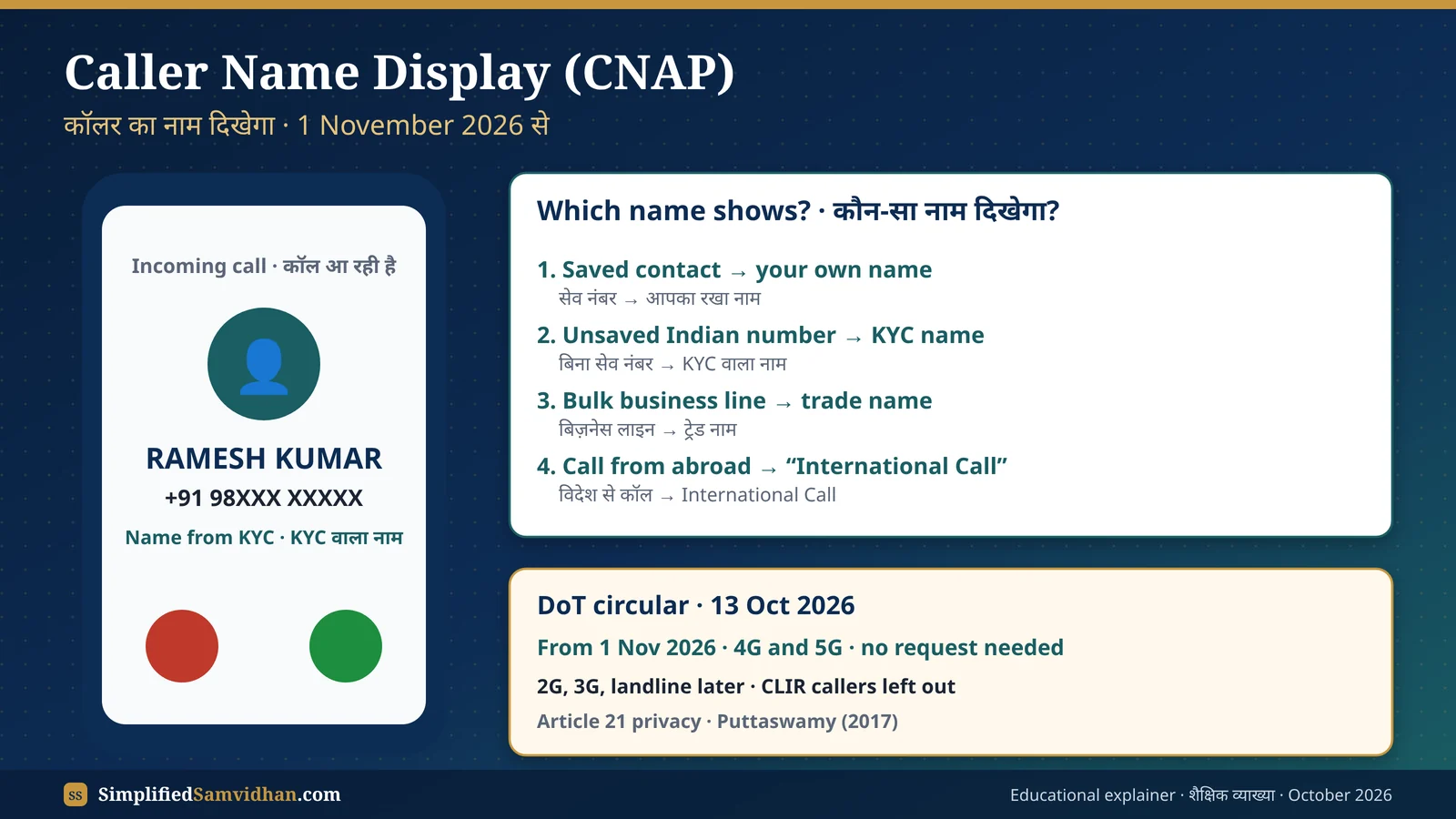
By a circular dated 13 October 2026, the Department of Telecommunications (DoT) directed all telecom operators to start the Calling Name Presentation (CNAP) service in every service area from 1 November 2026. It covers 4G and higher networks; 2G, 3G and landlines will be considered separately. Operators must give it to every user without any separate request.
The name comes from the caller's operator's subscriber records, that is, the name given at the time of KYC. A name saved in your own phonebook still appears first, calls from abroad are marked "International Call", and bulk business connections may show a registered trademark or trade name. Reports say callers who use the existing CLIR (number-hiding) facility are left out, and operators must not keep the name after the call ends. Reports differ on whether users can switch the service off; MediaNama found no opt-out in the circular.
How It WorksCaller Name Display Rule: Which Name Shows on Your Screen
| Who is calling | What you will see from 1 November 2026 |
|---|---|
| A number saved in your phone | Your own saved name (your phonebook comes first) |
| An unsaved Indian mobile number on 4G/5G | The number + the name in the caller's KYC record with the operator |
| A bulk business connection | The number + a registered trademark or trade name, as allowed by DoT |
| A call from outside India | The number + the label "International Call" |
| A caller who has activated CLIR (number hiding) | No name, as reported, under the existing CLIR rules |
| 2G, 3G or landline | Not covered yet; to be examined separately |
Today, an unknown number is a mystery. From 1 November, the telecom network itself will tell you whose name that SIM is registered in. If the caller says "I am from your bank" but the screen shows a person's name in another State, you have a reason to be careful.
🏠 Everyday analogy
It is like a courier parcel with the sender's name printed by the courier company, instead of a handwritten note that anyone could write.
🇮🇳 Real Indian example
A call says "KBC lottery, pay ₹5,000 tax to get ₹25 lakh". With CNAP, the screen shows an ordinary personal name, not "KBC" or any company, which is a warning sign before you even pick up.
Official TextArticle 21 and Entry 31 of the Union List
Constitution of India, Article 21. Protection of life and personal liberty.
No person shall be deprived of his life or personal liberty except according to procedure established by law.
Seventh Schedule, List I (Union List), Entry 31.
Posts and telegraphs; telephones, wireless, broadcasting and other like forms of communication.
Entry 31 of the Union List puts telephones and "other like forms of communication" with Parliament and the Centre, which is why one DoT order applies across India. The rule itself rests on the Telecommunications Act, 2023 and the authorisation rules made under it; reports cite Rule 48(1) of the 2026 authorisation rules, which asks that the calling line identity be shown in a tamper-proof way.
Article 21 matters because the Supreme Court in K.S. Puttaswamy v. Union of India (2017) held that privacy is a fundamental right. Showing your name to every person you call is a small limit on privacy. Under Puttaswamy, such a limit must have a law behind it, a legitimate aim (here, fighting fraud) and be proportionate.
Benefits vs ConcernsCNAP and Right to Privacy: Benefits vs Concerns
Benefits
- Warns you before you answer a fraud or spam call
- Name comes from KYC, not from strangers' phonebooks
- Works without any app or internet data
- Name not stored after the call ends
Concerns
- Your KYC name reaches everyone you call
- Risk for women and others who do not want their name known
- Wrong names where a SIM is in a parent's or employer's name
- No clear opt-out reported in the circular
What You Should DoWhat to Do Before 1 November 2026
- 1Check your KYC name
The name your operator holds is the name others will see. Check it in your operator's app; get it corrected at the store if it is wrong.
- 2Know which SIMs are in your name
Use the Sanchar Saathi portal (sancharsaathi.gov.in, TAFCOP) to see all mobile connections in your name and report ones you did not take.
- 3Report fraud calls
Report suspected fraud calls or messages on Chakshu in Sanchar Saathi; report spam to your operator or by sending SMS to 1909.
- 4Lost money? Act fast
Call the cybercrime helpline 1930 or file a complaint at cybercrime.gov.in as soon as possible.
- 5Need privacy?
If you have strong reasons not to show your name, ask your operator about the existing CLIR facility and its conditions.
UPSC CornerCaller Name Display (CNAP) for UPSC Prelims and Mains
- Prelims fact: CNAP stands for Calling Name Presentation; the DoT circular of 13 October 2026 makes it default on 4G and 5G networks from 1 November 2026.
- Prelims fact: TRAI recommended CNAP in February 2024 and, in October 2025, agreed with DoT that it should be available by default.
- Prelims fact: "Telephones, wireless, broadcasting and other like forms of communication" is Entry 31 of the Union List.
- Prelims fact: The Telecommunications Act, 2023 replaced the Indian Telegraph Act, 1885 and the Wireless Telegraphy Act, 1933.
- Prelims fact: Chakshu (reporting suspected fraud communication) and TAFCOP (connections in your name) are part of the DoT's Sanchar Saathi portal.
- Mains (150 words): "Caller name display is a fair trade of a little privacy for a lot of safety." Examine in the light of the Puttaswamy proportionality test.
Practice MCQTest Yourself: Caller Name Display (CNAP) from 1 November
With reference to the Calling Name Presentation (CNAP) service ordered by the Department of Telecommunications from 1 November 2026, consider the following statements: (1) It applies to 2G, 3G and 4G networks alike. (2) The name shown comes from the caller's KYC record with the telecom operator. (3) A name saved in the receiver's phonebook is shown first. Which of the statements given above is/are correct?
Doubts ClearedFrequently Asked Questions
What is CNAP or caller name display?
Calling Name Presentation (CNAP) is a telecom network service that shows the caller's name along with the number on your phone screen. In India the name comes from the caller's KYC record with the telecom operator.
From when will caller name display start in India?
The DoT circular of 13 October 2026 asks operators to start CNAP in all service areas from 1 November 2026 on 4G and higher networks. Operators may roll it out in stages, so it may reach some phones a little later.
Do I need to activate CNAP or install an app?
No. The circular asks operators to give the service to every user without any separate request, and it works through the network, not an app.
Whose name will show if the SIM is in my father's name?
The name in the KYC record of that SIM, so your father's name would show to people who have not saved your number. You can transfer the connection to your own name at your operator's store.
Can I hide my name from CNAP?
Reports say callers who use the existing Calling Line Identification Restriction (CLIR) facility will not have their name shown. Reports differ on a general opt-out, so check with your operator once the service starts.
Sources and further readingSources We Checked
News facts on this page were checked against the reports below on 22 October 2026. The DoT circular text was not available on the DoT website at the time, so details are as reported by the press and may be clarified.
- ThePrint: No more unknown callers, govt makes caller name display mandatory from 1 November
- MediaNama: DoT mandates caller name display on 4G, 5G networks, no opt out
- Daily Excelsior (PTI): Telcos directed to display callers' names on 4G and 5G networks from Nov 1
- Outlook Money: Caller name display from November 1: what mobile users need to know
- Business Standard: TRAI aligns with DoT on CNAP, makes caller ID service default with opt-out (October 2025)
- Sanchar Saathi portal (Department of Telecommunications)
- Constitution of India (Legislative Department)