NVS-03 Launch: How GSLV-F18 Brings NavIC, India's Own GPS, Back to Strength
Late on 30 October 2026, ISRO's GSLV-F18 rocket lifted off from Sriharikota carrying NVS-03, a new satellite for NavIC, India's own satellite navigation system. NavIC had slipped below the number of working satellites it needs because old satellites lost their atomic clocks and NVS-02 got stuck in the wrong orbit in 2025. NVS-03 is meant to fix that. Here is what NavIC is, what changed, and why it matters to you.
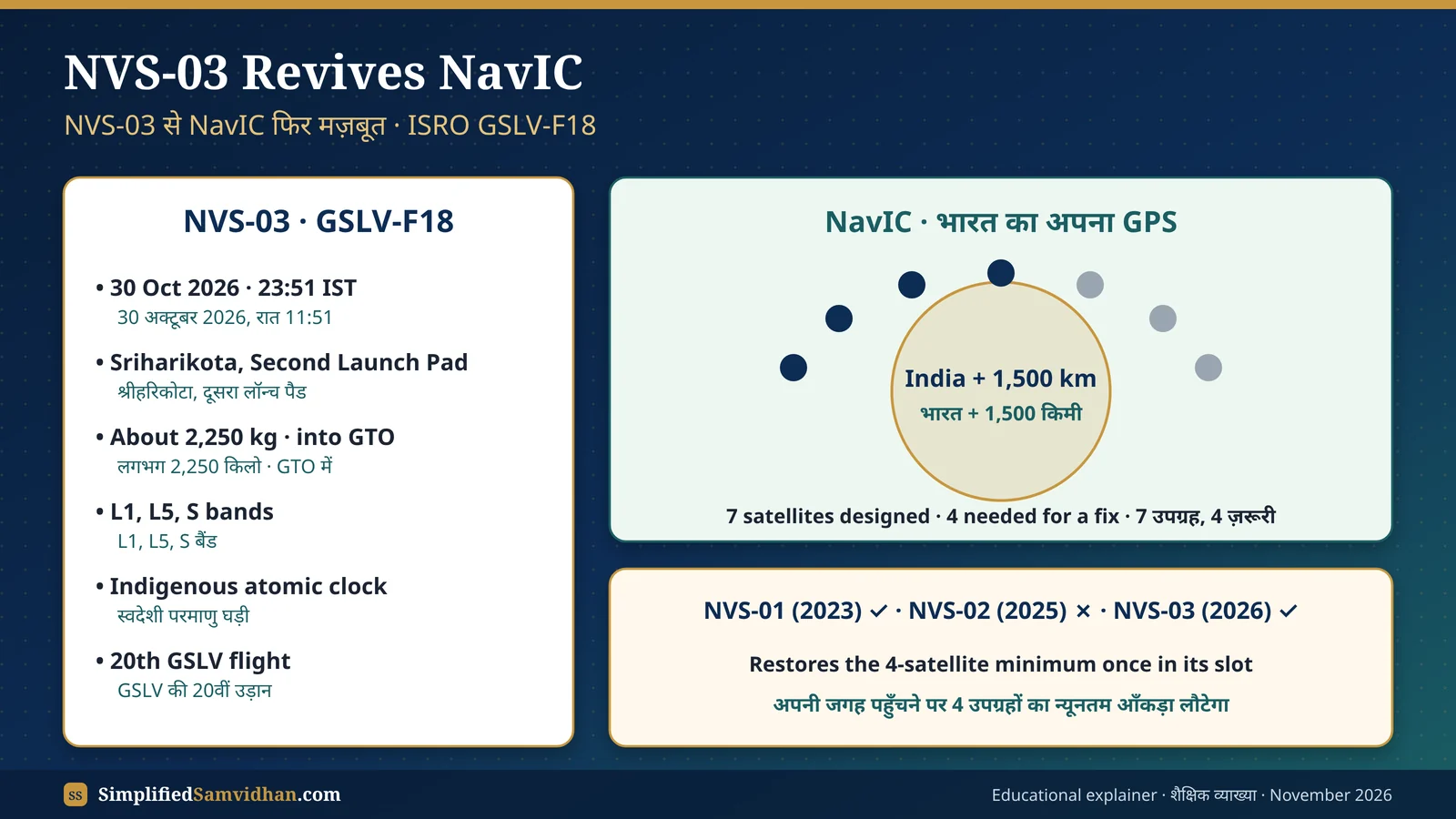
What happened
At 23:51 IST on 30 October 2026, GSLV-F18 lifted off from the Second Launch Pad of the Satish Dhawan Space Centre, Sriharikota. About 18 minutes later it released NVS-03, a satellite of about 2,250 kg, into a geosynchronous transfer orbit. The satellite will now fire its own engine several times to climb to its working slot. Once it is in service, NavIC returns to the minimum of four satellites needed to give a position fix.
This was the 20th flight of the GSLV, coming only 56 days after the previous one, the shortest gap so far between two GSLV launches.
At a GlanceNVS-03 and NavIC: Key Facts
| Point | Fact |
|---|---|
| Satellite | NVS-03 (second-generation NavIC satellite), about 2,250 kg |
| Rocket | GSLV-F18 (20th GSLV flight) |
| Launch | 30 October 2026, 23:51 IST, Second Launch Pad, Sriharikota |
| Signals | L1, L5 and S bands |
| Clock | Indigenous atomic clock |
| NavIC design | 7 satellites; covers India and about 1,500 km around it |
| Minimum for service | 4 working satellites |
| Earlier NVS satellites | NVS-01 (May 2023, working); NVS-02 (January 2025, could not reach its slot) |
Your phone finds its location by listening to time signals from at least four satellites and measuring how long each signal took to arrive. That needs extremely accurate clocks in space. America's GPS does this for the whole world, but it is controlled by another country. NavIC is India's own version for India and its neighbourhood, so our ships, trains, army and disaster teams do not depend on someone else's switch.
🏠 Everyday analogy
It is like having your own water tank at home instead of depending only on the municipal supply: on a normal day both work, but in a crisis your own tank is what keeps you going.
🇮🇳 Real Indian example
A fishing boat off Kerala receives a cyclone warning and its exact location through NavIC even where there is no mobile network.
TimelineHow NavIC Lost and Regained Its Strength
- 12013-2018
First-generation IRNSS satellites launched; NavIC declared operational.
- 2Clock failures
Imported atomic clocks on several older satellites failed, so they could no longer give navigation signals.
- 3May 2023
NVS-01, the first second-generation satellite with an indigenous atomic clock and the L1 band, launched on GSLV-F12.
- 4January 2025
NVS-02 launched on GSLV-F15, ISRO's 100th launch from Sriharikota, but a valve problem stopped it from reaching its slot.
- 530 October 2026
NVS-03 launched on GSLV-F18; on reaching its slot it restores the four-satellite minimum.
ConstitutionArticle 51A(h): Scientific Temper
Constitution of India, Article 51A(h). Fundamental duties.
It shall be the duty of every citizen of India to develop the scientific temper, humanism and the spirit of inquiry and reform.
- Space is a Union subject in practice: ISRO works under the Department of Space, which reports directly to the Prime Minister.
- The Indian Space Policy, 2023 opened space activities to private companies, with IN-SPACe as the authorising body.
- Related: Fundamental Duties (Article 51A).
Why It MattersNavIC vs GPS: Why India Needs Its Own System
NavIC
- Controlled by India
- Regional: India and about 1,500 km around
- Satellites sit high over India, good signal in deep valleys and cities
- Used for fishermen alerts, vehicle tracking, disaster work
GPS
- Controlled by the United States
- Global coverage
- Dozens of satellites, built into every phone
- Access can in theory be limited by its owner
UPSC CornerNavIC and NVS-03 for UPSC Prelims
- Prelims: NavIC (earlier IRNSS) has seven satellites and covers India and a region of about 1,500 km around it.
- Prelims: At least four satellites are needed for a position fix.
- Prelims: NVS satellites add the L1 band and carry indigenous atomic clocks.
- Prelims: GSLV uses an indigenous cryogenic upper stage; NVS satellites are placed first in a geosynchronous transfer orbit.
- Mains (GS III): "Strategic autonomy in space needs reliable, indigenous navigation." Discuss with reference to NavIC.
Practice MCQTest Yourself: NVS-03 Revives NavIC
With reference to NavIC, consider the following statements: (1) It is designed as a global navigation system like GPS. (2) Second-generation NVS satellites add the L1 band. (3) NVS-03 was launched by GSLV-F18 in October 2026. Which of the statements given above is/are correct?
Doubts ClearedFrequently Asked Questions
What is NVS-03?
NVS-03 is a second-generation navigation satellite for NavIC, launched by ISRO's GSLV-F18 on 30 October 2026.
What is NavIC?
Navigation with Indian Constellation, earlier called IRNSS, is India's own satellite navigation system covering India and about 1,500 km around it.
Why did NavIC need a new satellite?
Several older satellites lost their atomic clocks and NVS-02 could not reach its working orbit in 2025, leaving NavIC below the four satellites it needs.
Can my phone use NavIC?
Many newer phones with NavIC-capable chips can. The L1 band on NVS satellites makes support easier for ordinary phones.
What is the difference between NavIC and GPS?
GPS is a global system run by the United States. NavIC is a regional system run by India.
Sources and further readingSources We Checked
Facts checked against the reports below on 1 November 2026. ISRO will confirm when NVS-03 reaches its slot and enters service.