College Fee Hike Mid-Course: Supreme Court Says Students Must Know the Full Fee Before Admission
You join a four-year engineering course and in the second year the college raises the fee by a third. Is that allowed? The Supreme Court has said: ordinarily, no. A student must know the full financial cost at the time of admission, and a mid-course hike is allowed only in exceptional situations. Here is the case, the law on private college fees, and what you can do if it happens to you.
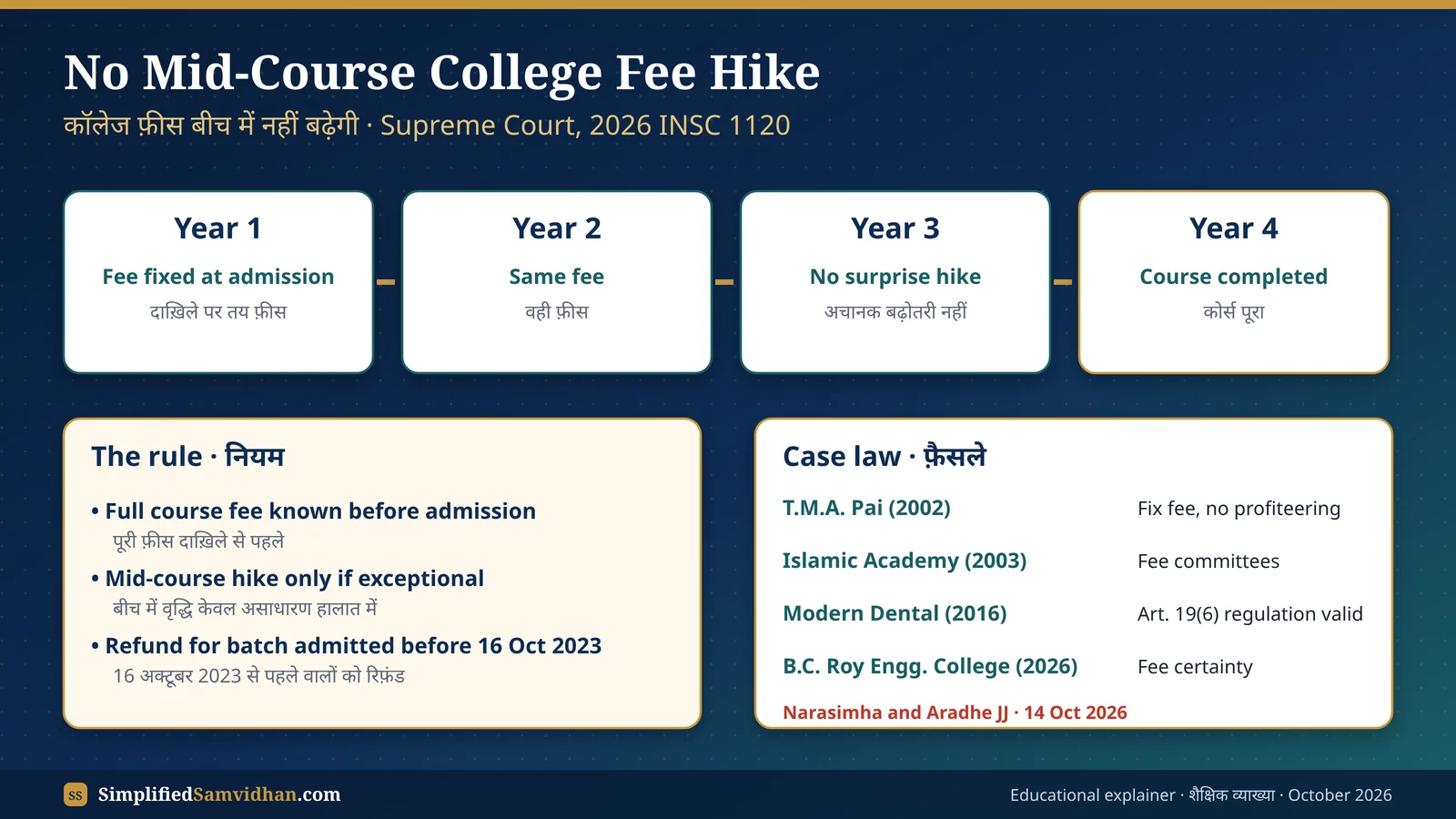
What the Supreme Court decided on 14 October 2026
In Dr. B.C. Roy Engineering College v State of West Bengal (2026 INSC 1120), a bench of Justices P.S. Narasimha and Alok Aradhe held on 14 October 2026 that the fee for a professional course should ordinarily be settled and disclosed before admission for the whole course. A student joining a four or five-year programme must know the financial liability at the threshold. A mid-course increase is allowed only in exceptional circumstances, such as an unforeseen rise in expenditure, extraordinary economic conditions or a change in law.
The dispute began when the State revised fees for self-financing colleges in October 2023 and the college raised the fee for its 2023-27 batch by about 37.5% in December 2023. The Calcutta High Court had ordered a refund for students admitted before 16 October 2023. The Supreme Court upheld that relief but on different reasoning, holding that the State's notification was not retrospective, and it blamed the State and its fee committee for a seven-year delay in revising fees.
The VerdictCollege Fee Hike Mid-Course: The Supreme Court's Fee Certainty Rule
- 1Disclose upfront
The fee for the entire course must be known before admission, in the prospectus or the fee committee's order.
- 2No surprise hikes
Once admitted, a student's fee should not be raised midway as a matter of routine.
- 3Narrow exceptions
A hike is possible only in exceptional cases: unforeseen expenditure, extraordinary economic conditions, statutory changes or other unforeseeable events.
- 4Old batch protected
A new State fee notification applies to students admitted after it, not retrospectively to those already studying.
- 5Refund
Students admitted before 16 October 2023 who paid the hiked fee must get the extra amount back, as the High Court had directed.
Think of booking a train ticket. The fare printed on the ticket is the fare you pay, even if the railways raise fares next month. An admission is like a ticket for the whole journey of four years. The college cannot stop the train halfway and demand more, unless something truly extraordinary happens.
🏠 Everyday analogy
A builder who sells a flat at a fixed price cannot ask for 35% more when the buyer is halfway through paying, just because his own costs went up.
🇮🇳 Real Indian example
A student from Bankura joins B.Tech in 2022 on a fee of ₹80,000 a year. If the college demands ₹1.1 lakh in the third year under a 2023 notification, the extra amount is refundable under this ruling.
Official TextArticle 19(1)(g), Article 19(6) and Article 14: Can Private Colleges Fix Their Own Fee?
Constitution of India, Article 19. Protection of certain rights regarding freedom of speech, etc.
(1) All citizens shall have the right—
(g) to practise any profession, or to carry on any occupation, trade or business.
(6) Nothing in sub-clause (g) of the said clause shall affect the operation of any existing law in so far as it imposes, or prevent the State from making any law imposing, in the interests of the general public, reasonable restrictions on the exercise of the right conferred by the said sub-clause, ...
Article 14. Equality before law.
The State shall not deny to any person equality before the law or the equal protection of the laws within the territory of India.
Running a college is an "occupation" under Article 19(1)(g), so private colleges have a right to set up institutions and fix a reasonable fee. But Article 19(6) lets the State impose reasonable restrictions in the public interest. That is why States set up fee regulatory committees: the college may cover its costs and earn a reasonable surplus for growth, but it may not profiteer or charge capitation fees. Treating students of the same batch differently without reason can also offend Article 14.
Case LawPrivate College Fee Regulation in India: TMA Pai to Modern Dental College
| Case | Year | What it held |
|---|---|---|
| Mohini Jain v State of Karnataka | 1992 | Capitation fees violate the right to education, then read into Article 21 |
| Unni Krishnan v State of Andhra Pradesh | 1993 | Right to education up to age 14 is a fundamental right; capitation fees banned (later Article 21A, 2002) |
| T.M.A. Pai Foundation v State of Karnataka (11 judges) | 2002 | Private unaided colleges can fix their own fee, but no profiteering and no capitation fee |
| Islamic Academy of Education v State of Karnataka | 2003 | States must set committees headed by a retired High Court judge to approve fees |
| P.A. Inamdar v State of Maharashtra (7 judges) | 2005 | Fee committees upheld; education is not a business for profit |
| Modern Dental College v State of Madhya Pradesh | 2016 | State regulation of fees and admissions is a reasonable restriction under Article 19(6) |
| Dr. B.C. Roy Engineering College v State of West Bengal | 2026 | Full course fee to be known before admission; mid-course hike only in exceptional cases |
The line of cases says one simple thing: a college may be a self-financing institution, but education is not a shop. The 2026 ruling adds a practical rule for students: certainty. Families plan loans and savings for the whole course, so the price cannot keep moving.
For StudentsWhat to Do If Your College Raises the Fee Midway
- 1Keep the proof
Save the prospectus, admission letter, fee receipts and the fee committee order for your batch.
- 2Ask in writing
Write to the college asking under which order the fee was raised and whether it applies to your batch.
- 3Approach the fee committee
Every State has a fee regulatory committee or authority for professional courses; complain there first.
- 4Use the regulator
For engineering colleges, the AICTE grievance portal; for medical colleges, the National Medical Commission; for others, the affiliating university.
- 5Go to court
A writ petition under Article 226 in the High Court is the remedy if the hike is illegal; cite this 2026 ruling.
Why colleges want flexibility
- Salaries and costs rise every year
- State fee revisions are often delayed for years
- Quality needs money
Why students need certainty
- Education loans are fixed at admission
- Leaving midway wastes years
- A hike after admission is unfair bargaining
UPSC CornerCollege Fee Regulation and Right to Education for UPSC Prelims and Mains
- Prelims fact: The right to establish and run an educational institution is an occupation under Article 19(1)(g) (T.M.A. Pai, 2002); Article 30(1) separately protects minority institutions.
- Prelims fact: Fee regulatory committees headed by a retired High Court judge flow from Islamic Academy (2003) and P.A. Inamdar (2005).
- Prelims fact: Article 21A was inserted by the 86th Amendment Act, 2002; the RTE Act, 2009 covers children aged 6 to 14.
- Prelims fact: Unni Krishnan (1993) limited the fundamental right to free education to children up to 14 years.
- Prelims fact: The October 2026 ruling (Narasimha and Aradhe JJ) requires full course fee disclosure before admission.
- Mains (150 words): "Fee certainty is a part of fairness in education." Discuss with reference to the regulation of private professional colleges in India.
Practice MCQTest Yourself: No Mid-Course College Fee Hike
Consider the following statements about the regulation of fees in private professional colleges in India: (1) In T.M.A. Pai Foundation (2002), the Supreme Court held that private unaided institutions can fix their own fee but cannot charge capitation fees or profiteer. (2) The right to establish an educational institution has been read as an occupation under Article 19(1)(g). (3) In October 2026 the Supreme Court held that colleges may raise fees every year in the middle of a course without any justification. Which of the statements given above is/are correct?
Doubts ClearedFrequently Asked Questions
Can a college increase fees in the middle of a course?
Ordinarily no. The Supreme Court held on 14 October 2026 that the fee for a professional course should be settled before admission for the whole course. A mid-course increase is allowed only in exceptional circumstances such as an unforeseen rise in expenditure, extraordinary economic conditions or a statutory change.
Which case is this?
Dr. B.C. Roy Engineering College v State of West Bengal, 2026 INSC 1120, decided by Justices P.S. Narasimha and Alok Aradhe. It arose from a fee hike of about 37.5% for the 2023-27 batch after a West Bengal fee notification of October 2023.
Will students get a refund?
In this case, yes. The Supreme Court upheld the Calcutta High Court's direction that students admitted before 16 October 2023 be refunded the hiked amount, because the State notification did not apply retrospectively.
Does this apply to all colleges?
The ruling is about professional courses in self-financing colleges, but its principle of fee certainty and disclosure before admission will guide fee committees and courts across India. Each State's fee law and committee orders still apply.
Where can I complain about an illegal fee hike?
First to the college in writing, then to your State's fee regulatory committee, the regulator (AICTE, NMC or the university), and finally the High Court through a writ petition under Article 226.
Sources and further readingSources We Checked
News facts on this page were checked against the reports below on 19 October 2026. Read the full judgment for the exact wording. Constitutional text is quoted from the Constitution of India.
- LiveLaw: Students' fees cannot be hiked midway through professional courses except in exceptional circumstances
- Bar & Bench: Fees for entire professional course must be notified before admission: Supreme Court
- Verdictum: Dr. B.C. Roy Engineering College v State of West Bengal, 2026 INSC 1120
- Raw Law: Supreme Court upholds refunds for engineering students facing 37.5% mid-course fee hike
- Advocatekhoj: Dr. B.C. Roy Engineering College Vs. State of West Bengal [October 14, 2026]
- Constitution of India (Legislative Department)