India-Mexico Preferential Trade Agreement Talks: Why They Started and What They Mean
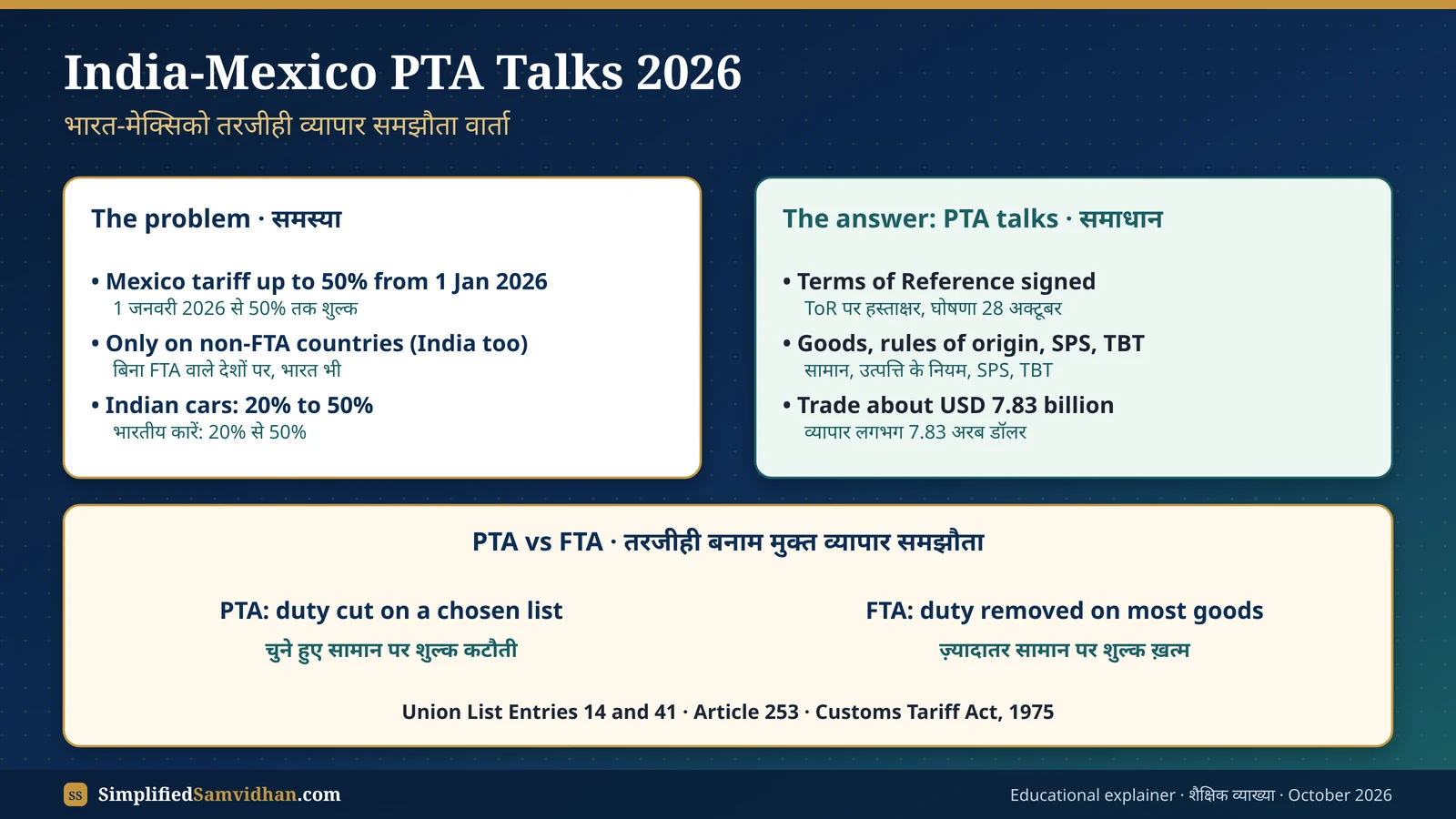
Since 1 January 2026, an Indian car shipped to Mexico pays a 50% import duty, because Mexico raised tariffs on countries that have no trade deal with it. To fix this, India and Mexico formally launched talks for a Preferential Trade Agreement (PTA), announced on 28 October 2026. A PTA cuts duties on a chosen list of goods. Here is what was signed, why it matters for Indian exporters, and the constitutional basis for trade deals.
What happened on 28 October 2026
The Ministry of Commerce and Industry announced on 28 October 2026 that India and Mexico have formally launched negotiations for a Preferential Trade Agreement (PTA). Commerce Secretary Rajesh Agrawal and Mexico's Undersecretary of Foreign Trade Luis Rosendo Gutiérrez Romano signed the Terms of Reference (ToR), the document that fixes what the talks will cover and how they will run.
The ToR covers market access for goods, rules of origin, customs procedures and trade facilitation, sanitary and phytosanitary (SPS) measures, technical barriers to trade (TBT), trade remedies and dispute settlement. Bilateral trade is about USD 7.83 billion a year, with India earning a surplus of roughly USD 3.6 billion. Indian sectors such as automobiles, auto parts, textiles, footwear, steel, plastics, chemicals and toys face Mexican duties of up to 50% and are expected to gain most. No date for the first negotiating round had been announced when we checked.
At a GlanceIndia-Mexico PTA Talks: Key Facts
| Point | Fact |
|---|---|
| What | Formal launch of negotiations for an India-Mexico Preferential Trade Agreement (PTA) |
| Announced | 28 October 2026, by India's Ministry of Commerce and Industry |
| Signed by | Rajesh Agrawal (Commerce Secretary, India) and Luis Rosendo Gutiérrez Romano (Undersecretary of Foreign Trade, Mexico) |
| Document | Terms of Reference (ToR): scope, chapters and roadmap of the talks |
| Trade size | About USD 7.83 billion (FY 2025-26); India runs a surplus of about USD 3.6 billion |
| The trigger | Mexican tariffs of up to 50% on goods from non-FTA countries, in force from 1 January 2026 |
| Indian goods hit | Cars and auto parts, textiles, footwear, steel, plastics, chemicals, toys |
| Mexico's leader | President Claudia Sheinbaum (in office since 1 October 2024) |
A PTA is a smaller cousin of a free trade agreement. Both countries pick a list of products and cut import duty on them. An FTA goes much further and removes duty on most goods. India wants a PTA first because it can be finished faster and gives quick relief from Mexico's new 50% tariff.
🏠 Everyday analogy
Think of a wholesale market that suddenly charges a heavy entry fee to traders who do not hold a membership card. A PTA is like a special pass for a few of your best-selling items, so you can keep selling while you talk about full membership.
🇮🇳 Real Indian example
A car made in Chennai or Gujarat for export to Mexico paid 20% duty in 2025 and 50% in 2026. If the PTA cuts this duty, the car becomes competitive again against cars from Mexico's FTA partners such as Japan and the United States.
Why NowWhy Mexico's 50% Tariff Pushed India to the Table
- In December 2025, Mexico's Senate approved higher import tariffs on more than 1,400 tariff lines for countries that have no free trade agreement with Mexico, including India, China, South Korea, Indonesia, Thailand and Turkey. They took effect on 1 January 2026.
- Duty on passenger cars went up from 20% to 50%; most other goods were capped at 35%. Reports estimated about USD 1.8 billion of Indian car exports, made by firms such as Volkswagen and Hyundai in India, were hit.
- Countries with trade deals with Mexico, such as the United States, Canada, Japan and Singapore, are exempt. Mexico is part of the USMCA with the US and Canada and of the CPTPP with Japan and others.
- A trade deal is the only way to get out of the non-FTA list. That is why the ToR names market access for goods first.
- The idea of talks came from the meeting of PM Modi and President Sheinbaum at the G7 Summit in Canada in June 2025.
| Year | Event |
|---|---|
| 1950 | India and Mexico establish diplomatic relations. |
| 1960s | Mexican semi-dwarf wheat varieties, developed with Norman Borlaug, help start India's Green Revolution. |
| 2007 | The two countries agree on a Privileged Partnership. |
| June 2025 | PM Modi and President Claudia Sheinbaum meet at the G7 Summit in Kananaskis, Canada. |
| Dec 2025 | Mexico's Senate approves tariffs of up to 50% on goods from countries without a trade deal with Mexico, including India. |
| 1 Jan 2026 | Mexico's higher tariffs take effect; cars from India face 50% instead of 20%. |
| 28 Oct 2026 | Commerce Ministry announces the formal launch of PTA negotiations after the Terms of Reference are signed. |
How It WorksHow a Trade Agreement Is Negotiated in India
- 1Terms of Reference
Both sides agree on the chapters and rules of the talks. India and Mexico reached this step on 28 October 2026.
- 2Negotiating rounds
Officials meet in rounds to exchange lists of goods, offer duty cuts and settle rules of origin.
- 3Early harvest (possible)
Some analysts report Mexico is open to cutting duties on a short list first; this is not officially confirmed.
- 4Legal scrubbing and Cabinet approval
The final text is checked by lawyers and approved by the Union Cabinet.
- 5Signing and entry into force
Ministers sign; the Finance Ministry notifies lower duties under the Customs Tariff Act, 1975.
Rules of origin are the heart of any trade deal. They decide how much of a product must really be made in India to get the lower duty, so that goods from a third country cannot simply be re-labelled in India and sent to Mexico cheaply.
Official TextArticle 51, Article 253 and Union List Entries 14 and 41: Trade Deals in the Constitution
Constitution of India, Article 51. Promotion of international peace and security.
The State shall endeavour to (a) promote international peace and security; (b) maintain just and honourable relations between nations; (c) foster respect for international law and treaty obligations in the dealings of organised peoples with one another; and (d) encourage settlement of international disputes by arbitration.
Article 253. Legislation for giving effect to international agreements.
Notwithstanding anything in the foregoing provisions of this Chapter, Parliament has power to make any law for the whole or any part of the territory of India for implementing any treaty, agreement or convention with any other country or countries or any decision made at any international conference, association or other body.
- Article 73 extends the Union's executive power to matters on which Parliament can make laws. With Union List Entry 14 (entering into treaties and agreements with foreign countries) and Entry 41 (trade and commerce with foreign countries), this lets the Union government negotiate a PTA.
- Trade agreements in India are approved by the Union Cabinet; Parliament's ratification is not required by law.
- Article 253 lets Parliament make any law needed to implement a treaty, even on a State List subject.
- Article 51(c) asks the State to foster respect for international law and treaty obligations.
Why It MattersIndia-Mexico PTA: Gains vs Concerns
Gains for India
- Relief from 50% duty for cars and auto parts
- Entry point into North America's supply chains
- More room for pharma, IT and textiles in Latin America
- Builds on a trade surplus with Mexico
Concerns
- A PTA covers only a limited list of goods
- Mexico may seek lower Indian duties on farm goods and machinery
- Rules of origin may be strict because of Mexico's USMCA links
- Talks can take years; tariffs stay meanwhile
UPSC CornerIndia-Mexico Relations for UPSC Prelims and Mains
- Prelims: PTA = duty cuts on a limited list of goods; FTA = duty removal on most goods; CEPA/CECA add services and investment.
- Prelims: India's existing PTAs include those with Afghanistan, Chile and MERCOSUR (Brazil, Argentina, Paraguay, Uruguay).
- Prelims: Mexico: capital Mexico City; member of USMCA, CPTPP and the Pacific Alliance; President Claudia Sheinbaum.
- Prelims: Mexican wheat varieties (Lerma Rojo 64, Sonora 64) from Norman Borlaug's work powered India's Green Revolution.
- Mains (GS II): "Rising protectionism is pushing India towards a new wave of trade agreements." Discuss with reference to the India-Mexico PTA and the India-EFTA TEPA.
Practice MCQTest Yourself: India-Mexico PTA Talks Launched
With reference to the India-Mexico trade talks announced in October 2026, consider the following statements: (1) The two countries have launched negotiations for a Preferential Trade Agreement. (2) Mexico's tariffs of up to 50% apply only to countries that do not have a free trade agreement with Mexico. (3) India already has a free trade agreement with Mexico through MERCOSUR. Which of the statements given above is/are correct?
Doubts ClearedFrequently Asked Questions
What is the India-Mexico PTA?
It is a proposed Preferential Trade Agreement under which India and Mexico will cut import duties on an agreed list of goods. Talks were formally launched with the signing of Terms of Reference, announced on 28 October 2026.
Why did Mexico put 50% tariffs on Indian goods?
Mexico raised duties from 1 January 2026 on more than 1,400 tariff lines from countries without a free trade agreement with it, mainly to protect local industry and curb cheap Asian imports. It was not aimed only at India; China, Korea and others are also covered.
What is the difference between a PTA and an FTA?
A PTA cuts duty on a limited list of products. An FTA removes or sharply cuts duty on most goods traded between the partners. A CEPA or CECA also covers services and investment.
Which Indian sectors gain from the India-Mexico PTA?
Automobiles and auto parts first, then textiles, footwear, steel, plastics, chemicals, pharmaceuticals and toys, which now face Mexican duties of up to 50%.
When will the India-Mexico PTA come into force?
No timeline has been announced. After the Terms of Reference, the two sides must hold negotiating rounds, agree the text, get Cabinet approval and sign it.
Sources and further readingSources We Checked
Facts checked against the reports below on 29 October 2026. The exact date of the ToR signing differs across reports; the Commerce Ministry announced it on 28 October 2026.
- ANI: India, Mexico launch preferential trade agreement talks to expand trade, investment (28 Oct 2026)
- Telangana Today: India, Mexico launch negotiations for preferential trade agreement (28 Oct 2026)
- Upstox News: India-Mexico trade talks move ahead with ToR signing; autos, pharma, electronics in focus
- Swarajya: India and Mexico formalise trade negotiations to safeguard automobiles, textiles from 50% duties
- Tribune: Mexico hikes tariffs up to 50% on imports from China, India (Dec 2025)
- Mexico Business News: Mexico boosts car import tariffs to 50% for non-FTA markets
- Clark Hill: Mexico approves significant tariff increases on imports from non-FTA countries