Validation Act Cannot Nullify a Judgment: Supreme Court Strikes Down Karnataka's KPSC 2011 Law
Can a State legislature pass a law that simply cancels a court's final judgment? On 29 October 2026 the Supreme Court said no. It struck down a 2022 Karnataka law that tried to save the jobs of 362 officers selected in the tainted KPSC 2011 recruitment, after the courts had upheld its cancellation. Here is the case, the rule on "validation laws", and why it is a lesson in the separation of powers.
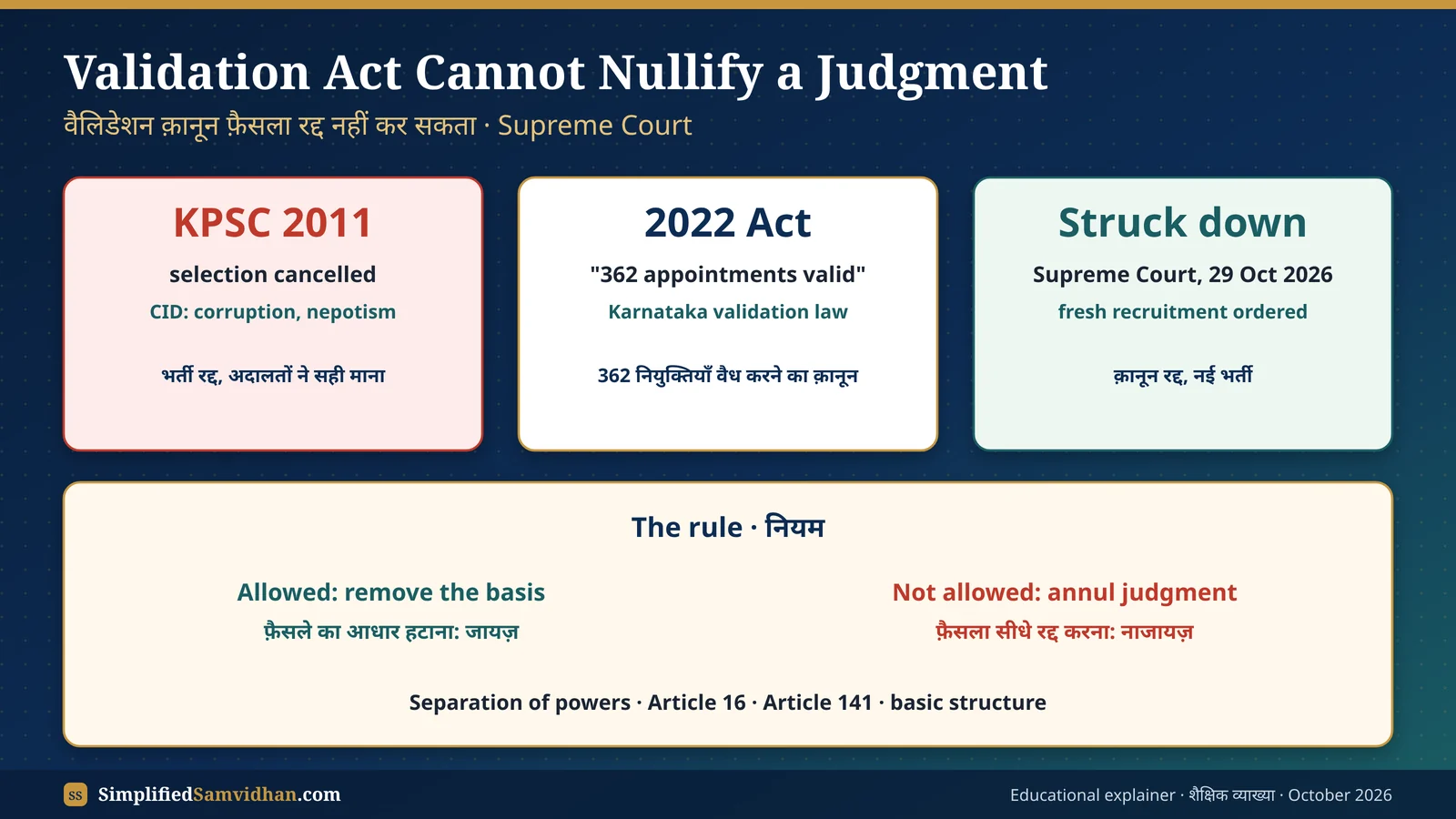
What the Supreme Court decided on 29 October 2026
In Srinivasa T v State of Karnataka (2026 INSC 1173), a bench of Justices J.B. Pardiwala and K. Vinod Chandran declared the Karnataka Civil Services (Validation of Selection and Appointment of 2011 Batch Gazetted Probationers) Act, 2022 unconstitutional. The Act had tried to validate the selection of 362 Group A and Group B officers through the Karnataka Public Service Commission's 2011 examination. That selection had been cancelled after a CID inquiry found manipulation, corruption and nepotism involving KPSC officials, and the courts had upheld the cancellation.
The Court held that a legislature can change the law to remove the basis on which a judgment rests, but it cannot directly annul a final judgment. Because the Act left the basis of the judgment untouched, it amounted to overruling the court, which is impermissible. Appointments made under the Act come to an end, and Karnataka must recruit afresh for the vacant Group A and B posts under the rules now in force.
At a GlanceKarnataka Validation Act Case: Key Facts
| Point | Fact |
|---|---|
| Case | Srinivasa T v State of Karnataka, 2026 INSC 1173 |
| Decided | 29 October 2026 |
| Bench | Justices J.B. Pardiwala and K. Vinod Chandran |
| Law struck down | Karnataka Civil Services (Validation of Selection and Appointment of 2011 Batch Gazetted Probationers) Act, 2022 |
| Who was affected | 362 gazetted probationers (Group A and B) selected through KPSC's 2011 recruitment |
| Why the selection fell | CID inquiry found manipulation, corruption and nepotism; cancellation upheld by courts |
| Core holding | A legislature may remove the basis of a judgment but cannot annul a final judgment |
| Result | Appointments under the Act end; fresh recruitment for vacant posts |
Courts and legislatures have different jobs. The legislature makes and changes laws; courts apply them to decide disputes. If a court says "this selection was illegal", the legislature cannot pass a law that just says "no, it is legal". It may only change the underlying rule so that the old problem no longer exists, and even then it cannot reopen a decided case unfairly.
🏠 Everyday analogy
Imagine a cricket umpire gives a batsman out after checking the replay. The team captain cannot announce "he is not out" and send him back in. The captain may push for a change in the rules for future matches, but cannot overturn the umpire's decision.
🇮🇳 Real Indian example
Thousands of honest candidates who wrote the KPSC 2011 exam lost out because of a tainted process. The Court's ruling means the State must now fill these posts again through a fair, fresh selection.
The RuleWhen Can a Legislature Overturn a Court Judgment?
Allowed (valid validation law)
- Changes the law with retrospective effect
- Removes the defect the court pointed out
- Applies generally, not to undo one case
- Is within the legislature's competence
Not allowed (invalid)
- Simply declares a court's decision void
- Leaves the court's reasoning untouched
- Overrules a final judgment between parties
- Rewards illegality found by the court
- 1Find the basis
What defect did the court find? Here, a recruitment tainted by corruption and nepotism.
- 2Check the new law
Did the legislature cure that defect by changing the rule itself?
- 3Apply the test
If the defect is cured, the validation can stand; if the law only says 'the selection is valid', it falls.
- 4Result in this case
The 2022 Act did not cure the taint, so the Court struck it down.
The Supreme Court has applied this test for decades, in cases such as Madan Mohan Pathak v Union of India (1978), S.R. Bhagwat v State of Mysore (1995), Indian Aluminium Co. v State of Kerala (1996) and Medical Council of India v State of Kerala (2018).
Official TextArticle 16 and Article 141: The Constitution Behind the Ruling
Constitution of India, Article 16(1). Equality of opportunity in matters of public employment.
There shall be equality of opportunity for all citizens in matters relating to employment or appointment to any office under the State.
Article 141. Law declared by Supreme Court to be binding on all courts.
The law declared by the Supreme Court shall be binding on all courts within the territory of India.
- Article 16(1): every citizen deserves an equal chance at government jobs; a tainted selection denies it to honest candidates.
- Articles 315-320 create Public Service Commissions to hold fair recruitment; Article 320 gives them the duty to conduct examinations.
- Article 141: law declared by the Supreme Court binds all courts; together with judicial review, it ensures court judgments are not set aside by ordinary laws.
- Separation of powers and judicial review are part of the basic structure of the Constitution (Kesavananda Bharati, 1973; Indira Nehru Gandhi, 1975).
Why It MattersWhat the Ruling Means
- For recruitment: governments cannot use their majority in the Assembly to save appointments that courts found tainted.
- For job-seekers: honest candidates get a fresh, fair chance through new recruitment.
- For federalism and courts: the rule applies equally to Parliament and State legislatures.
- Hard side: officers who have served for years lose their jobs; the Court weighed this against the public interest in clean recruitment.
UPSC CornerValidation Laws and Separation of Powers for UPSC
- Prelims: A legislature can remove the basis of a judgment retrospectively but cannot directly overrule it (Madan Mohan Pathak, 1978; Indian Aluminium Co., 1996).
- Prelims: Article 320 lists the functions of Public Service Commissions; Article 315 provides for UPSC and State PSCs.
- Prelims: Article 141 makes the law declared by the Supreme Court binding on all courts in India.
- Prelims: Judicial review is part of the basic structure (Kesavananda Bharati, 1973; L. Chandra Kumar, 1997).
- Mains (GS II): "Legislative override of judicial decisions threatens the separation of powers." Examine with reference to the Supreme Court's October 2026 ruling on the Karnataka validation law.
Practice MCQTest Yourself: SC: Law Can't Cancel a Judgment
With reference to the Supreme Court's ruling of October 2026 on Karnataka's 2022 validation law, consider the following statements: (1) A legislature can retrospectively change the law to remove the basis of a court judgment. (2) A legislature can directly declare a final court judgment to be void. (3) The Court ordered fresh recruitment for the vacant posts. Which of the statements given above is/are correct?
Doubts ClearedFrequently Asked Questions
Why did the Supreme Court strike down the Karnataka validation act?
Because the 2022 Act tried to validate the 2011 KPSC selection without removing the defect (a corrupt and manipulated process) that the courts had found. Simply overriding a final judgment is not allowed.
What was the KPSC 2011 recruitment controversy?
The Karnataka Public Service Commission's 2011 selection of gazetted probationers was cancelled after a CID inquiry found manipulation, corruption and nepotism. The State later passed a 2022 law to validate 362 appointments.
What happens to the 362 officers now?
The Court said appointments made under the unconstitutional Act come to an end, and Karnataka must recruit afresh for the vacant Group A and B posts under the current rules.
Can Parliament or a State legislature ever overturn a court ruling?
It can change the law, even retrospectively, so that the basis of the judgment no longer exists. It cannot pass a law that merely declares the judgment ineffective.
Which constitutional principle is involved?
Separation of powers and judicial review, both part of the basic structure, along with Article 16's guarantee of equal opportunity in public employment.
Sources and further readingSources We Checked
Facts checked against the reports below on 31 October 2026. We relied on legal news reports of the judgment; dates of the earlier High Court rulings differ across reports and are not given here.
- Verdictum: Legislature cannot nullify judgments of constitutional courts: SC strikes down Karnataka Validation Act (2026 INSC 1173)
- LiveLaw: 'Legislature cannot directly annul judgment': SC strikes down 2022 Karnataka law validating tainted 2011 civil service selection
- Daily Pioneer: Supreme Court orders fresh recruitment after scrapping Karnataka law on disputed KPSC appointments
- Daijiworld: SC strikes down 2022 law validating 362 KPSC 2011 batch gazetted probationers' appointments