RTI on a Private Body: Supreme Court Says Records a Public Authority Can Access Are 'Information'
Can you use RTI to get papers of a co-operative bank, a private society or a company? Usually the answer was "no, it is not a public authority". On 26 October 2026 the Supreme Court made the other door clear: if a government office has the legal power to call for those papers, you can ask that office under RTI, and it must call for them. Here is the ruling in simple words.
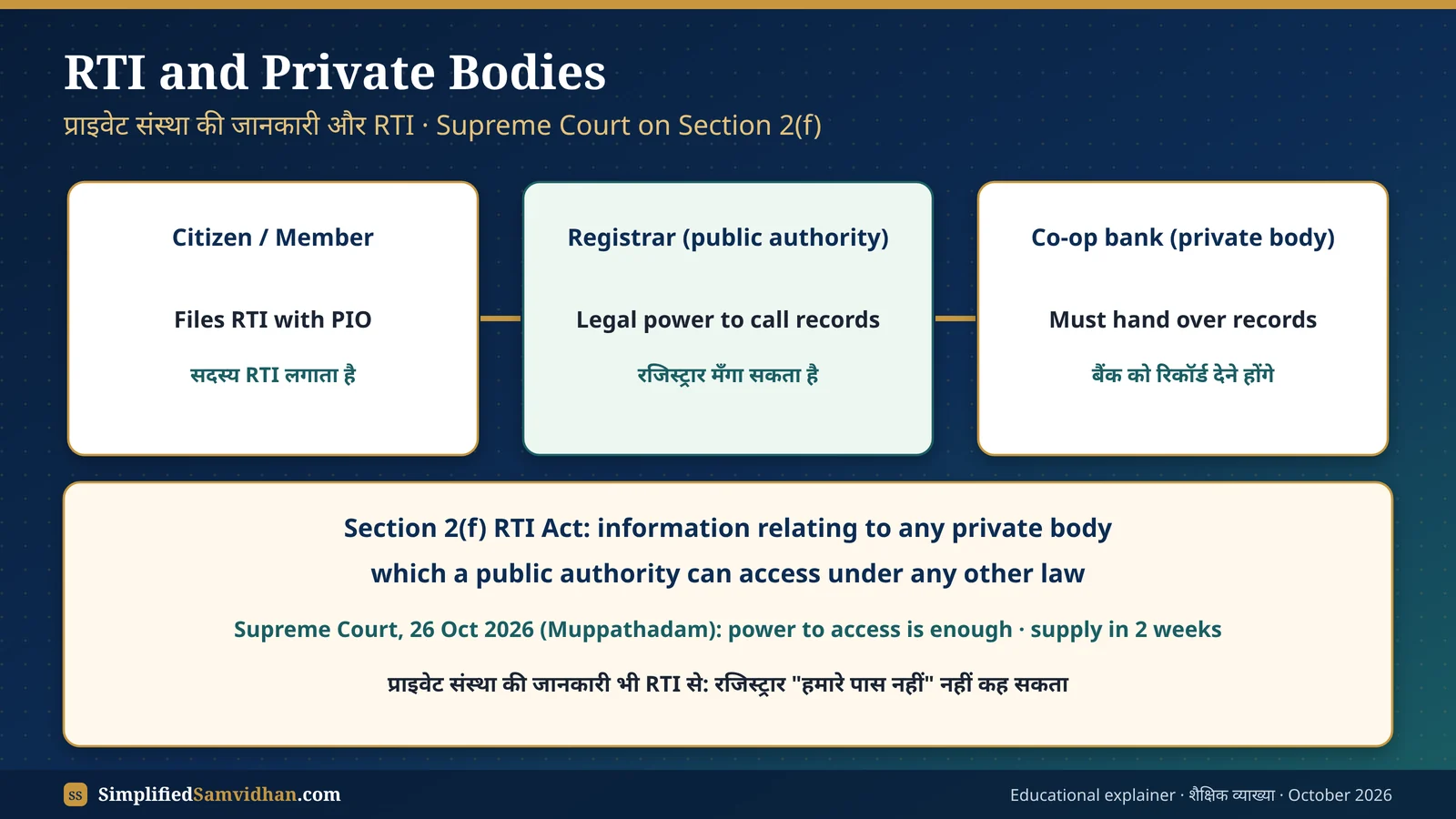
What the Supreme Court decided on 26 October 2026
A Bench of Justices J.B. Pardiwala and K. Vinod Chandran decided Muppathadam Service Co-operative Bank Ltd v State Chief Information Commissioner (2026 INSC 1153) on 26 October 2026. A member of the co-operative bank in Keralam had asked, through the Joint Registrar (General) of Co-operative Societies, for the bank's construction agreement and the minutes of its general body meetings. The information commission and the Kerala High Court ordered disclosure, and the bank appealed.
The Supreme Court dismissed the bank's appeals. It held that material relating to a private body which a public authority can access under another law is "information" under Section 2(f) of the RTI Act. The Registrar does not need to already hold the papers or start an inquiry first: the legal power to call for them is enough. The bank's pleas of commercial confidence (Section 8(1)(d)) and personal information (Section 8(1)(j)) were rejected, and the Joint Registrar was told to obtain the documents and give them to the member within two weeks. As reported, the Court noted that a stranger with no link to the society may not get the same result.
At a GlanceThe Ruling at a Glance: Key Facts
| Point | Fact |
|---|---|
| Case | Muppathadam Service Co-operative Bank Ltd v State Chief Information Commissioner, 2026 INSC 1153 |
| Date and Bench | 26 October 2026; Justices J.B. Pardiwala and K. Vinod Chandran |
| What was asked | Construction agreement and general body meeting minutes of a co-operative bank |
| Asked from | Joint Registrar (General) of Co-operative Societies, a public authority |
| Key holding | Private-body material that a public authority can access under any law is 'information' under Section 2(f) |
| Exemptions | Section 8(1)(d) commercial confidence and 8(1)(j) personal information pleas rejected on the facts |
| Order | Documents to be called for and supplied to the member within two weeks |
| Earlier law | Thalappalam (2013): co-operative societies are usually not 'public authorities'; Subhash Chandra Agarwal (2019) on access to private-body information |
A private body does not have to answer RTI itself. But many private bodies must show their records to a government office when asked: a co-operative society to its Registrar, a bank to the RBI, a company to the Registrar of Companies. The Court says: if that office can legally get the records, an RTI applicant can ask that office, and "we do not have it" is not an answer.
🏠 Everyday analogy
Think of a school principal who can ask any class teacher for the attendance register. A parent cannot force the teacher, but can ask the principal. The principal cannot say "the register is in the classroom, not my office"; he has the power to send for it.
🇮🇳 Real Indian example
A member of a village co-operative bank in Kerala or a dairy society in Rajasthan who suspects a costly building contract can file RTI with the Assistant or Joint Registrar of Co-operative Societies and ask for the contract and meeting minutes.
How to Use ItHow to File RTI for a Private Body's Records
- 1Find the controlling office
Identify the public authority that has legal power over the private body: Registrar of Co-operative Societies, RBI, SEBI, Registrar of Companies, a regulator or a licensing department.
- 2Write to its PIO
File RTI with that office's Public Information Officer. Name the private body and the exact documents (date, meeting, contract).
- 3Mention the law
Quote Section 2(f): information relating to a private body that the public authority can access under any law, and refer to the Supreme Court's 26 October 2026 ruling.
- 4Show your link
If you are a member, depositor or shareholder, say so. The ruling was given to a member; a stranger may not get the same result.
- 5Appeal if refused
If the PIO says "not held by us", file a first appeal within 30 days and then a second appeal to the Information Commission.
Official TextSections 2(f), 2(j) and 8(1) of the RTI Act, 2005
Right to Information Act, 2005, Section 2(f).
"information" means any material in any form, including records, documents, memos, e-mails, opinions, advices, press releases, circulars, orders, logbooks, contracts, reports, papers, samples, models, data material held in any electronic form and information relating to any private body which can be accessed by a public authority under any other law for the time being in force;
Section 2(j).
"right to information" means the right to information accessible under this Act which is held by or under the control of any public authority and includes the right to (i) inspection of work, documents, records; (ii) taking notes, extracts or certified copies of documents or records; (iii) taking certified samples of material; (iv) obtaining information in the form of diskettes, floppies, tapes, video cassettes or in any other electronic mode or through printouts where such information is stored in a computer or in any other device;
Section 8(1)(d) and (j) (extract).
(d) information including commercial confidence, trade secrets or intellectual property, the disclosure of which would harm the competitive position of a third party, unless the competent authority is satisfied that larger public interest warrants the disclosure of such information; ... (j) information which relates to personal information the disclosure of which has no relationship to any public activity or interest, or which would cause unwarranted invasion of the privacy of the individual unless ... the larger public interest justifies the disclosure of such information.
- Section 2(f) has two parts: material in any form, and information relating to any private body that a public authority can access under another law. This case is about the second part.
- Section 2(j) speaks of information "held by or under the control of" a public authority. The Court read 'control' with Section 2(f): a legal power to obtain the records counts, even without physical possession.
- Section 8 exemptions still apply. A body can still refuse genuine trade secrets or truly private personal data, unless larger public interest justifies disclosure.
- The RTI Act gives effect to the right to know, which the Supreme Court has read into Article 19(1)(a) (freedom of speech and expression).
BackgroundThalappalam to Muppathadam: How the Law Developed
| Year | Case and point |
|---|---|
| 12 Oct 2005 | RTI Act, 2005 comes fully into force. |
| 7 Oct 2013 | Thalappalam Service Co-operative Bank v State of Kerala: co-operative societies are not 'public authorities' under Section 2(h) unless owned, controlled or substantially financed by Government; but the Registrar can be asked for information it can access under law. |
| 13 Nov 2019 | CPIO, Supreme Court v Subhash Chandra Agarwal (Constitution Bench): access by a public authority to private-body information should not be shackled by pre-imposed conditions. |
| 26 Oct 2026 | Muppathadam: the power to access is enough; the Registrar must call for the records and supply them. |
Before this ruling
- Registrars often replied "not held in this office"
- Societies called contracts 'commercial' and minutes 'personal'
- Members had to go to court or the cooperative department
After this ruling
- Power to call for records = information under RTI
- Registrar must obtain and supply the records
- Exemptions judged case by case, not used as a blanket
Why It MattersTransparency vs Privacy of Private Bodies
Gains
- Members of co-operative banks and societies can check how their money is spent
- Regulators cannot hide behind 'not in our file'
- Helps expose costly contracts and fraud early
- Useful for depositors of failed co-operative banks
Limits and concerns
- Private bodies' genuine trade secrets still protected
- A stranger with no connection may be refused
- Only records the authority can lawfully access are covered
- More work for Registrars and regulators
UPSC CornerRTI and Private Bodies for UPSC Prelims and Mains
- Prelims: Section 2(f) defines 'information' and includes information relating to any private body accessible to a public authority under any other law.
- Prelims: Section 2(h) defines 'public authority'; Thalappalam (2013) held co-operative societies are not automatically public authorities.
- Prelims: Right to information is part of Article 19(1)(a); Section 8(1)(j) protects personal information unless larger public interest applies.
- Mains (GS II): "Transparency should follow public money and public power, even into private bodies." Discuss with reference to recent RTI rulings.
Practice MCQTest Yourself: RTI on Private Bodies: Supreme Court on Section 2(f)
Under the Right to Information Act, 2005, consider the following statements: (1) 'Information' under Section 2(f) includes information relating to a private body that a public authority can access under any other law. (2) A co-operative society is always a 'public authority' under Section 2(h). (3) According to the Supreme Court in October 2026, a Registrar must already hold the records physically before they can be given under RTI. Which of the statements given above is/are correct?
Doubts ClearedFrequently Asked Questions
Can I file RTI against a private company or society?
Not directly, unless it is a public authority. But you can file RTI with the government office that has legal power over it (Registrar of Co-operative Societies, RBI, SEBI, Registrar of Companies and so on) and ask for the private body's records that office can access.
What did the Supreme Court decide on 26 October 2026?
In Muppathadam Service Co-operative Bank v State Chief Information Commissioner, it held that material about a private body which a public authority can access under any law is 'information' under Section 2(f), and told the Joint Registrar to obtain the bank's construction agreement and meeting minutes and give them to the member within two weeks.
Can the PIO say the records are not in his office?
Not if the office has legal power to call for them. The Court said the power to access is different from physical possession, and the power is enough.
Can a co-operative bank refuse by calling the documents personal or commercial?
Only if a Section 8 exemption really applies. In this case the Court rejected the commercial-confidence and personal-information pleas for a contract and general body minutes asked for by a member.
Is a co-operative society a public authority under RTI?
Usually not. In Thalappalam (2013) the Supreme Court said it is a public authority only if owned, controlled or substantially financed by the Government. That is why the route through the Registrar matters.
Sources and further readingSources We Checked
Facts checked against the legal news reports below on 28 October 2026; we could not read the full judgment text, so the exact wording should be checked in the Supreme Court's copy (2026 INSC 1153).
- Verdictum: Material relating to private body which can be accessed by public authority can fall under 'information' under RTI Act: Supreme Court (2026 INSC 1153)
- LiveLaw: Cooperative society cannot deny RTI information to member as 'personal' if Registrar can access such records (Oct 2026)
- Law Trend: Co-operative society member can seek contract and general body minutes under RTI through Registrar
- TaxGuru: RTI Act covers private cooperative bank records accessible to Registrar: SC
- Indian Cooperative: SC upholds co-op member's right to bank records; dismisses appeal
- India Code: Right to Information Act, 2005