Cancer Medicine Price Cut 2026: NPPA Revises MRP of 543 Brands
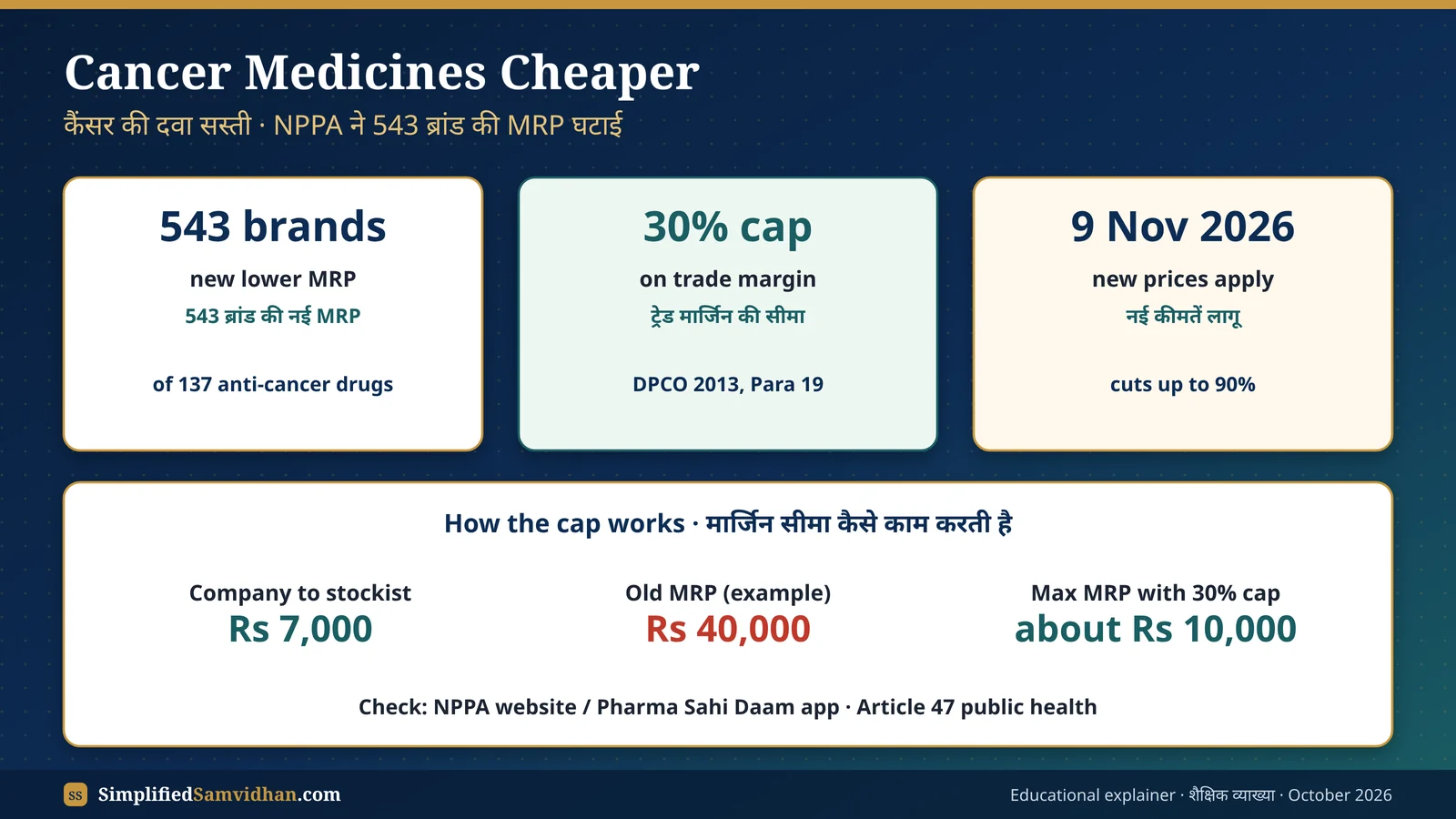
A month of cancer treatment can cost more than a family earns in a year, and a large part of a medicine's MRP often goes as margin to traders, not to the maker. The National Pharmaceutical Pricing Authority (NPPA) has now capped these trade margins at 30% for 137 anti-cancer drugs and released new, lower MRPs for 543 brands, effective 9 November 2026. Some prices fall by up to 90%. Here is how it works, the law behind it, and how to make sure your chemist charges the new price.
What NPPA has done
On 17 October 2026 the NPPA, which works under the Department of Pharmaceuticals, Ministry of Chemicals and Fertilizers, applied Trade Margin Rationalisation (TMR) to 137 non-scheduled anti-cancer drugs. The trade margin, the gap between the price at which the company sells to the stockist and the MRP you pay, was capped at 30%, using the special power in Paragraph 19 of the Drugs (Prices Control) Order, 2013. Companies were told to submit revised prices.
Based on submissions up to 27 October, NPPA has now published revised MRPs for 543 brands, effective from 9 November 2026. The list will be updated as more companies report. Reports say some brands become cheaper by up to 90%. Medicines already in shops may carry the old MRP; from 9 November they must be sold at no more than the new price.
At a GlanceCancer Medicine Price Cut: Key Facts
| Point | Fact |
|---|---|
| Who | National Pharmaceutical Pricing Authority (NPPA), set up in 1997 |
| What | Trade margin capped at 30% for 137 non-scheduled anti-cancer drugs |
| Order dated | 17 October 2026 (Trade Margin Rationalisation) |
| Brands with new MRP | 543 (list to be updated continually) |
| New prices from | 9 November 2026 |
| Legal power | Paragraph 19, Drugs (Prices Control) Order, 2013 (made under the Essential Commodities Act, 1955) |
| Biggest cuts | Up to 90% for some brands, as reported |
| Earlier pilot | February 2019: 42 anti-cancer drugs, same 30% cap |
When a cancer drug leaves the factory it may be sold to a stockist for Rs 7,000, yet its printed MRP may be Rs 40,000. The extra Rs 33,000 is shared along the supply chain and is often used to give hospitals and chemists big discounts to push that brand. With a 30% cap, the MRP before GST can be at most about Rs 10,000 in this example. The company still gets the same Rs 7,000; what shrinks is the middle margin.
🏠 Everyday analogy
Think of a vegetable bought from a farmer at Rs 20 a kilo and sold in the city at Rs 100. If a rule says sellers can add at most a fixed share on top, the farmer is paid the same, but you pay far less.
🇮🇳 Real Indian example
A family in Patna buying an imported breast-cancer injection every three weeks, or a patient in Pune on oral chemotherapy tablets every day, can save thousands of rupees a month once the new MRP applies.
How It WorksHow Drug Prices Are Controlled in India
| Type of medicine | How its price is set |
|---|---|
| Scheduled (in Schedule I of DPCO, from the National List of Essential Medicines) | NPPA fixes a ceiling price; revised every year with the wholesale price index |
| Non-scheduled (all other medicines) | Company fixes the price, but can raise MRP by only 10% a year |
| Special cases (Paragraph 19) | In public interest the government can fix or cut prices of any drug, as in this TMR |
- 1NPPA order
NPPA notifies the trade margin cap for the chosen drugs (17 October 2026).
- 2Companies report
Makers send revised prices for each brand through NPPA's system.
- 3New MRP list
NPPA publishes brand-wise revised MRPs (543 brands so far).
- 4In force
From 9 November 2026 no chemist or hospital may charge more than the new MRP.
- 5Enforcement
Overcharging can be reported to NPPA, which can recover the excess with interest.
Official TextArticle 47 and Paragraph 19 DPCO 2013: The Law Behind the Price Cut
Constitution of India, Article 47. Duty of the State to raise the level of nutrition and the standard of living and to improve public health.
The State shall regard the raising of the level of nutrition and the standard of living of its people and the improvement of public health as among its primary duties and, in particular, the State shall endeavour to bring about prohibition of the consumption except for medicinal purposes of intoxicating drinks and of drugs which are injurious to health.
Drugs (Prices Control) Order, 2013, Paragraph 19 (in substance).
In case of extraordinary circumstances, if the Government considers it necessary in public interest, it may fix the ceiling price or retail price of any drug for such period as it deems fit, and where a price is already fixed, may allow an increase or decrease in it irrespective of the annual wholesale price index.
- Article 47 (a Directive Principle) makes improving public health a primary duty of the State. Courts have also read the right to health into Article 21.
- The Drugs (Prices Control) Order, 2013 is issued under Section 3 of the Essential Commodities Act, 1955; drugs are an essential commodity under that Act.
- Price control falls under Entry 33 of the Concurrent List (trade and commerce in, and production and supply of, products of controlled industries and foodstuffs and other goods).
What You Can DoHow to Check the New Price and Complain About Overcharging
- 1Check the new MRP
Look up your medicine's brand on NPPA's website (nppaindia.nic.in) or its Pharma Sahi Daam app.
- 2Ask the chemist or hospital pharmacy
From 9 November 2026 they must not charge more than the revised MRP, even if the strip shows the old one.
- 3Keep the bill
Always take a printed bill with batch number and price.
- 4Complain
Report overcharging to NPPA's Pharma Jan Samadhan portal or the State Drug Controller.
Why It MattersTrade Margin Cap: Benefits vs Limits
Benefits
- Big, quick relief for cancer patients
- Makers still get their selling price
- Ends hidden discount games in hospitals
- Builds on the 2019 pilot that worked
Limits
- Covers only 137 drugs, not all cancer care
- Companies with low margins see little change
- Old stock with old MRP can confuse buyers
- Public health groups say direct price control is still needed
UPSC CornerDrug Price Control for UPSC Prelims and Mains
- Prelims: NPPA was set up in 1997 and works under the Department of Pharmaceuticals, Ministry of Chemicals and Fertilizers.
- Prelims: DPCO 2013 is issued under the Essential Commodities Act, 1955; scheduled drugs come from the National List of Essential Medicines.
- Prelims: Non-scheduled drug prices can rise by at most 10% in 12 months; Paragraph 19 gives emergency power in public interest.
- Prelims: Trade Margin Rationalisation was first tried on 42 anti-cancer drugs in February 2019.
- Mains (GS II): "Affordable medicine is central to the right to health." Examine India's drug price regulation in the light of the 2026 cap on anti-cancer drug trade margins.
Practice MCQTest Yourself: Cancer Medicines Cheaper from 9 Nov
With reference to the October 2026 cut in anti-cancer drug prices, consider the following statements: (1) The National Pharmaceutical Pricing Authority works under the Ministry of Health and Family Welfare. (2) The trade margin on 137 non-scheduled anti-cancer drugs was capped at 30%. (3) The Drugs (Prices Control) Order, 2013 is issued under the Essential Commodities Act, 1955. Which of the statements given above is/are correct?
Doubts ClearedFrequently Asked Questions
Which cancer medicines have become cheaper?
NPPA has published revised MRPs for 543 brands of 137 non-scheduled anti-cancer drugs. The brand-wise list is on NPPA's website and will be updated as more companies report.
From when do the new cancer medicine prices apply?
From 9 November 2026.
What is trade margin rationalisation?
It is a cap on the difference between the price at which a company sells a drug to the stockist and the MRP paid by the patient. For these drugs the cap is 30%.
What if a chemist charges the old MRP after 9 November?
Ask for the revised price and a bill. If overcharged, complain to NPPA through its Pharma Jan Samadhan portal or to your State Drug Controller; NPPA can recover overcharged amounts with interest.
Which law allows the government to cut medicine prices?
Paragraph 19 of the Drugs (Prices Control) Order, 2013, issued under the Essential Commodities Act, 1955, lets the government fix or reduce the price of any drug in public interest.
Sources and further readingSources We Checked
Facts checked against the reports below on 30 October 2026. Always confirm your brand's revised MRP on NPPA's official list, which is updated as companies submit prices.
- PIB: NPPA releases revised MRP for 543 brands of anti-cancer medicines; new prices effective from November 9, 2026
- Tribune: Cancer drug prices slashed by up to 90%; new rates effective from November 9
- Medical Dialogues: NPPA revises prices of 543 anti-cancer medicine brands, new MRPs effective Nov 9
- Devdiscourse: NPPA caps trade margins for 137 non-scheduled anti-cancer drugs (Oct 2026)
- Deccan Herald: Govt caps retail prices of 42 anti-cancer drugs (Feb 2019 pilot)