Peace Bond Notice under Section 126 BNSS: Why Police Ask Protesters for a Bond, and the Limits
A peace bond is a written promise, backed by money and sometimes a surety, that you will not disturb public peace for a fixed time. It is not a punishment and not an FIR. This week a Delhi student leader challenged such a notice in the High Court. Here is the law, the safeguards, and what you can do if you get one.
What happened in Delhi
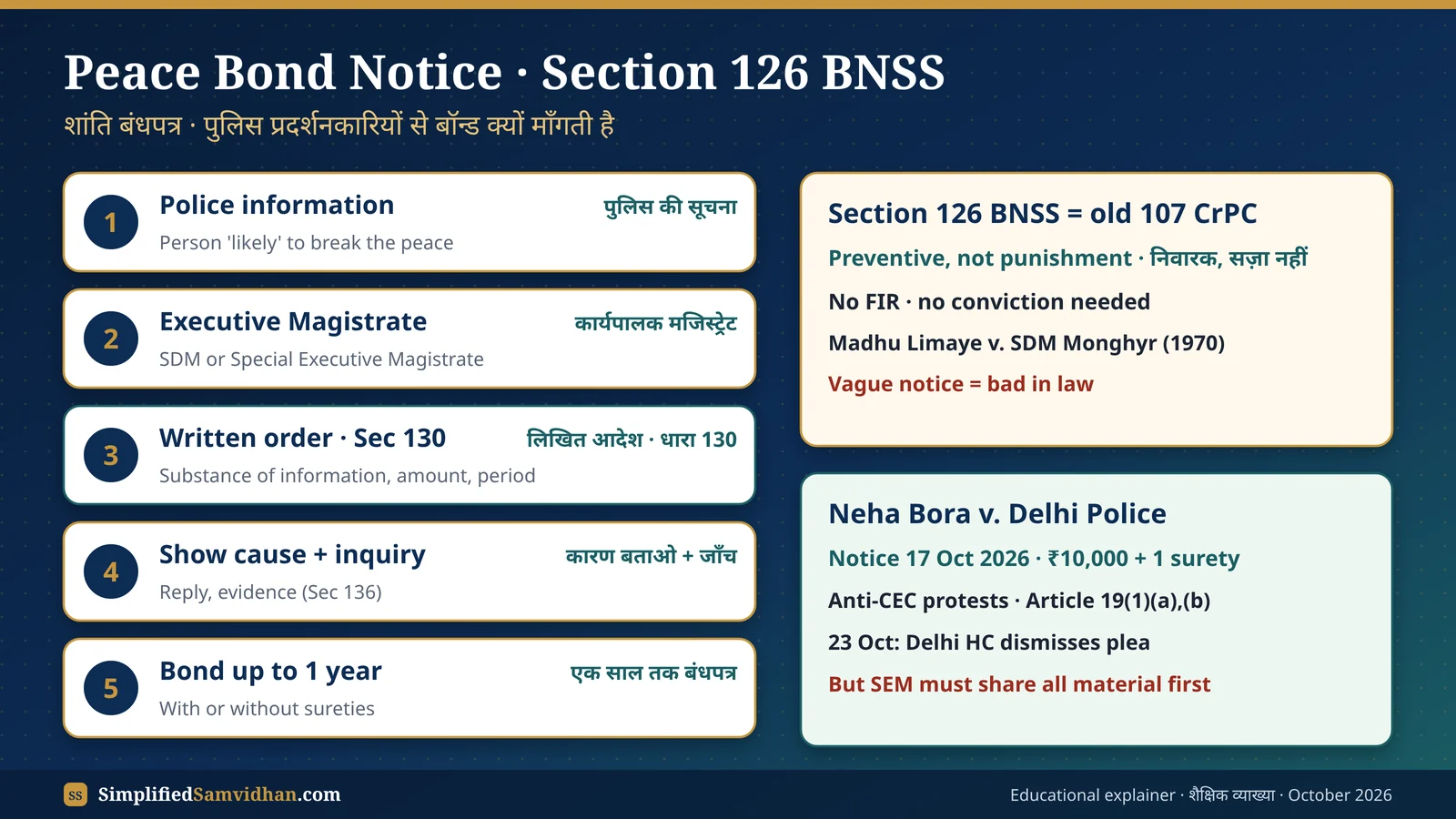
On 17 October 2026 a police officer acting as a Special Executive Magistrate in Delhi issued a notice under Sections 126 and 130 of the BNSS to Neha Bora, president of the students' group AISA, asking her to appear and sign a personal bond of ₹10,000 with one surety. The grounds given were alleged sloganeering at Mandi House on 16 October, repeated protests near Jantar Mantar despite prohibitory orders under Section 163 BNSS, and a call to join a demonstration at Connaught Place. The protests demand the resignation of Chief Election Commissioner Gyanesh Kumar over "vote chori" allegations.
She moved the Delhi High Court, saying she was not given the order and material behind the notice and that it chills her rights under Articles 19(1)(a) and 19(1)(b). The Delhi Police, through the Additional Solicitor General, questioned whether the petition was maintainable. The Court reserved its verdict on 22 October.
Update, 23 October 2026: Justice Subramonium Prasad of the Delhi High Court dismissed the plea, so the notice stands and the Magistrate's inquiry can go on. But the Court directed the Special Executive Magistrate to give her all the material relied on for the notice before the inquiry, so that she can answer it. Reports quote the judge as saying adequate safeguards and directions are in place. The written order was not yet public when we checked, so the full reasons may add more.
The BasicsWhat Is a Peace Bond under Section 126 BNSS?
| Question | Answer under the BNSS |
|---|---|
| Who issues it? | An Executive Magistrate (for example an SDM, or a police officer appointed Special Executive Magistrate), not a judge of a criminal court |
| Why? | Information that a person is likely to break the peace or disturb public tranquillity |
| Is it a punishment? | No. It is preventive: it looks at the future, not at a crime already proved |
| How long? | Up to one year (Section 126) |
| What do you sign? | A bond for a sum of money, with or without sureties (people who guarantee you) |
| What if you break it? | The bond money can be forfeited, and refusing to give a bond ordered after inquiry can lead to custody until it is given |
| Old law | Section 107 CrPC (now 126 BNSS); written order Section 111 CrPC (now 130 BNSS) |
A peace bond is like a promise note to the State: "For the next few months I will not create trouble, and if I do, I will lose this money." The Magistrate does not decide whether you committed a crime. He only asks whether there is real, specific information that you may break the peace soon.
🏠 Everyday analogy
Think of a school asking two students who fought yesterday to sign an undertaking not to fight again this term, with a parent's signature. Nobody is expelled, but a promise is put on paper.
🇮🇳 Real Indian example
Before elections, district magistrates across India routinely bind over known trouble-makers under this section so that polling stays peaceful. The same power is now being used against student protesters in Delhi.
Official TextSections 126 and 130 BNSS and Article 19(1)
Bharatiya Nagarik Suraksha Sanhita, 2023 · Section 126(1). Security for keeping the peace in other cases.
When an Executive Magistrate receives information that any person is likely to commit a breach of the peace or disturb the public tranquillity or to do any wrongful act that may probably occasion a breach of the peace or disturb the public tranquillity and is of opinion that there is sufficient ground for proceeding, he may, in the manner hereinafter provided, require such person to show cause why he should not be ordered to execute a bond or bail bond for his keeping the peace for such period, not exceeding one year, as the Magistrate thinks fit.
Section 130. Order to be made.
When a Magistrate acting under section 125, section 126, section 127, section 128 or section 129, deems it necessary to require any person to show cause under such section, he shall make an order in writing, setting forth the substance of the information received, the amount of the bond to be executed, the term for which it is to be in force, and the number of sureties, if any, required.
Constitution of India, Article 19(1). All citizens shall have the right (a) to freedom of speech and expression; (b) to assemble peaceably and without arms; …
SafeguardsLimits on Peace Bond Notices: What the Courts Have Said
- Written order with reasons: Section 130 BNSS (old 111 CrPC) is mandatory. The order must state the substance of the information, the amount, the period and the sureties. In Madhu Limaye v. Sub-Divisional Magistrate, Monghyr (1970) the Supreme Court upheld the power but said this written order is a vital safeguard; a vague notice is bad in law.
- Inquiry before final order: the person can show cause, and the Magistrate must hold an inquiry and record evidence before ordering a bond (Section 136 BNSS, old 116 CrPC).
- Bond amount must be fair: it should not be excessive given the person's means (Section 140 BNSS, old 121 CrPC).
- Protest is not breach of peace: peaceful protest is protected by Article 19(1)(a) and (b). It can be limited only by reasonable restrictions in the interest of public order (Articles 19(2) and 19(3)), not merely because the government dislikes the cause.
- Remedy: a person can challenge the notice before the Sessions Court in revision or before the High Court under its inherent powers (Section 528 BNSS, old 482 CrPC) and Article 226.
Why the police use it
- Stops violence before it happens
- Quick, no FIR or trial needed
- Useful before elections, festivals, large rallies
Why critics worry
- Can be used to scare peaceful protesters
- Decided by executive officers, not judges
- Vague notices hide the real material
If You Get a NoticeGot a Section 126 BNSS Notice? What to Do
- 1Read the notice and ask for the order
Check that it mentions Section 130 and gives the substance of the information, the amount and the period. Ask in writing for a copy of the order and the material relied on.
- 2Appear on the date
A show-cause notice is not an arrest. Appear before the Magistrate, personally or through a lawyer, and say if you deny the information.
- 3Give a written reply
Explain that your activity is peaceful and protected by Article 19. Ask for an inquiry with evidence before any bond is ordered.
- 4Get free legal aid if needed
Students and people with low income can get a free lawyer from the District Legal Services Authority (helpline 15100).
- 5Challenge an unfair order
File a revision before the Sessions Court or a petition before the High Court, as Neha Bora has done.
UPSC CornerPeace Bond (Section 126 BNSS) for UPSC Prelims and Mains
- Prelims: Chapter IX of the BNSS (Sections 125 to 143) covers security for keeping the peace and for good behaviour; Section 125 applies on conviction, Section 126 without conviction, Section 127 to dissemination of seditious matters, Section 128 to suspected persons and Section 129 to habitual offenders.
- Maximum period under Section 126: one year. Who: Executive Magistrate.
- Mains (GS II): "Preventive powers of the executive and the right to protest": discuss Madhu Limaye (1970), Anita Thakur (2016) on peaceful protest, Mazdoor Kisan Shakti Sangathan (2018) on balancing protest and public order.
- Ethics (GS IV): the duty of officers to use preventive powers in good faith and not to silence dissent.
Practice MCQTest Yourself: Peace Bond Notice under Section 126 BNSS
With reference to a bond for keeping the peace under Section 126 of the Bharatiya Nagarik Suraksha Sanhita, 2023, consider the following statements: (1) It can be ordered only after the person is convicted of an offence. (2) It can be required by an Executive Magistrate for a period not exceeding one year. (3) The order requiring the person to show cause must set out the substance of the information received. Which of the statements given above is/are correct?
Doubts ClearedFrequently Asked Questions
What is a peace bond?
A peace bond is a written undertaking, backed by a sum of money and sometimes sureties, that a person will keep the peace for a fixed period of up to one year. It is ordered by an Executive Magistrate under Section 126 BNSS.
Is a Section 126 BNSS notice the same as an FIR or arrest?
No. It is a preventive proceeding. No offence is being tried. You are asked to show cause why you should not be bound over.
What was the old section for a peace bond?
Section 107 of the Code of Criminal Procedure, 1973. The written order was under Section 111 CrPC, now Section 130 BNSS.
Can a peace bond notice be challenged?
Yes. You can reply to the Magistrate, ask for an inquiry, and challenge an unfair order before the Sessions Court or the High Court.
Why is the Neha Bora case in the news?
A Special Executive Magistrate in Delhi asked the AISA president for a ₹10,000 bond during the anti-CEC protests. On 23 October 2026 the Delhi High Court dismissed her challenge but ordered the Magistrate to give her all the material behind the notice before the inquiry.
Sources and further readingSources We Checked
News facts on this page were checked against the reports below on 24 October 2026, after the Delhi High Court's ruling of 23 October (based on news reports; the written order was not yet public). Section text is from the BNSS, 2023.
- ThePrint: Delhi HC rejects Neha Bora's plea, directs magistrate to share material behind peace bond notice (23 Oct 2026)
- LiveLaw: Delhi High Court's judgment on Neha Bora's plea against peace bond notice, live updates (23 Oct 2026)
- LiveLaw: Delhi High Court reserves verdict on Neha Bora's plea against peace bond notice amid anti-CEC protests (22 Oct 2026)
- LiveLaw: Neha Bora moves Delhi High Court, challenges notice for peace bond
- Deccan Herald: Anti-CEC protests, AISA president Neha Bora moves Delhi High Court against police notice
- Bharatiya Nagarik Suraksha Sanhita, 2023 (India Code)
- Constitution of India (Legislative Department)