Hexavalent Chromium in Groundwater: NGT Acts on Uttar Pradesh Contamination and Your Right to Clean Water
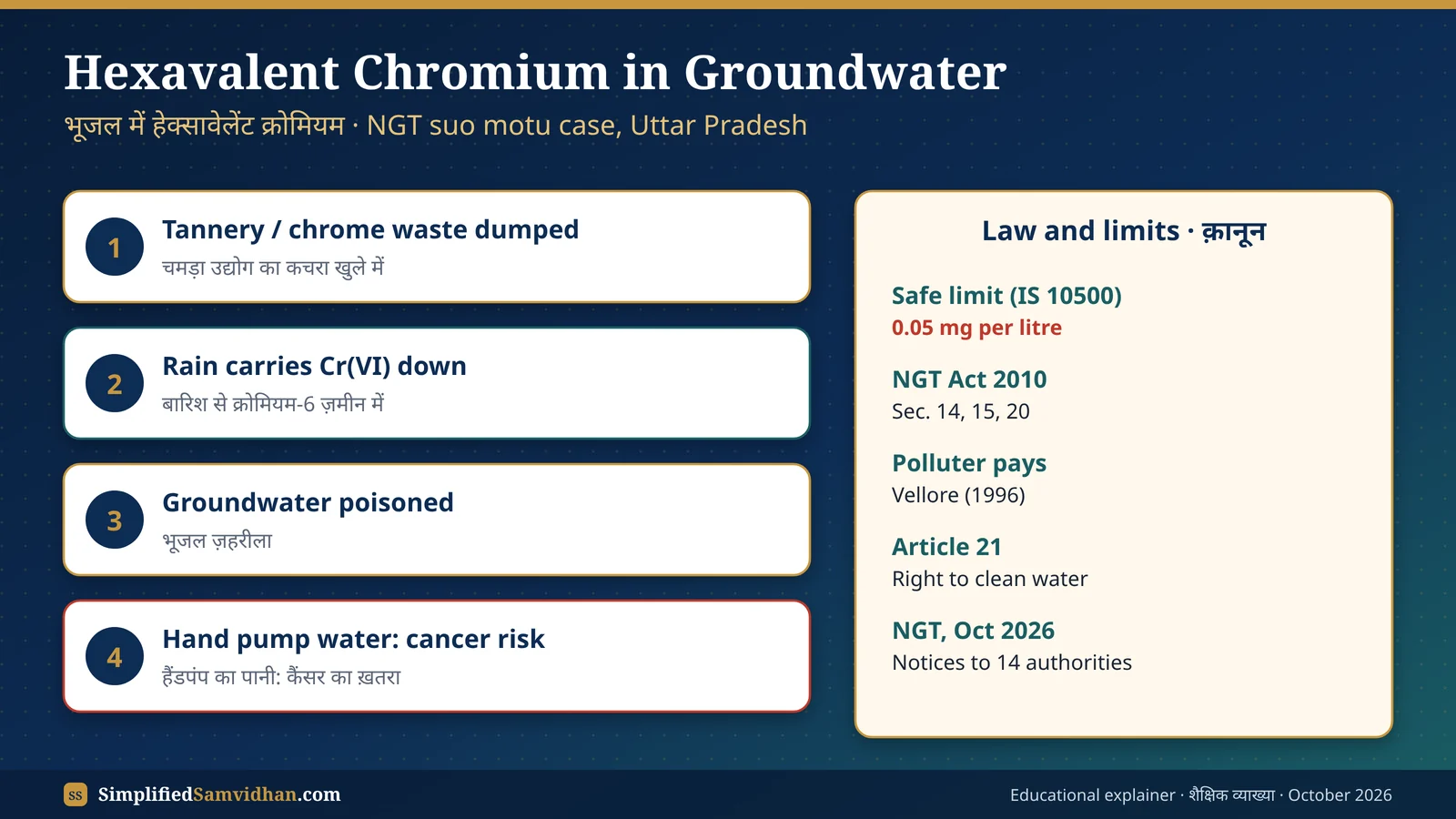
For decades, toxic waste from leather tanning and chrome factories was dumped in open fields of Uttar Pradesh. Rain carried it into the ground, and families still draw that water from hand pumps. This month the National Green Tribunal took up the problem on its own. Here is what hexavalent chromium is, what the law says, and what a citizen can do.
What the National Green Tribunal did in October 2026
The National Green Tribunal (NGT) has taken suo motu cognisance (on its own) of a report in The Hindu on hexavalent chromium contamination of groundwater across parts of three districts of Uttar Pradesh, caused by decades of industrial waste dumping. It issued notices to 14 authorities, including the Chief Secretary of Uttar Pradesh, the National Mission for Clean Ganga and AIIMS, New Delhi, and asked them to file affidavits before the next hearing.
The problem is not new. In 2025 the NGT had repeatedly pulled up the State over chromium dumps at Rania (Kanpur Dehat), Rakhi Mandi (Kanpur Nagar) and Fatehpur, ordering safe drinking water, medical help for residents and quick removal of the dumps, and had found the State's steps inadequate. The new case looks at the spread of the poison and the health of people living there.
BasicsWhat Is Hexavalent Chromium and Why Is It Dangerous
- Two forms: chromium-3 (trivalent) is found in food and is needed by the body in tiny amounts. Chromium-6 (hexavalent) is mostly man-made and highly toxic.
- Where it comes from: leather tanning, chrome plating, chromium chemical factories, paints and dyes. Waste sludge dumped in the open releases it when it rains.
- Health effects: chromium-6 is classified as a Group 1 human carcinogen (causes cancer). Drinking it over years is linked to stomach and digestive problems, skin ulcers, and liver and kidney damage.
- Drinking water limit: India's standard IS 10500:2012 allows at most 0.05 mg per litre of chromium. Tests near old dumps have often found levels many times higher.
- Why it is hard to fix: once in groundwater, chromium-6 travels with the water and stays for years. Cleaning the aquifer is slow and costly, so stopping the source and supplying safe piped water come first.
Imagine someone spills ink in the water tank on the roof. Every tap in the building turns blue, and changing the taps will not help. You must stop the spill, clean the tank and supply clean water meanwhile. Chromium dumps are that ink, and the aquifer is the tank that a whole village shares.
Official TextNGT Act Sections 14, 15 and 20, Article 48A and Article 51A(g)
National Green Tribunal Act, 2010: Section 14. Tribunal to settle disputes.
(1) The Tribunal shall have the jurisdiction over all civil cases where a substantial question relating to environment (including enforcement of any legal right relating to environment), is involved and such question arises out of the implementation of the enactments specified in Schedule I.
Section 15. Relief, compensation and restitution.
(1) The Tribunal may, by an order, provide,— (a) relief and compensation to the victims of pollution and other environmental damage arising under the enactments specified in the Schedule I (including accident occurring while handling any hazardous substance); (b) for restitution of property damaged; (c) for restitution of the environment for such area or areas, as the Tribunal may think fit.
Section 20. Tribunal to apply certain principles.
The Tribunal shall, while passing any order or decision or award, apply the principles of sustainable development, the precautionary principle and the polluter pays principle.
Constitution of India, Article 48A. The State shall endeavour to protect and improve the environment and to safeguard the forests and wild life of the country.
Article 51A(g). It shall be the duty of every citizen of India to protect and improve the natural environment including forests, lakes, rivers and wild life, and to have compassion for living creatures.
The NGT is a special court for the environment. Section 14 lets it decide any substantial question on the environment under laws like the Water Act, 1974 and the Environment (Protection) Act, 1986. Section 15 lets it order compensation for victims and restoration of the damaged land and water. Section 20 binds it to three principles: sustainable development, precaution, and polluter pays. In 2021 the Supreme Court held in Municipal Corporation of Greater Mumbai v Ankita Sinha that the NGT can act suo motu on news reports and letters.
🏠 Everyday analogy
Polluter pays is the simple rule of a hostel: whoever breaks the window pays for the glass, not the warden and not the other students.
🇮🇳 Real Indian example
In Vellore Citizens' Welfare Forum v Union of India (1996), the Supreme Court made Tamil Nadu tanneries pay for the damage their chromium waste caused to farms and wells.
Your RightsRight to Clean Water Under Article 21: What the Courts Have Said
| Case | Year | What it held |
|---|---|---|
| Subhash Kumar v State of Bihar | 1991 | Right to life under Article 21 includes the right to enjoy pollution-free water and air |
| Indian Council for Enviro-Legal Action v Union of India (Bichhri) | 1996 | Polluter is absolutely liable to pay for remedying the damage, whether or not it was careless |
| Vellore Citizens' Welfare Forum v Union of India | 1996 | Precautionary and polluter pays principles are part of Indian law; tannery case |
| M.C. Mehta v Union of India (Kanpur tanneries) | 1987 | Tanneries polluting the Ganga at Kanpur ordered to set up treatment plants or shut down |
| Municipal Corporation of Greater Mumbai v Ankita Sinha | 2021 | NGT has suo motu power to take up environmental issues |
Duties of the State
- Article 21: protect the right to safe water and health
- Article 47: improve public health
- Article 48A: protect and improve the environment
- Water Act, 1974 and Hazardous Waste Rules, 2016: stop dumping and clean up
Duties of polluters and citizens
- Industry: treat waste, pay for clean-up and compensation (polluter pays)
- Citizens: Article 51A(g) duty to protect rivers and lakes
- Report dumping to the State Pollution Control Board
- Approach the NGT or the High Court if authorities fail
For CitizensHow to Check Water Safety and Complain About Chromium Pollution
- 1Test the water
Ask the Jal Jeevan Mission or district water testing laboratory to test your hand pump or well. Yellowish water is a warning sign, but chromium-6 is often invisible.
- 2Use safe water
Until tests are clear, drink only piped or treated water supplied by the authorities. Boiling does not remove chromium.
- 3Complain to the Pollution Control Board
Report open dumping of industrial sludge to the State Pollution Control Board (UPPCB in Uttar Pradesh) with photos and location.
- 4Health check
People in affected villages can ask the district health department for check-ups; the NGT has earlier ordered medical help for residents.
- 5Go to the NGT
Any affected person or group can file an application before the NGT under Sections 14 and 15. A letter or petition can also reach a High Court under Article 226.
- 6Use RTI
File an RTI to ask for water test results of your village and action taken on chromium dumps.
In simple words: clean water is your fundamental right, not a favour. If a factory poisoned it, the factory must pay to clean it, and the government must give you safe water in the meantime.
UPSC CornerHexavalent Chromium, NGT and Environmental Law for UPSC Prelims and Mains
- Prelims fact: The NGT was set up on 18 October 2010 under the NGT Act, 2010; its Principal Bench is in New Delhi.
- Prelims fact: Section 20 of the NGT Act requires it to apply sustainable development, the precautionary principle and the polluter pays principle.
- Prelims fact: The NGT does not hear cases under the Wildlife (Protection) Act, 1972 and the Forest Rights Act, 2006, which are not in its Schedule I.
- Prelims fact: The IS 10500:2012 permissible limit for total chromium in drinking water is 0.05 mg/L.
- Prelims fact: Article 48A and Article 51A(g) were added by the 42nd Amendment Act, 1976.
- Mains (250 words): "Legacy industrial waste is India's silent water crisis." Discuss with reference to chromium contamination in Uttar Pradesh and the role of the NGT.
- Mains (150 words): Explain the polluter pays and precautionary principles with Indian case law.
Practice MCQTest Yourself: Hexavalent Chromium and the NGT
With reference to the National Green Tribunal (NGT), consider the following statements: (1) Section 20 of the NGT Act, 2010 requires the Tribunal to apply the polluter pays principle. (2) The Supreme Court has held that the NGT can take suo motu cognisance of environmental issues. (3) The NGT hears disputes under the Wildlife (Protection) Act, 1972. Which of the statements given above is/are correct?
Doubts ClearedFrequently Asked Questions
What did the NGT do about hexavalent chromium in Uttar Pradesh?
The NGT took suo motu cognisance of a report in The Hindu on hexavalent chromium in groundwater across parts of three Uttar Pradesh districts and issued notices to 14 authorities, including the UP Chief Secretary, the National Mission for Clean Ganga and AIIMS New Delhi, seeking their replies.
What is hexavalent chromium?
Hexavalent chromium (chromium-6) is a toxic form of chromium released by tanning, chrome plating and chromium chemical industries. It is a known human carcinogen and harms the stomach, skin, liver and kidneys.
What is the safe limit of chromium in drinking water in India?
Under the Bureau of Indian Standards drinking water specification IS 10500:2012, total chromium should not exceed 0.05 milligrams per litre.
Is clean water a fundamental right?
Yes. In Subhash Kumar v State of Bihar (1991) and later cases, the Supreme Court held that the right to life under Article 21 includes the right to pollution-free water and air.
Who pays for cleaning up chromium pollution?
Under the polluter pays principle, applied through Section 20 of the NGT Act and cases like Vellore Citizens' Welfare Forum (1996), the industry that caused the pollution must pay for clean-up and compensation.
Sources and further readingSources We Checked
News facts on this page were checked on 18 October 2026 against the reports below. The NGT's latest order was not available to us in full; details of it are as summarised in daily news digests. Earlier NGT orders are from 2025.
- Legacy IAS: The Hindu UPSC News Analysis, 17 October 2026 (NGT notices on hexavalent chromium report)
- Tribune: NGT raps UP Government over chromium contamination, directs Chief Secretary to act fast
- ANI, Apr 2025: Kanpur's chromium crisis, NGT pushes for immediate action on water supply
- Down To Earth, 17 Apr 2026: NGT flags Ganga pollution and sewerage gaps in Uttar Pradesh
- India Code: The National Green Tribunal Act, 2010
- Bureau of Indian Standards: IS 10500:2012 Drinking Water Specification