POCSO Act Special Public Prosecutor: Kerala High Court Orders Exclusive Prosecutors for POCSO Cases
When a child survivor of sexual abuse goes to court, the law promises a special court, a dedicated prosecutor and a trial within one year. On 14 October 2026 the Kerala High Court said a State cannot dilute that promise by making POCSO prosecutors handle other cases too. Here is what the POCSO Act says, what the Court ordered, and how any citizen can report child abuse.
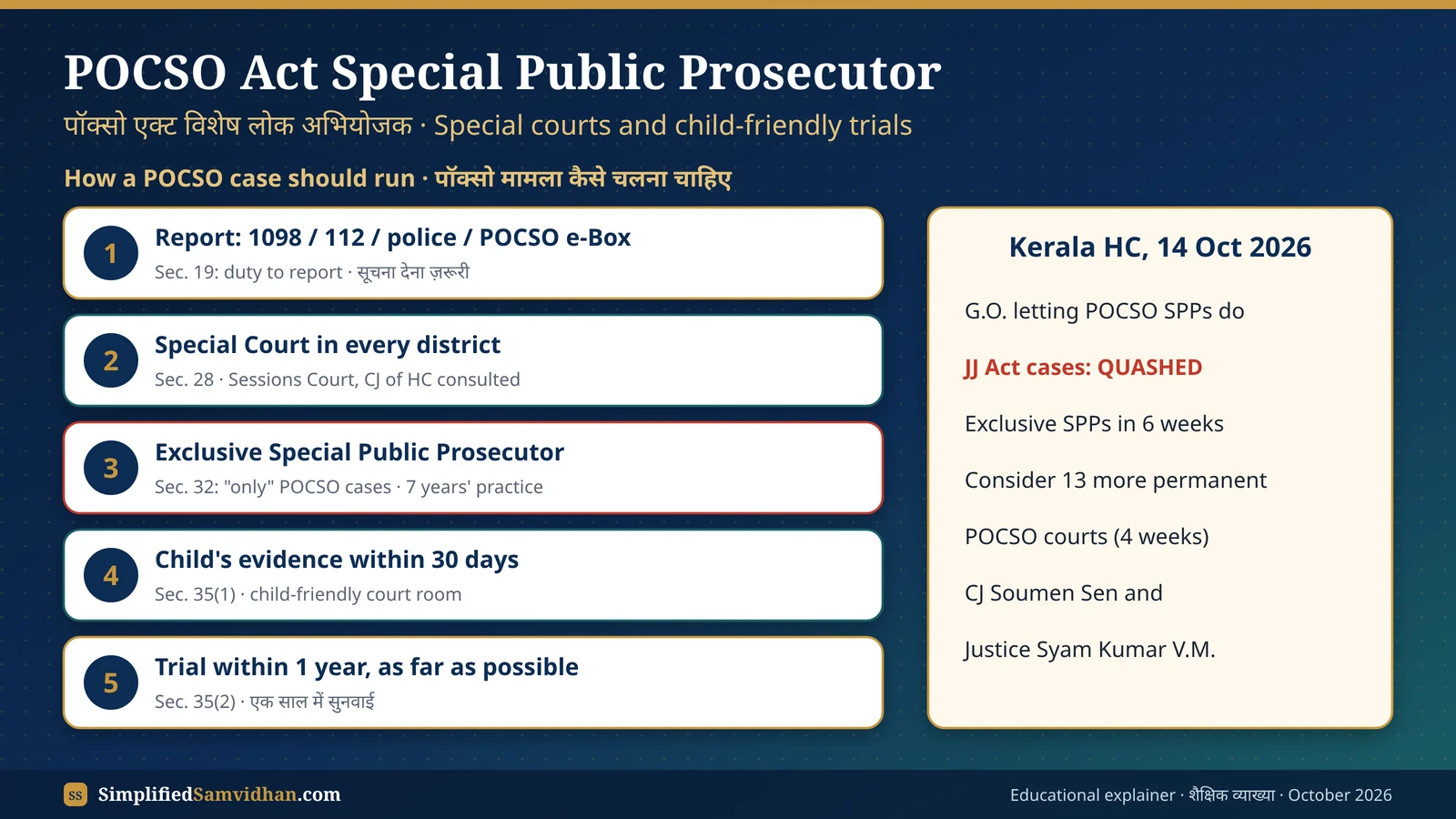
What the Kerala High Court ordered on 14 October 2026
On 14 October 2026 a Division Bench of Chief Justice Soumen Sen and Justice Syam Kumar V.M. of the Kerala High Court quashed a State Government Order that allowed POCSO Special Public Prosecutors to also conduct non-POCSO cases under the Juvenile Justice Act. The Court directed the State to appoint Special Public Prosecutors exclusively for POCSO cases within six weeks.
The State was also asked to consider setting up the remaining 13 permanent, exclusive POCSO Special Courts, one in each district except Ernakulam, and to tell the Court its decision within four weeks of receiving the judgment. The public interest petition was filed by the District Court Bar Association, Thodupuzha-Muttom, and its Secretary. The Court relied on the Supreme Court's directions in the suo motu case In Re: Alarming Rise in the Number of Reported Child Rape Incidents, which asked all States to appoint exclusive prosecutors in courts set up only for POCSO cases. In earlier hearings the High Court had also found that most POCSO courts in Kerala lacked the child-friendly facilities the guidelines require.
BasicsPOCSO Act 2012 in Simple Words: Who It Protects and What It Punishes
- Full name: Protection of Children from Sexual Offences Act, 2012. In force from 14 November 2012.
- Who is a child: any person below 18 years. The law is gender-neutral: it protects boys and girls alike.
- Offences: penetrative sexual assault, aggravated penetrative sexual assault, sexual assault, sexual harassment and using a child for pornography.
- 2019 amendment: raised punishments; aggravated penetrative sexual assault now carries a minimum of 20 years and up to life imprisonment or death.
- Must report: anyone who knows of such an offence must report it to the police or the Special Juvenile Police Unit (Section 19). Not reporting is itself punishable (Section 21).
- Child-friendly process: statement at the child's home or a place of choice, preferably by a woman officer; child's identity must never be disclosed by media (Section 23); presumption of guilt against the accused for key offences (Section 29).
POCSO is a special shield for children. Ordinary criminal courts can be frightening and slow, so the law creates a separate court, a separate prosecutor and strict time limits so that a child does not have to relive the trauma for years.
Official TextSection 28, Section 32 and Section 35 of the POCSO Act: Special Courts and Prosecutors
Protection of Children from Sexual Offences Act, 2012: Section 28. Designation of Special Courts.
(1) For the purposes of providing a speedy trial, the State Government shall in consultation with the Chief Justice of the High Court, by notification in the Official Gazette, designate for each district, a Court of Session to be a Special Court to try the offences under the Act:
Provided that if a Court of Session is notified as a children's court under the Commissions for Protection of Child Rights Act, 2005 or a Special Court designated for similar purposes under any other law for the time being in force, then, such court shall be deemed to be a Special Court under this section.
Section 32. Special Public Prosecutors.
(1) The State Government shall, by notification in the Official Gazette, appoint a Special Public Prosecutor for every Special Court for conducting cases only under the provisions of this Act.
(2) A person shall be eligible to be appointed as a Special Public Prosecutor under sub-section (1) only if he had been in practice for not less than seven years as an advocate.
(3) Every person appointed as a Special Public Prosecutor under this section shall be deemed to be a Public Prosecutor within the meaning of clause (u) of section 2 of the Code of Criminal Procedure, 1973 and provision of that Code shall have effect accordingly.
Section 35. Period for recording of evidence of child and disposal of case.
(1) The evidence of the child shall be recorded within a period of thirty days of the Special Court taking cognizance of the offence and reasons for delay, if any, shall be recorded by the Special Court.
(2) The Special Court shall complete the trial, as far as possible, within a period of one year from the date of taking cognizance of the offence.
Note: The Code of Criminal Procedure, 1973 named in Section 32(3) has been replaced by the Bharatiya Nagarik Suraksha Sanhita, 2023 (from 1 July 2024); references to the old Code are now read as references to the BNSS.
Look closely at Section 32(1): the Special Public Prosecutor is appointed "for conducting cases only under the provisions of this Act". That one word, only, is the heart of the Kerala case. If the same prosecutor is also running juvenile justice cases, POCSO trials get adjourned, the child is called again and again, and the one-year deadline in Section 35 becomes impossible.
🏠 Everyday analogy
A hospital sets up a children's emergency ward with its own doctor so that sick children are seen immediately. If that doctor is also sent to handle the general OPD, the children's ward has no doctor when an emergency comes in.
🇮🇳 Real Indian example
A 12-year-old in a Kerala district gives her statement in the POCSO court. The trial is adjourned three times because the prosecutor is busy with other cases. With an exclusive prosecutor, the court can fix dates around her case and finish within the year.
The JudgmentKerala High Court POCSO Judgment: What Was Ordered and Why
| Issue | Kerala High Court's direction (14 Oct 2026) |
|---|---|
| Government Order letting POCSO prosecutors handle non-POCSO (JJ Act) cases | Quashed |
| Special Public Prosecutors for POCSO courts | Appoint exclusively for POCSO cases within six weeks |
| Permanent exclusive POCSO Special Courts | State to consider the remaining 13 (one per district except Ernakulam) and inform the Court within four weeks |
| Legal basis | Section 32 of the POCSO Act and the Supreme Court's directions in In Re: Alarming Rise in the Number of Reported Child Rape Incidents |
Why the State allowed sharing
- Fewer cases in some courts, so prosecutors had spare time
- Saving money on extra appointments
- Juvenile Justice cases also involve children
Why the Court said no
- Section 32(1) says "only" POCSO cases
- Supreme Court directions require exclusive prosecutors in exclusive POCSO courts
- Delay and repeated appearances harm child survivors (Article 21 right to a speedy trial and dignity)
Bigger PicturePOCSO Special Courts and Fast Track Special Courts in India
Special courts are only as good as the staff and facilities behind them. In 2019 the Supreme Court, in its suo motu case on the rise in child rape cases, asked for a dedicated POCSO court in every district with a large number of pending POCSO cases. The Union Government then launched a centrally sponsored scheme for Fast Track Special Courts (FTSCs) in October 2019, aiming at 1,023 FTSCs, of which 389 are exclusive POCSO courts, for rape and POCSO cases.
- 1Designated court
Every district must have a Court of Session designated as a POCSO Special Court (Section 28).
- 2Exclusive prosecutor
Every Special Court gets its own Special Public Prosecutor with at least 7 years' practice (Section 32).
- 3Child-friendly room
Separate waiting room, screen between child and accused, support person, recording through video where needed (Sections 33 to 37).
- 4Time limits
Child's evidence within 30 days of cognizance; trial within one year as far as possible (Section 35).
- 5Compensation
The Special Court can order interim and final compensation for the child's relief and rehabilitation.
For CitizensHow to Report Child Sexual Abuse Under the POCSO Act
- 1Call for help
Dial 1098 (Childline, free, 24x7) or 112 (emergency). In danger, take the child to a safe place first.
- 2Go to the police
Report to the nearest police station or the Special Juvenile Police Unit. An FIR must be registered; Zero FIR can be filed at any police station.
- 3Online complaint
Use the POCSO e-Box on the National Commission for Protection of Child Rights (NCPCR) website.
- 4Medical care
The child must get free medical examination and treatment in any hospital, government or private.
- 5Protect identity
Do not post the child's name, photo, school or village on social media. It is a crime under Section 23.
- 6Remember the duty
Teachers, doctors, hostel staff and neighbours who know of abuse must report it. Hiding it is punishable under Section 21.
In simple words: if you know, you must tell. The law protects the person who reports in good faith, and it gives the child a special court and a special prosecutor. Kerala's case is about making sure that prosecutor is really there for the child.
UPSC CornerPOCSO Act and Special Courts for UPSC Prelims and Mains
- Prelims fact: POCSO Act, 2012 defines a child as anyone below 18; it is gender-neutral.
- Prelims fact: Special Courts under Section 28 are designated by the State Government in consultation with the Chief Justice of the High Court.
- Prelims fact: A Special Public Prosecutor under Section 32 needs at least 7 years of practice as an advocate.
- Prelims fact: Section 35: child's evidence within 30 days; trial within one year, as far as possible.
- Prelims fact: NCPCR and State Commissions monitor implementation of the POCSO Act (Section 44); NCPCR was set up under the Commissions for Protection of Child Rights Act, 2005.
- Mains (250 words): "Special laws fail without special infrastructure." Examine the implementation of the POCSO Act in the light of the Kerala High Court's October 2026 directions on exclusive prosecutors and courts.
- Ethics angle: Mandatory reporting versus family pressure: how should a teacher act when a student discloses abuse by a relative?
Practice MCQTest Yourself: POCSO Special Public Prosecutor
With reference to the Protection of Children from Sexual Offences (POCSO) Act, 2012, consider the following statements: (1) The Act protects only girl children below 18 years. (2) A Special Public Prosecutor under the Act must have at least seven years of practice as an advocate. (3) The Special Court should, as far as possible, complete the trial within one year of taking cognizance. Which of the statements given above is/are correct?
Doubts ClearedFrequently Asked Questions
What did the Kerala High Court order on POCSO prosecutors?
On 14 October 2026 a bench of Chief Justice Soumen Sen and Justice Syam Kumar V.M. quashed a Government Order that let POCSO Special Public Prosecutors also handle Juvenile Justice Act cases, and directed the State to appoint exclusive POCSO prosecutors within six weeks. It also asked the State to consider 13 more permanent exclusive POCSO courts.
What is a Special Public Prosecutor under the POCSO Act?
Under Section 32, the State Government appoints a Special Public Prosecutor for every POCSO Special Court to conduct cases only under the POCSO Act. The person must have at least seven years of practice as an advocate.
What is the time limit for a POCSO trial?
Section 35 says the child's evidence must be recorded within 30 days of the Special Court taking cognizance, and the trial should be completed within one year, as far as possible.
How can I report child sexual abuse?
Call Childline 1098 or 112, report to the nearest police station or Special Juvenile Police Unit, or use the POCSO e-Box on the NCPCR website. Anyone who knows of such abuse is legally bound to report it under Section 19.
Is the POCSO Act only for girls?
No. The POCSO Act is gender-neutral. It protects every child, boy or girl, below 18 years of age.
Sources and further readingSources We Checked
News facts on this page were checked against the reports below on 17 October 2026. The full text of the Kerala High Court judgment was not available to us when this page was written.
- LiveLaw, Oct 2026: Kerala High Court directs State to appoint Special Public Prosecutors exclusively for POCSO cases within six weeks
- Bar & Bench: Kerala High Court quashes GO permitting POCSO prosecutors to conduct non-POCSO cases
- LawChakra: Kerala High Court quashes order letting POCSO Special Prosecutors handle non-POCSO cases
- The News Minute: Kerala HC finds most POCSO courts lack mandated facilities
- India Code: The Protection of Children from Sexual Offences Act, 2012