Can the Opposition Remove the Chief Election Commissioner? The Law Behind the 'Public Impeachment'
On 31 October 2026 opposition parties of the INDIA bloc held what they called a "public impeachment" of Chief Election Commissioner Gyanesh Kumar and adopted a resolution seeking his removal. It made headlines, but it has no legal effect. The Constitution protects the CEC exactly like a Supreme Court judge, and only Parliament, by a special majority in both Houses, can remove him. Here is what happened, what the law says, and why no CEC has ever been removed.
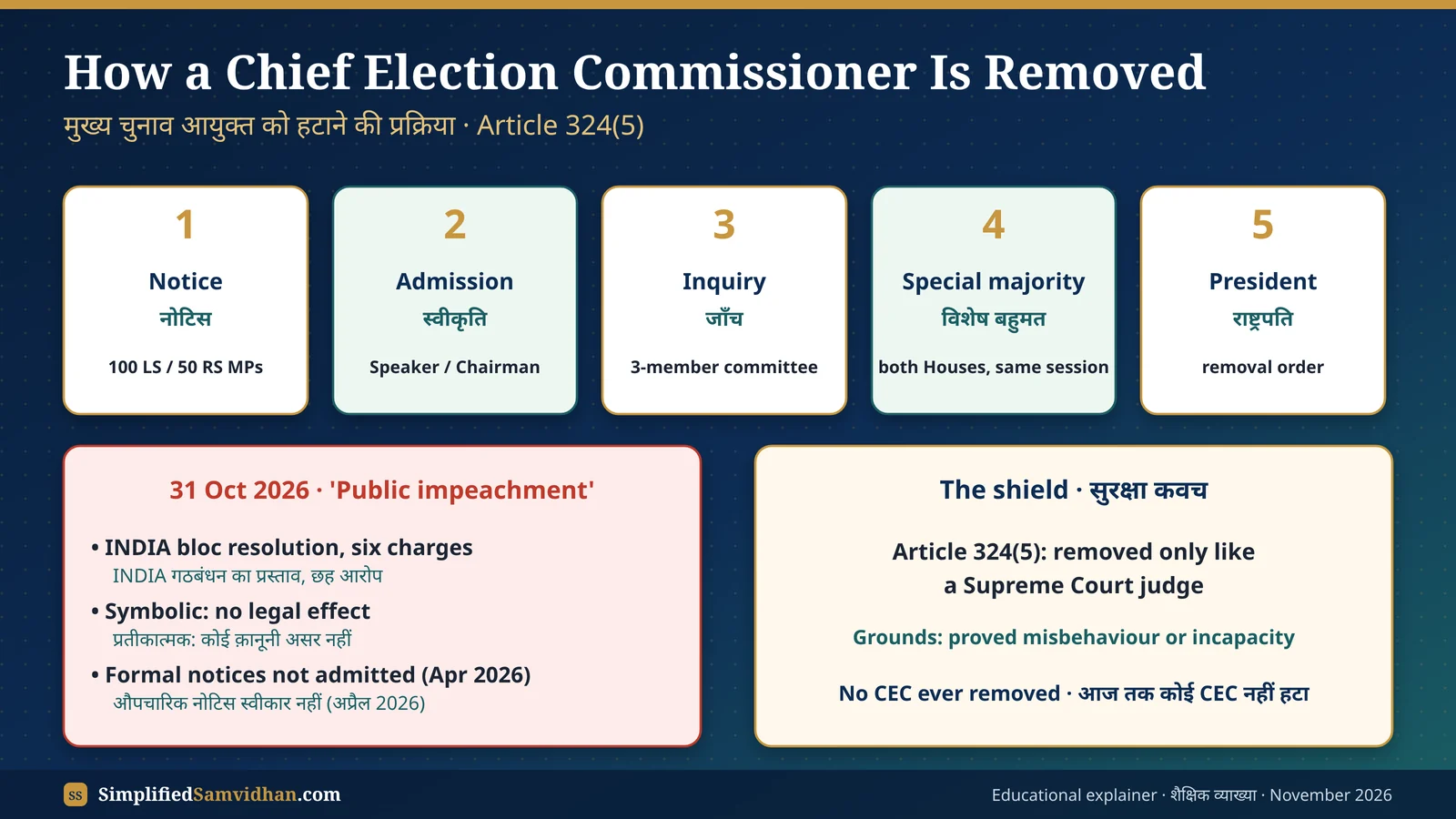
What happened
On Saturday, 31 October 2026, INDIA bloc parties held a "public impeachment" event in New Delhi. Congress president Mallikarjun Kharge moved a resolution seeking the removal of CEC Gyanesh Kumar, which the parties adopted. The resolution lists six charges. According to the opposition, these include large-scale deletion of voters during the Special Intensive Revision (SIR) of electoral rolls, acting in favour of the ruling party, and failing to keep the office independent. These are allegations; the Election Commission has rejected such claims in the past and none of them has been examined by any inquiry.
The event was the opposition's answer to an earlier setback. Formal removal notices against the CEC had been submitted in Parliament, but in April 2026 the Rajya Sabha Chairman and the Lok Sabha Speaker declined to admit them. Without admission there is no inquiry and no vote, so the opposition took the matter to a public platform.
At a GlanceCEC Removal: Key Facts
| Point | Fact |
|---|---|
| Current CEC | Gyanesh Kumar (in office since February 2025) |
| Opposition event | INDIA bloc 'public impeachment', 31 October 2026, six charges (allegations) |
| Formal notices | Not admitted by the Rajya Sabha Chairman and Lok Sabha Speaker, April 2026 |
| Constitutional protection | Article 324(5): removal only like a Supreme Court judge |
| Statute | Section 11, CEC and Other ECs (Appointment, Conditions of Service and Term of Office) Act, 2023 |
| Grounds | Proved misbehaviour or incapacity |
| Majority needed | Special majority in each House (Article 124(4)) |
| CECs ever removed | None |
The CEC runs elections in which the ruling party and the opposition both compete. If any government could sack him easily, he could never be fair. So the Constitution gives him the same shield as a Supreme Court judge: he can be removed only after a formal inquiry proves misconduct and both Houses of Parliament agree by a large majority. A rally or a resolution passed outside Parliament is a political message, not a legal step.
🏠 Everyday analogy
A cricket umpire cannot be changed in the middle of a match just because one team shouts at him. Only the board can remove him, and only after a proper hearing.
🇮🇳 Real Indian example
The 2026 resolution is like a team's press conference against the umpire: it can influence public opinion, but the umpire stays until the board acts.
ProcedureHow a Chief Election Commissioner Is Removed: Step by Step
- 1Notice of motion
At least 100 Lok Sabha MPs or 50 Rajya Sabha MPs sign a notice (Judges (Inquiry) Act, 1968).
- 2Admission
The Speaker or Chairman decides whether to admit it. If not admitted, the process ends there, as happened in April 2026.
- 3Inquiry committee
If admitted, a three-member committee is formed: a Supreme Court judge, a High Court Chief Justice and a distinguished jurist.
- 4Report
If the committee finds misbehaviour or incapacity proved, the motion is taken up; if not, it lapses.
- 5Special majority
Each House must pass it by a majority of its total membership and two-thirds of members present and voting, in the same session.
- 6President's order
The President then orders removal.
Official TextArticle 324(5) and Article 124(4): The Constitutional Text
Constitution of India, Article 324(5), provisos.
Provided that the Chief Election Commissioner shall not be removed from his office except in like manner and on the like grounds as a Judge of the Supreme Court and the conditions of service of the Chief Election Commissioner shall not be varied to his disadvantage after his appointment:
Provided further that any other Election Commissioner or a Regional Commissioner shall not be removed from office except on the recommendation of the Chief Election Commissioner.
Constitution of India, Article 124(4).
A Judge of the Supreme Court shall not be removed from his office except by an order of the President passed after an address by each House of Parliament supported by a majority of the total membership of that House and by a majority of not less than two-thirds of the members of that House present and voting has been presented to the President in the same session for such removal on the ground of proved misbehaviour or incapacity.
- The 2023 Act repeats this protection in Section 11(1) and replaced the 1991 Act on the CEC's service conditions.
- The Judges (Inquiry) Act, 1968 lays down the notice, admission and inquiry procedure used for judges and, by extension, for the CEC.
- Related: How the CEC is appointed and Immunity of Election Commissioners.
Both SidesOpposition's Case vs Government's Case
Opposition says
- Voter deletions in the SIR hurt genuine voters
- The 2023 Act gave the government a majority in the selection panel
- Public pressure is needed when notices are not admitted
- The CEC must answer to the people
Government and EC side say
- SIR removes dead, shifted and duplicate entries as the law requires
- Notices did not meet the test for admission
- A 'public impeachment' has no place in the Constitution
- Attacks on the EC damage trust in elections
UPSC CornerCEC Removal for UPSC Prelims and Mains
- Prelims: The CEC is removed in the same manner and on the same grounds as a Supreme Court judge (Article 324(5)).
- Prelims: Other Election Commissioners are removed on the recommendation of the CEC.
- Prelims: A removal notice needs 100 Lok Sabha or 50 Rajya Sabha signatures under the Judges (Inquiry) Act, 1968.
- Prelims: The CEC and Other ECs Act, 2023 governs appointment by a panel of the PM, a Union Minister and the Leader of Opposition.
- Mains (GS II): "Security of tenure is the backbone of the Election Commission's independence." Discuss with reference to the 2023 Act and recent demands for the removal of the CEC.
- Read more: Indian Election System hub.
Practice MCQTest Yourself: Can the CEC Be 'Impeached'?
With reference to the removal of the Chief Election Commissioner of India, consider the following statements: (1) He can be removed only in the manner and on the grounds applicable to a Judge of the Supreme Court. (2) Other Election Commissioners can be removed only on the recommendation of the CEC. (3) A resolution passed by opposition parties outside Parliament can start the removal inquiry. Which of the statements given above is/are correct?
Doubts ClearedFrequently Asked Questions
What is the 'public impeachment' of the CEC?
It was a symbolic event held by INDIA bloc parties on 31 October 2026, where a resolution seeking the removal of CEC Gyanesh Kumar was adopted. It has no legal effect.
How can a Chief Election Commissioner be removed?
Only like a Supreme Court judge: a notice by 100 Lok Sabha or 50 Rajya Sabha MPs, admission, an inquiry by a three-member committee, a special majority in both Houses in the same session, and then the President's order.
On what grounds can the CEC be removed?
Proved misbehaviour or incapacity.
Has any CEC ever been removed?
No. No Chief Election Commissioner of India has ever been removed from office.
Who can remove other Election Commissioners?
They can be removed on the recommendation of the Chief Election Commissioner, under the second proviso to Article 324(5).
Sources and further readingSources We Checked
Facts checked against the reports below on 1 November 2026. The six charges are the opposition's allegations and are reported as such; they have not been tested by any inquiry.
- National Herald: INDIA bloc holds 'public impeachment'; Kharge moves resolution against CEC
- Northeast Now: INDIA bloc raises six charges against CEC Gyanesh Kumar, seeks removal
- Deccan Herald: INDIA bloc to move impeachment motion against CEC Gyanesh Kumar
- News On AIR: Gyanesh Kumar assumes charge as new Chief Election Commissioner (20 Feb 2025)