India-Canada Relations 2026: First Migration and Mobility Dialogue and What It Means for Indians
On 26 October 2026 India and Canada held their first-ever Migration and Mobility Dialogue in New Delhi, on how students, skilled workers, professionals and business visitors move between the two countries. It comes three years after the worst rift in their history and just weeks before PM Modi's planned visit to Canada. Here is the full story: what was agreed, how ties broke and were repaired, the CEPA trade deal, and what Indian students should know.
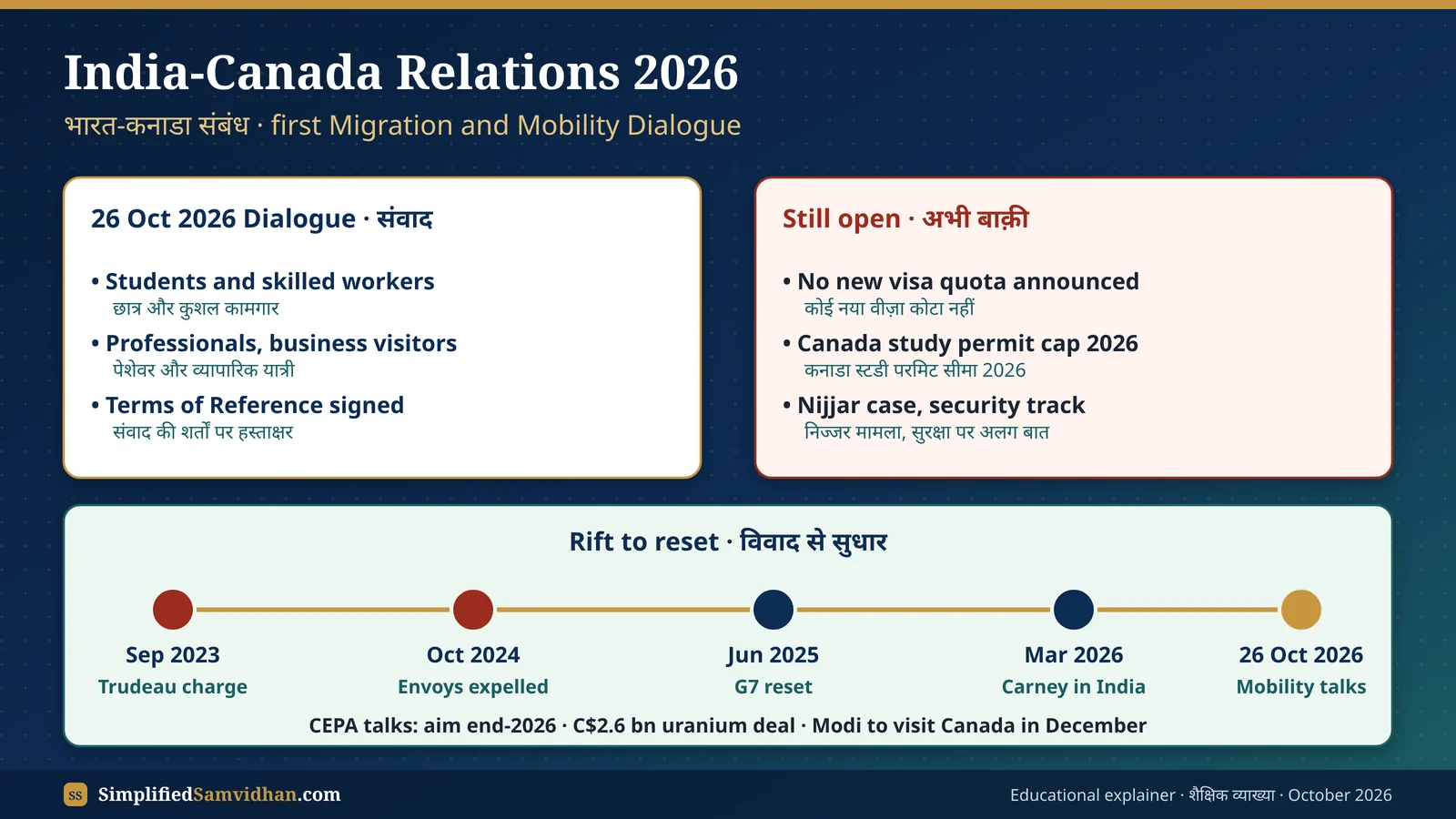
What happened on 26 October 2026
India and Canada held the inaugural India-Canada Migration and Mobility Dialogue in New Delhi on Monday, 26 October 2026. It was co-chaired by Sripriya Ranganathan, Secretary (Consular, Passport, Visa and Overseas Indian Affairs) in the Ministry of External Affairs, and Ted Gallivan, Deputy Minister of Immigration, Refugees and Citizenship Canada (IRCC). The talks covered easier movement of students, skilled workers, professionals and business visitors, and the two sides signed the Terms of Reference of the dialogue. The MEA called migration and mobility a key driver of future growth in ties.
No new visa rule or quota was announced. The dialogue is a regular channel for talks, not an agreement. It follows a Modi-Carney phone call on 13 October, in which both leaders agreed to conclude the CEPA trade deal at the earliest and to stay in touch ahead of PM Modi's visit to Canada in December 2026.
At a GlanceIndia-Canada Relations at a Glance: Key Facts 2026
| Point | Fact |
|---|---|
| New dialogue | First Migration and Mobility Dialogue, New Delhi, 26 October 2026 (MEA and IRCC) |
| Who moves | Students, skilled workers, professionals and business visitors |
| People | About 1.8 million people of Indian origin plus about 1 million NRIs live in Canada (MEA estimate) |
| Students | Canada is among the top study destinations for Indians, but its 2026 plan allows only about 408,000 study permits, about 155,000 for new arrivals |
| Trade deal | CEPA talks launched November 2025; both sides aim to finish in 2026 |
| Energy | Cameco to supply about 22 million pounds of uranium to India's Department of Atomic Energy, 2027-2035 (C$2.6 billion) |
| Envoys | Dinesh K. Patnaik (India in Ottawa) and Christopher Cooter (Canada in New Delhi), named 28 August 2025 |
| Next step | PM Modi's visit to Canada planned for December 2026 |
A dialogue is a fixed meeting table where officials of both countries sit regularly and solve problems. This one is about people: who gets a visa, how fast, how fake agents are stopped, and how Indian degrees and skills are recognised in Canada.
🏠 Everyday analogy
Think of two neighbours who had a big fight and stopped talking. Now they have set a fixed day every month to sit together and settle small matters, like whose children use which gate. The fight is not fully forgotten, but daily life gets easier.
🇮🇳 Real Indian example
A nursing student from Jalandhar or a software engineer from Hyderabad does not get a visa from this meeting directly, but complaints about long processing times, fake admission letters and job rules can now be raised at an official table.
HistoryIndia-Canada Relations Timeline: From CIRUS to the 2026 Reset
| Year | Event |
|---|---|
| 1947 | India and Canada establish diplomatic relations; both are Commonwealth members. |
| 1956-1960 | Canada helps India build the CIRUS research reactor at Trombay. |
| 1974 | After India's Pokhran test, Canada ends nuclear cooperation; ties stay cool for decades. |
| 23 Jun 1985 | Air India Flight 182 (Kanishka) is bombed by Khalistani extremists based in Canada; 329 people die. |
| 2010 | India-Canada Civil Nuclear Cooperation Agreement is signed (in force 2013). |
| Apr 2015 | PM Modi visits Ottawa, the first standalone PM visit in 42 years; Cameco uranium supply deal. |
| 18 Sep 2023 | PM Justin Trudeau alleges a link between Indian agents and the June 2023 killing of Hardeep Singh Nijjar; India rejects it. |
| 14 Oct 2024 | Both sides expel six diplomats each, including High Commissioners. |
| Jun 2025 | PM Mark Carney and PM Modi meet at the G7 in Kananaskis and agree to restore High Commissioners. |
| Nov 2025 | At the G20 in Johannesburg the two PMs launch talks for a Comprehensive Economic Partnership Agreement (CEPA). |
| 27 Feb-2 Mar 2026 | PM Carney visits India: CEPA Terms of Reference, C$2.6 billion uranium deal, energy and AI cooperation. |
| 13 Oct 2026 | Modi-Carney phone call: conclude CEPA at the earliest; Modi to visit Canada in December. |
| 26 Oct 2026 | First India-Canada Migration and Mobility Dialogue in New Delhi. |
Rift and ResetHow India-Canada Ties Broke in 2023-24 and Were Repaired in 2025-26
The rift (2023-2024)
- Trudeau's allegation in Parliament on 18 September 2023, which India called "absurd"
- India paused visas for Canadians for about two months in 2023
- Canada withdrew 41 diplomats from India in October 2023
- Six diplomats each expelled on 14 October 2024; trade talks frozen
The reset (2025-2026)
- Carney-Modi meeting at the G7, June 2025
- High Commissioners back, August-September 2025
- CEPA talks launched November 2025; Carney in India, March 2026
- Migration and Mobility Dialogue, October 2026; Modi to visit in December
How It WorksHow Visas, Students and Migration Work Between India and Canada
- 1Canada decides its own visas
Study permits, work permits and permanent residence are granted by IRCC under Canada's own law and yearly caps.
- 2India looks after its citizens abroad
The MEA handles passports, consular help and the welfare of Indians overseas; the Emigration Act, 1983 regulates recruiting agents.
- 3The dialogue
Officials meet regularly to discuss quotas, processing times, recognition of skills, fraud by agents and the return of irregular migrants.
- 4A future agreement
If talks go well, the two countries can sign a mobility agreement, as India has done with Germany, France, the UK and others.
- 5Trade link
The CEPA trade deal can add rules on short-term movement of professionals for services trade.
Canada alone decides who enters Canada, and India cannot order it to give more visas. What India can do is negotiate: ask for fair treatment, faster processing and protection of its students, and in return help Canada stop fraud and illegal migration.
Official TextArticle 51, Article 253 and the Union List: The Constitution and Foreign Relations
Constitution of India, Article 51. Promotion of international peace and security.
The State shall endeavour to (a) promote international peace and security; (b) maintain just and honourable relations between nations; (c) foster respect for international law and treaty obligations in the dealings of organised peoples with one another; and (d) encourage settlement of international disputes by arbitration.
Article 253. Legislation for giving effect to international agreements.
Notwithstanding anything in the foregoing provisions of this Chapter, Parliament has power to make any law for the whole or any part of the territory of India for implementing any treaty, agreement or convention with any other country or countries or any decision made at any international conference, association or other body.
- Article 73 gives the Union government power over subjects in the Union List, including Entry 10 (foreign affairs), Entry 14 (treaties and agreements), Entry 17 (citizenship and aliens) and Entry 19 (admission into and emigration from India; passports and visas).
- Article 253 lets Parliament make a law to carry out an international agreement, such as a future trade or mobility pact, if one is needed.
- Article 51 (Directive Principle) asks the State to keep just and honourable relations between nations and settle disputes peacefully, which is what a dialogue does.
Why It MattersIndia-Canada Reset: Gains vs Concerns
Gains for India
- A regular channel for students' and workers' problems
- Trade deal (CEPA) talks and uranium supply for nuclear power
- Canadian pension funds are among the large investors in Indian infrastructure
- A G7 partner on critical minerals, AI and clean energy
Concerns
- Canada's study permit cap means far fewer seats for Indian students
- High visa refusal rates and long processing times
- Fake agents and fake admissions still trap students
- Security issues and the Nijjar case are not resolved
UPSC CornerIndia-Canada Relations for UPSC Prelims and Mains
- Prelims: First Migration and Mobility Dialogue, New Delhi, 26 October 2026; Canada's capital is Ottawa; IRCC is Canada's immigration department.
- Prelims: CIRUS (Trombay) was built with Canadian help; Kanishka bombing, 23 June 1985; Civil Nuclear Cooperation Agreement, 2010.
- Prelims: Union List Entry 19 covers passports and visas; Entry 14 treaties; Article 253 for implementing laws.
- Mains (GS II): "Diaspora is both an asset and a challenge for India's foreign policy." Discuss with reference to India-Canada relations since 2023.
Practice MCQTest Yourself: India-Canada: First Migration and Mobility Dialogue
With reference to India-Canada relations, consider the following statements: (1) The first India-Canada Migration and Mobility Dialogue was held in New Delhi in October 2026. (2) The dialogue fixed a new annual quota of study permits for Indian students. (3) Negotiations for an India-Canada CEPA were launched at the G20 summit in Johannesburg. Which of the statements given above is/are correct?
Doubts ClearedFrequently Asked Questions
What is the India-Canada Migration and Mobility Dialogue?
It is a new official forum between India's Ministry of External Affairs and Canada's immigration department (IRCC). The first meeting was held in New Delhi on 26 October 2026 and covered students, skilled workers, professionals and business visitors.
Will Indian students get Canadian visas more easily now?
Not automatically. No new visa rule or quota was announced. Canada still decides study permits under its 2026 cap of about 408,000 permits, but India can now raise processing delays, refusals and fraud at a regular official table.
Why did India-Canada relations break down?
In September 2023 PM Justin Trudeau alleged a link between Indian agents and the killing of Hardeep Singh Nijjar. India rejected it as absurd. In October 2024 both sides expelled six diplomats each, including High Commissioners.
Are India-Canada relations normal now?
They are much better. Since PM Mark Carney took office, High Commissioners have returned (2025), CEPA trade talks began, Carney visited India in March 2026 and PM Modi is expected in Canada in December 2026. Security issues are discussed on a separate track.
What is India-Canada CEPA?
A Comprehensive Economic Partnership Agreement covering goods, services and investment. Talks were launched in November 2025 and both governments aim to finish them in 2026.
Sources and further readingSources We Checked
Facts checked against the reports below on 27 October 2026. Diaspora and student numbers are estimates reported by the governments and media. The Nijjar case is before Canadian courts; this page only reports each government's stated position.
- IANS: India and Canada hold inaugural Migration and Mobility Dialogue in New Delhi (26 Oct 2026)
- The Tribune: India, Canada hold inaugural migration and mobility dialogue in New Delhi (26 Oct 2026)
- DD India: India, Canada hold inaugural Migration and Mobility Dialogue in Delhi (Oct 2026)
- Business Today: PM Modi after phone call with Canadian PM Mark Carney (14 Oct 2026)
- The Wire: Modi, Carney reaffirm commitment to conclude CEPA negotiations at the earliest opportunity
- Prime Minister of Canada: Factsheet on deliverables of PM Carney's visit to India (2 Mar 2026)
- The Tribune: India, Canada ink $2.6 bn uranium supply pact (Mar 2026)
- The Diplomat: Canada-India relations stabilize with PM Carney's visit (Mar 2026)
- Gulf News: Canada and India name new top envoys as they restore relations (28 Aug 2025)
- Ministry of External Affairs: Brief on India-Canada bilateral relations (April 2026)
- The Federal: Canada cuts 2026 study permits; Indian students most affected