Court Fee vs Tax: Why the Supreme Court Is Examining Kerala's Uncapped Court Fee
To file a money suit in a civil court, you first pay a court fee, usually a percentage of the amount you claim. Kerala raised its court fees steeply in 2025 and kept many of them as a percentage with no upper limit. In October 2026 the Supreme Court agreed to examine one sharp question: when a fee has no ceiling, does it stop being a fee and become a tax? Here is the case, the law, and why it matters for anyone who goes to court.
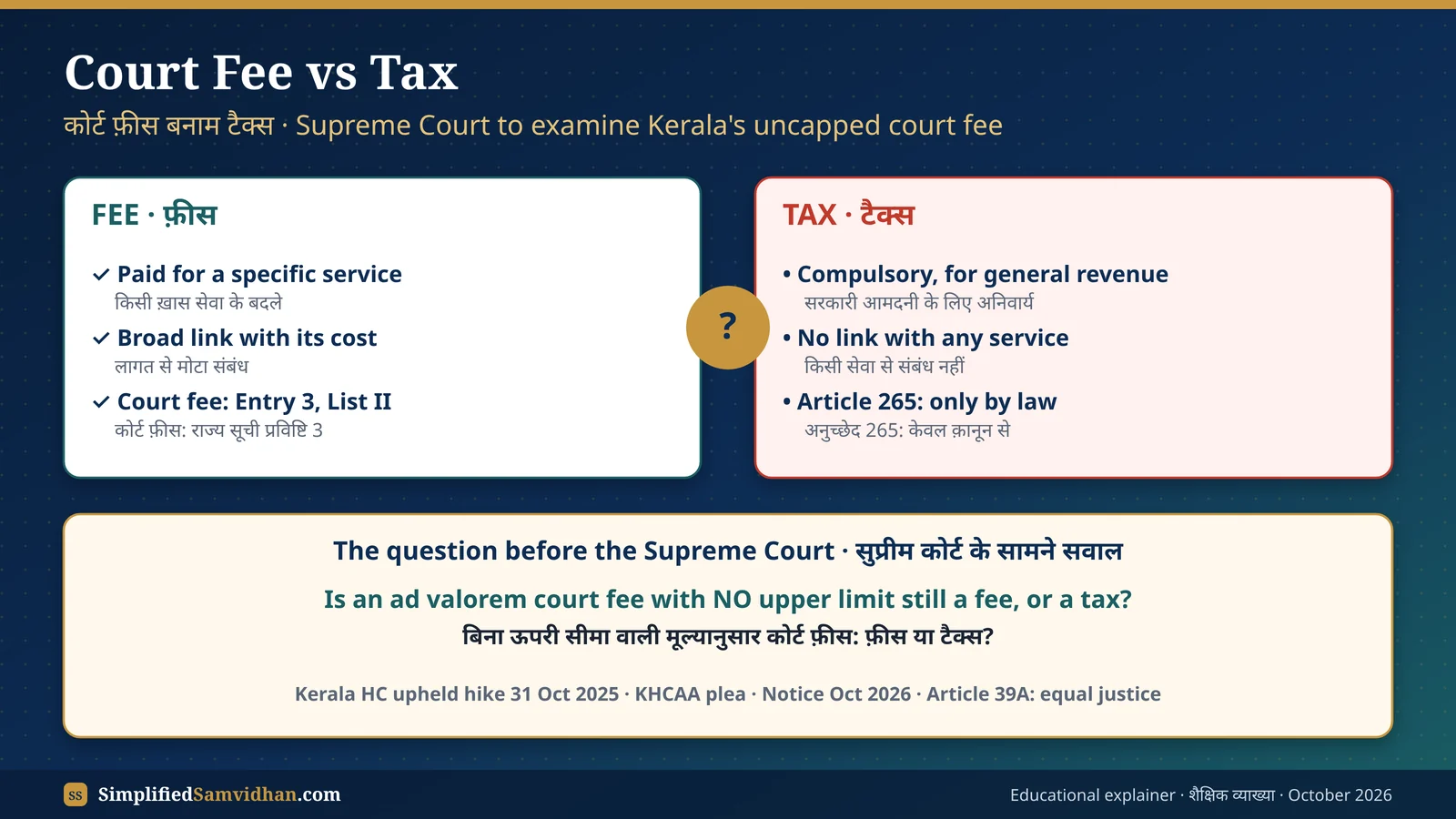
What the Supreme Court did in October 2026
A bench of Chief Justice Surya Kant and Justice Joymalya Bagchi issued notice on a special leave petition by the Kerala High Court Advocates' Association (KHCAA), reported on 16 October 2026. The petition challenges the Kerala High Court's judgment of 31 October 2025, which upheld the steep revision of court fees made through the Kerala Finance Act, 2025, an amendment to the Kerala Court Fees and Suits Valuation Act, 1959.
The Court limited the notice to one question: is an ad valorem court fee without any upper limit valid, or does it take the character of a tax? Senior Advocate K. Parameshwar pointed out that the Supreme Court's own rules cap ad valorem fees. The plea also questions Section 73A, which exempts the State Government from paying court fees. The Chief Justice reportedly remarked that the Court may consider directions to all States. The case is pending; no final ruling has been given.
The CaseKerala Court Fee Hike: From the High Court to the Supreme Court
- 1Early 2025
Kerala Finance Act, 2025 revises court fees under the 1959 Act; the State says fixed fees were not revised for over two decades.
- 2Challenge
KHCAA calls the hike arbitrary; it says increases range from 400 to 9,900 percent and many fees have no ceiling.
- 331 Oct 2025
Kerala High Court upholds the revision, citing inflation and the rising cost of running courts.
- 4Oct 2026
Supreme Court issues notice, limited to whether an uncapped ad valorem fee is valid.
- 5Next
The State replies; the Court may decide the question for Kerala or set a rule for all States.
There are two kinds of court fee. A fixed fee is a flat amount, like ₹50 for an application. An ad valorem fee is a percentage of the value of what you claim. If the percentage has no ceiling, a person suing for ₹10 crore pays a hundred times more than a person suing for ₹10 lakh, though the judge, courtroom and staff are the same. The question is whether such a charge still pays for a service or simply raises revenue.
🏠 Everyday analogy
A parking fee pays for the parking. If the mall charged 2 percent of the price of your car, with no limit, the owner of a luxury car would pay lakhs for the same parking slot. At some point it is no longer a parking fee but a tax on owning a costly car.
🇮🇳 Real Indian example
A trader in Kochi who wants to recover ₹5 crore in unpaid bills must pay the full percentage fee on ₹5 crore before the case is even registered. If the fee is too high, they may simply give up the claim.
Official TextArticle 39A, Article 265 and Entry 3 of the State List
Constitution of India, Article 39A. Equal justice and free legal aid.
The State shall secure that the operation of the legal system promotes justice, on a basis of equal opportunity, and shall, in particular, provide free legal aid, by suitable legislation or schemes or in any other way, to ensure that opportunities for securing justice are not denied to any citizen by reason of economic or other disabilities.
Article 265. Taxes not to be imposed save by authority of law.
No tax shall be levied or collected except by authority of law.
Seventh Schedule, List II (State List), Entry 3.
Officers and servants of the High Court; procedure in rent and revenue courts; fees taken in all courts except the Supreme Court.
Entry 3 of the State List lets each State fix the fees taken in its courts (the Supreme Court's fees fall under the Union List). Article 265 says a tax needs the authority of law, and a tax and a fee are treated differently: a fee must be linked to a service. Article 39A, a Directive Principle added by the 42nd Amendment (1976), tells the State that no one should be denied justice because they are poor.
Fee vs TaxCourt Fee vs Tax: How Indian Courts Tell Them Apart
Fee
- Paid for a specific service
- Broad link with the cost of that service
- Money goes towards that service
- Example: court fee, licence fee
Tax
- Compulsory payment for general revenue
- No link with any service to the payer
- Money goes to the general treasury
- Example: income tax, GST
| Case | What the Supreme Court said |
|---|---|
| Shirur Mutt (1954) | Explained the difference: a fee is a charge for a special service; a tax is for general public purposes. |
| Zenith Lamp (1973) | A Constitution Bench held that court fees are fees, not taxes; total fees must have a link with the cost of administering civil justice. |
| P.M. Ashwathanarayana Setty (1988) | Upheld ad valorem court fees without a ceiling in Karnataka and Rajasthan; the link with cost need only be broad, not exact. |
| Anita Kushwaha (2016) | Access to justice is a fundamental right under Articles 14 and 21. |
For LitigantsWhat a Court Fee Hike Means for Ordinary People
- 1Check the fee first
Court fee depends on the valuation of the suit under your State's Court Fees and Suits Valuation Act.
- 2Free legal aid
Under the Legal Services Authorities Act, 1987, women, children, SC/ST persons, workers, victims of disaster and people below the income limit get free lawyers.
- 3Pauper suit
Order XXXIII of the Civil Procedure Code lets a person who cannot pay the court fee sue as an "indigent person".
- 4Lok Adalat refund
If a pending court case is settled in a Lok Adalat, the court fee paid is refunded.
- 5Ask the DLSA
The District Legal Services Authority in every district court complex helps with these steps.
UPSC CornerCourt Fees, Article 39A and Access to Justice for UPSC
- Prelims fact: Fees taken in all courts except the Supreme Court are in Entry 3 of List II (State List); Supreme Court fees are in Entry 77 of List I.
- Prelims fact: Article 39A (equal justice and free legal aid) was inserted by the 42nd Constitutional Amendment Act, 1976.
- Prelims fact: Article 265 says no tax shall be levied or collected except by authority of law.
- Prelims fact: NALSA was constituted under the Legal Services Authorities Act, 1987; the Chief Justice of India is its Patron-in-Chief.
- Prelims fact: Under Section 21 of the 1987 Act, an award of a Lok Adalat is final and no appeal lies against it.
- Mains (150 words): "Court fees are the price of a public service, not a source of revenue." Discuss with reference to ad valorem court fees and Article 39A.
Practice MCQTest Yourself: Court Fee vs Tax: Kerala Case in Supreme Court
With reference to court fees in India, consider the following statements: (1) Fees taken in all courts except the Supreme Court are a subject of the State List. (2) Article 39A, providing for equal justice and free legal aid, was part of the original Constitution of 1950. (3) In the Zenith Lamp case (1973), the Supreme Court held that court fees are in the nature of fees and not taxes. Which of the statements given above is/are correct?
Doubts ClearedFrequently Asked Questions
Why is the Supreme Court examining Kerala's court fee?
On a plea by the Kerala High Court Advocates' Association, the Supreme Court issued notice in October 2026 on a limited question: whether an ad valorem court fee with no upper limit is valid, or whether it becomes a tax. The plea challenges the Kerala High Court's 31 October 2025 judgment upholding the 2025 hike.
What is an ad valorem court fee?
It is a court fee charged as a percentage of the value of the claim or property in the suit, instead of a fixed amount. For example, a money suit may attract a fee that rises with the amount claimed.
What is the difference between a fee and a tax?
A fee is paid for a specific service and must have a broad link with its cost. A tax is a compulsory payment for general public purposes with no direct service in return. Courts have held that court fees are fees, not taxes.
Can a poor person file a case without paying court fee?
Yes. Order XXXIII of the Code of Civil Procedure allows a suit by an indigent person without paying the court fee upfront, and the Legal Services Authorities Act, 1987 provides free legal aid to eligible people through NALSA, State and District Legal Services Authorities.
Has the Supreme Court struck down Kerala's court fee hike?
No. As of 21 October 2026 the Court has only issued notice. The Kerala High Court's judgment upholding the hike stands until the Supreme Court decides.
Sources and further readingSources We Checked
News facts on this page were checked against the reports below on 21 October 2026. The case is pending and may change. Legal text is quoted from the Constitution of India.
- LiveLaw: 'Is ad valorem court fee without cap valid?': Supreme Court to examine Kerala court fee hike on KHCAA plea
- Bar & Bench: Is uncapped ad valorem court fee a form of tax? Supreme Court to examine
- Business Standard: Supreme Court to examine if court fees without upper limit amount to tax
- Bar & Bench: Kerala High Court rejects plea challenging hike in court fees (31 October 2025)
- P.M. Ashwathanarayana Setty v. State of Karnataka (1988), Indian Kanoon
- Constitution of India (Legislative Department)