Stampede Law in India: Kolkata Pandal Tragedy and the Crowd Management Rules Organisers Must Follow
On Maha Saptami night, a sudden announcement and heavy rain turned a packed Durga Puja pandal in north Kolkata into a death trap. Nineteen people died. Every year India loses lives in temples, rallies, stations and stadiums in the same way. Is a stampede just bad luck, or is someone legally responsible? Here is the law, in simple words.
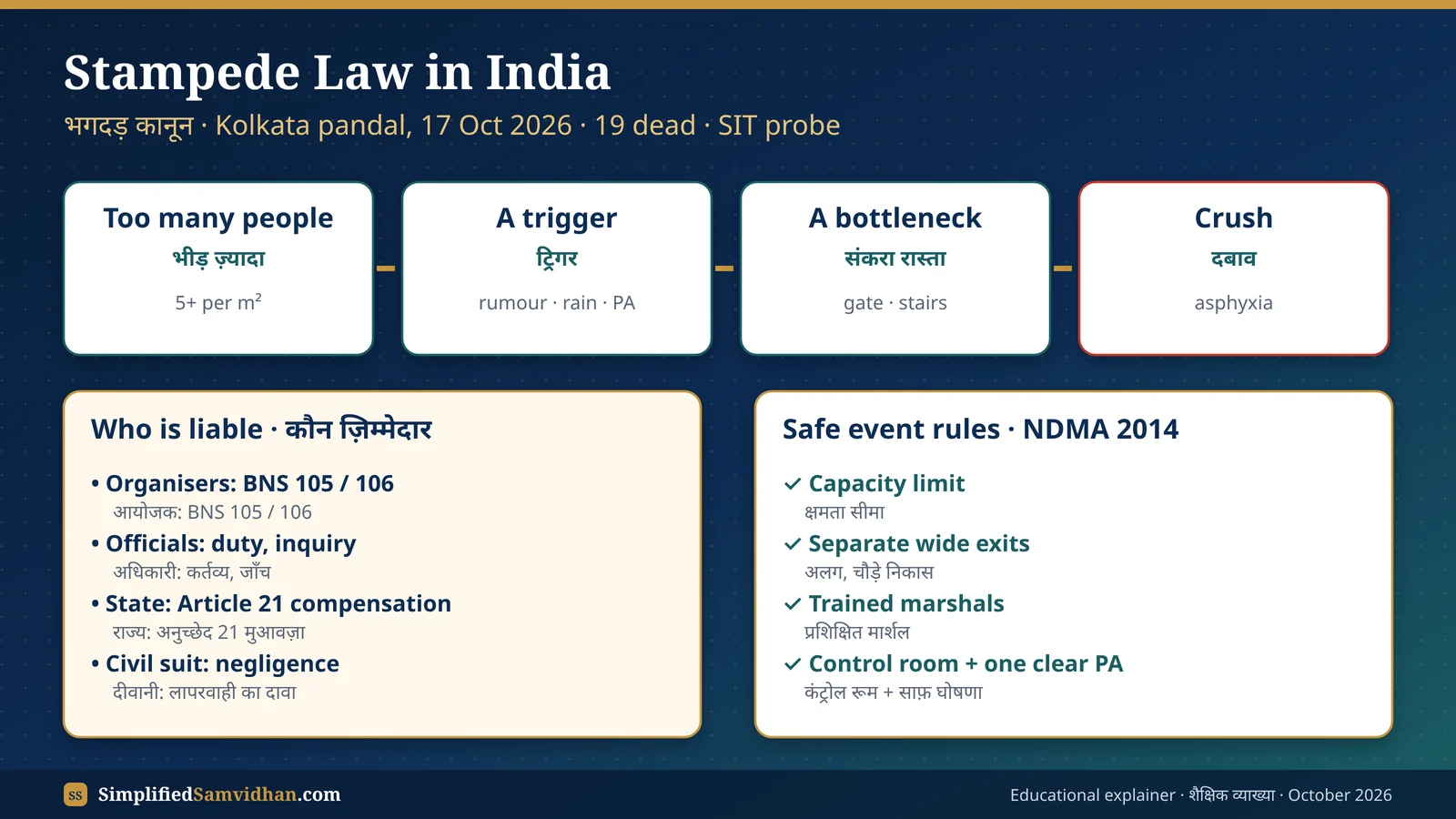
What happened in Kolkata on 17 October 2026
On 17 October 2026 (Maha Saptami), a stampede broke out at the Chorbagan Sarbojanin Durga Puja pandal in north Kolkata. Nineteen people died, most of them on the spot, and more than 20 were injured. The FIR at Girish Park police station says sudden heavy rain, poor crowd control and an announcement warning that the pandal could collapse set off the panic.
The FIR invokes Sections 105 (culpable homicide not amounting to murder), 110 (attempt to commit culpable homicide) and 3(5) (common intention) of the Bharatiya Nyaya Sanhita. Seven people, including organising committee office-bearers, private security staff and a contractor, have been arrested. The West Bengal government has formed a Special Investigation Team, to be headed by a sitting Calcutta High Court judge, and announced ₹25 lakh ex-gratia and a government job for each victim's family and ₹5 lakh for each injured person.
The ScienceWhy Stampedes Happen: Crowd Density, Panic and Bottlenecks
- 1Too many people
When more than about 5 people stand in one square metre, nobody can move freely; the crowd starts to behave like a liquid.
- 2A trigger
A rumour, an announcement, rain, a fallen barricade or a VIP arrival makes everyone move at once.
- 3A bottleneck
A narrow gate, a staircase or a dead end blocks the flow, so pressure builds from behind.
- 4Crush
Most victims die of compressive asphyxia, unable to breathe, not of being trampled.
- 5Delay in help
Without clear exits, ambulances and control rooms, minutes of confusion cost lives.
A stampede is rarely caused by "a mad crowd". It is a design and planning failure. Organisers decide how many people enter, how wide the gates are, and what the loudspeaker says. That is why the law looks at the people who planned the event, not at the frightened public.
🏠 Everyday analogy
Pour water into a funnel too fast and it overflows, however good the water is. A pandal with one narrow exit is a funnel; the only fix is to control how fast people pour in.
🇮🇳 Real Indian example
At a crowded railway platform in Patna, a last-minute platform change announcement makes thousands rush to one footbridge. The danger came from the announcement and the bridge, not from the passengers.
Official TextArticle 21 and BNS Section 106: The Law That Makes Someone Liable for a Stampede
Constitution of India, Article 21. Protection of life and personal liberty.
No person shall be deprived of his life or personal liberty except according to procedure established by law.
Bharatiya Nyaya Sanhita, 2023, Section 106(1). Causing death by negligence.
Whoever causes death of any person by doing any rash or negligent act not amounting to culpable homicide, shall be punished with imprisonment of either description for a term which may extend to five years, and shall also be liable to fine.
Article 21 protects every person's life, and the Supreme Court has read it to include a duty on the State to keep public places safe. If officials fail in that duty, courts can order compensation from the State (the public-law remedy recognised in Nilabati Behera v State of Orissa, 1993).
Section 106(1) BNS (old IPC 304A) punishes death caused by a rash or negligent act with up to 5 years in jail. If the police think the organisers knew their acts were likely to cause death, they may use Section 105 (culpable homicide not amounting to murder), which carries a much heavier punishment. In the Kolkata FIR the police chose Section 105.
LiabilityWho Is Liable for a Stampede in India: Organisers, Officials and the State
| Who | What law | What can happen |
|---|---|---|
| Organisers and their security agency | BNS 105 / 106 / 3(5); permission conditions | Arrest, trial, jail and fine; cancellation of future permission |
| Contractors (pandal, barricades, lighting) | BNS 106; building and fire rules | Criminal case if unsafe structure or exits |
| Police and local officials | Departmental rules; BNS if negligence is gross | Suspension, inquiry, prosecution in serious cases |
| The State | Article 21 (public law compensation) | Ex-gratia; courts can order further compensation |
| Everyone above | Civil law of negligence (tort) | Families can sue for damages in civil court |
Think of three layers: the organiser who invited the crowd, the official who gave the permission and was meant to check it, and the State that must protect life. Criminal law punishes the guilty person; Article 21 and civil law make sure the victim's family is paid.
The RulesCrowd Management Rules in India: Disaster Management Act and the NDMA Guide
- Disaster Management Act, 2005: sets up the NDMA (chaired by the Prime Minister), State authorities (chaired by the Chief Minister) and District authorities (chaired by the Collector or District Magistrate), who must plan for local disasters, including crowd disasters.
- NDMA guide on Managing Crowds at Events and Venues of Mass Gathering (2014): asks organisers to estimate crowd size, plan separate entry and exit routes, avoid dead ends, use trained marshals, set up a control room with CCTV and public address, and keep ambulance routes open.
- Local permissions: police, municipal and fire department approvals for pandals and venues come with conditions on capacity, exits and fire safety. Breaking them is evidence of negligence.
- Communication: one clear, calm voice on the loudspeaker. Panic-causing announcements, like the one reported in Kolkata, are the most common trigger.
What usually goes wrong
- No head count or crowd estimate
- Single narrow gate for entry and exit
- Untrained private guards
- Confusing announcements
What the NDMA guide asks for
- Capacity limit and timed entry
- Separate, wide, marked exits
- Trained marshals and police coordination
- Control room, CCTV and one clear PA voice
Past TragediesMajor Stampedes in India 2024-2026 and What Courts and Probes Said
| Event | Date | Deaths | What followed |
|---|---|---|---|
| Hathras satsang, Uttar Pradesh | 2 Jul 2024 | 121 | SIT blamed organisers; judicial commission |
| Maha Kumbh, Prayagraj | 29 Jan 2025 | 30 (official) | Judicial commission |
| New Delhi railway station | 15 Feb 2025 | 18 | High-level railway inquiry |
| Chinnaswamy stadium, Bengaluru | 4 Jun 2025 | 11 | Magisterial probe, arrests, Karnataka High Court case |
| Karur rally, Tamil Nadu | 27 Sep 2025 | 41 | Madras High Court ordered an SIT; later CBI probe on Supreme Court orders |
| Chorbagan pandal, Kolkata | 17 Oct 2026 | 19 | SIT under a sitting High Court judge sought; 7 arrested |
UPSC CornerStampede and Crowd Management for UPSC Prelims and Mains
- Prelims fact: The NDMA is chaired by the Prime Minister under the Disaster Management Act, 2005; State authorities by the Chief Minister.
- Prelims fact: Section 106 BNS (causing death by negligence) replaced Section 304A IPC; maximum 5 years' imprisonment.
- Prelims fact: Section 105 BNS (culpable homicide not amounting to murder) replaced Section 304 IPC.
- Prelims fact: Public-law compensation for violation of Article 21 was recognised in Nilabati Behera v State of Orissa (1993).
- Prelims fact: The NDMA guide on Managing Crowds at Events and Venues of Mass Gathering was issued in 2014.
- Mains (250 words): "Stampedes in India are man-made disasters." Examine the legal and institutional gaps in crowd management and suggest reforms.
Practice MCQTest Yourself: Stampede Law and Crowd Safety
Consider the following statements about the legal framework on stampedes in India: (1) Causing death by a rash or negligent act is punishable under Section 106 of the Bharatiya Nyaya Sanhita, 2023. (2) The National Disaster Management Authority is chaired by the Union Home Minister. (3) Courts can award compensation against the State for violation of the right to life under Article 21. Which of the statements given above is/are correct?
Doubts ClearedFrequently Asked Questions
What happened at the Kolkata Durga Puja pandal?
On 17 October 2026, Maha Saptami, a stampede at the Chorbagan Sarbojanin Durga Puja pandal in north Kolkata killed 19 people and injured more than 20. The FIR blames sudden heavy rain, poor crowd control and an announcement warning that the pandal could collapse.
Who is legally responsible for a stampede?
The organisers and their security agency face criminal cases under the Bharatiya Nyaya Sanhita (Sections 105 or 106). Officials who failed in their duty can face departmental action or prosecution, and the State can be ordered to pay compensation under Article 21.
What is the punishment for causing death by negligence?
Under Section 106(1) of the Bharatiya Nyaya Sanhita, up to five years' imprisonment and fine. If the act was done with knowledge that it was likely to cause death, Section 105 (culpable homicide not amounting to murder) can apply, with a heavier punishment.
Is there a law on crowd management in India?
There is no single crowd safety law. The Disaster Management Act, 2005 makes national, State and district authorities responsible for disaster planning, and the NDMA's 2014 guide on managing crowds at mass gatherings lays down detailed but advisory rules. Local police, municipal and fire permissions add conditions.
What compensation did the victims get?
The West Bengal government announced ₹25 lakh ex-gratia and a government job for the next of kin of each person who died, and ₹5 lakh for each injured person. Families can also seek compensation in court.
Sources and further readingSources We Checked
News facts on this page were checked against the reports below on 19 October 2026. The death toll and the investigation may change; the SIT's findings are awaited. Legal text is quoted from the Constitution of India and the Bharatiya Nyaya Sanhita, 2023.
- ANI: Kolkata pandal stampede: Bengal govt forms SIT, announces Rs 25 lakh ex-gratia, job for victims' kin
- ThePrint: Kolkata pandal stampede FIR blames sudden heavy rain, poor crowd control and a warning that sparked panic
- The Week: Chorbagan Durga Puja stampede and the lessons of the 2015 Desh Priya Park incident
- NDMA: Managing Crowds at Events and Venues of Mass Gathering (guide, 2014)
- Bharatiya Nyaya Sanhita, 2023 (India Code)
- Constitution of India (Legislative Department)