Rape Case Cannot Be Quashed Just Because of a Compromise: Supreme Court
Can a rape case end because the accused and the victim say they have "settled"? In a judgment reported on 29-30 October 2026, the Supreme Court said no, not on that ground alone. It set aside a Madhya Pradesh High Court order that had quashed a rape case after a settlement, and sent the case back to trial. Here is what the Court held, how quashing and compounding work under the new criminal laws, and what rights a survivor has.
What the Supreme Court held
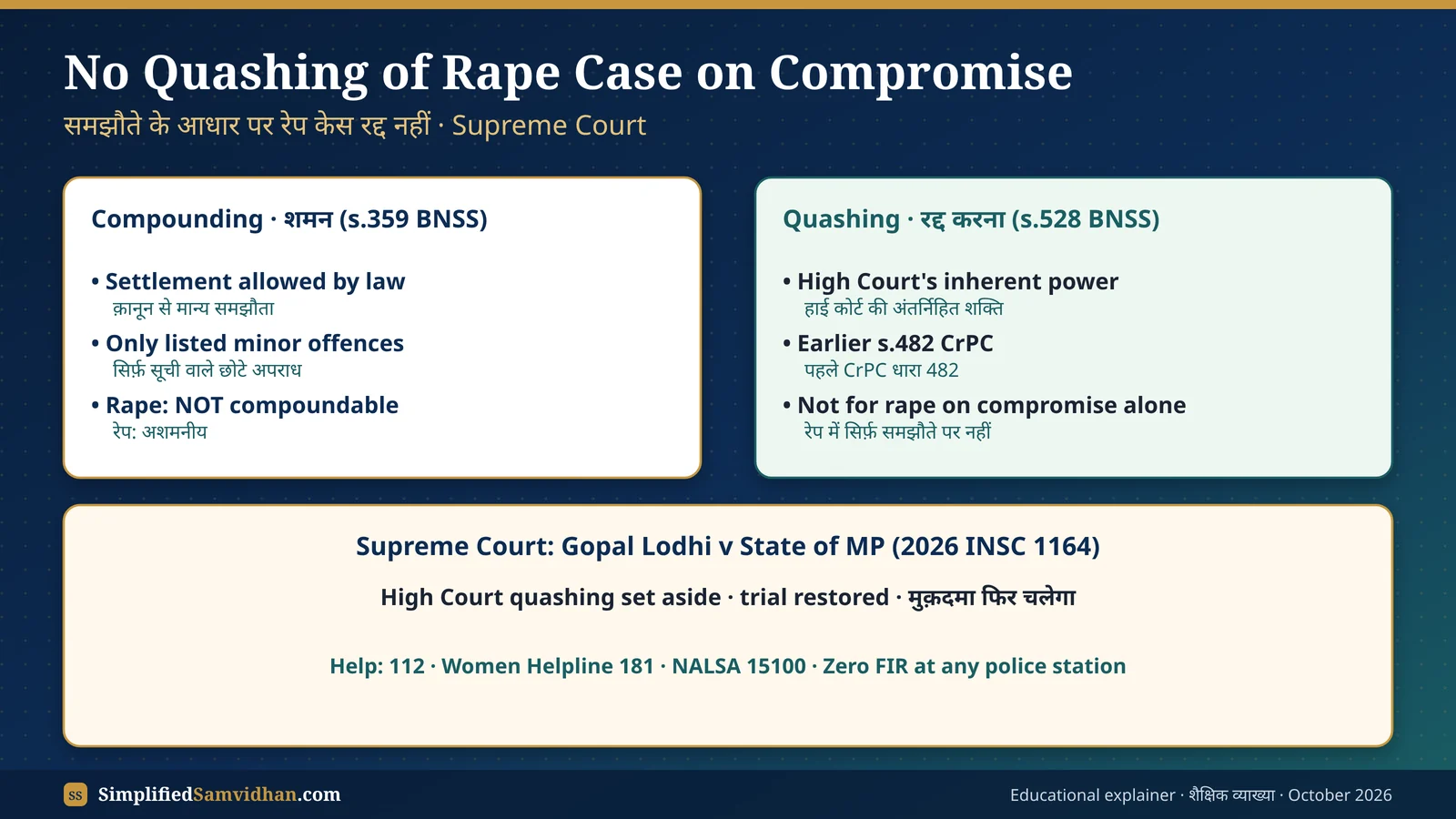
In Gopal Lodhi v State of Madhya Pradesh (2026 INSC 1164), a bench of Justices J.B. Pardiwala and K. Vinod Chandran set aside an order of the Madhya Pradesh High Court that had quashed a rape case because the accused and the complainant had reached a compromise. The Court restored the case for trial.
The Court said that quashing a case of a serious, non-compoundable offence like rape solely on the basis of a compromise goes beyond the High Court's inherent power (Section 482 CrPC, now Section 528 BNSS) and gets around the law on compounding (Section 320 CrPC, now Section 359 BNSS). It also voiced concern that easy quashing could encourage false complaints made with the hope of a later "settlement". Reports say the Court noted that the victim in this case had been pressured into the compromise.
At a GlanceRape Case and Compromise: Key Facts
| Point | Fact |
|---|---|
| Case | Gopal Lodhi v State of Madhya Pradesh, 2026 INSC 1164 |
| Bench | Justices J.B. Pardiwala and K. Vinod Chandran |
| What the High Court did | Quashed a rape case after the accused and complainant settled |
| What the Supreme Court did | Set aside the High Court order; trial to go on |
| Core point | A rape case cannot be quashed solely on compromise |
| Law on rape | Section 64 BNS (earlier Section 376 IPC): non-compoundable |
| Quashing power | Section 528 BNSS (earlier Section 482 CrPC) |
| Earlier rulings | Gian Singh (2012); Madhukar (2025): only truly exceptional cases |
Some crimes, like a small quarrel or simple hurt, are seen mainly as a wrong to one person, so the law lets the two sides compound (settle) them. Rape is treated as a crime against society as a whole. That is why the law does not allow it to be settled, and why courts are careful that money or pressure do not decide such cases.
🏠 Everyday analogy
If two neighbours fight over a parking spot, they can shake hands and end it. But if someone sets fire to a building, the owner cannot "settle" and stop the police case, because everyone in the area was put in danger.
🇮🇳 Real Indian example
In many villages and small towns, survivors and their families face pressure from panchayats or relatives to "compromise". This ruling means such a deal by itself will not end the case in the High Court.
How It WorksQuashing vs Compounding: How Criminal Cases End Early
Compounding (Section 359 BNSS)
- Victim and accused settle
- Only for offences listed as compoundable
- Some need court's permission
- Rape is not compoundable
Quashing (Section 528 BNSS)
- High Court ends a case using inherent power
- To prevent abuse of process or secure justice
- Used for mostly private disputes
- Not for heinous crimes merely on settlement
In Gian Singh v State of Punjab (2012) the Supreme Court said High Courts may quash cases on settlement in mainly private disputes (commercial, matrimonial, property), but not heinous offences like murder, rape or dacoity. In Madhukar v State of Maharashtra (2025) it allowed quashing of a rape case only in a truly exceptional situation. The 2026 ruling makes clear that a compromise alone is never enough.
Official TextSection 528 BNSS: The High Court's Inherent Power
Bharatiya Nagarik Suraksha Sanhita, 2023, Section 528 (earlier Section 482 CrPC). Saving of inherent powers of High Court.
Nothing in this Sanhita shall be deemed to limit or affect the inherent powers of the High Court to make such orders as may be necessary to give effect to any order under this Sanhita, or to prevent abuse of the process of any Court or otherwise to secure the ends of justice.
- Article 21: a survivor's right to dignity and a fair trial is part of the right to life.
- Article 15(3) allows special provisions for women; fast-track courts and special procedures for sexual offences flow from this idea.
- Section 72 BNS (earlier Section 228A IPC) makes it a crime to disclose a rape survivor's identity.
- Section 396 BNSS (earlier Section 357A CrPC) provides for victim compensation schemes run by legal services authorities.
Survivor's RightsRights of a Survivor and Where to Get Help
- 1Emergency help
Call 112 (emergency) or 181 (Women Helpline).
- 2FIR anywhere
An FIR can be lodged at any police station (Zero FIR); a woman officer should record the statement.
- 3Free medical care
All hospitals, public and private, must give free first aid and treatment.
- 4Free legal aid
Contact the District Legal Services Authority or NALSA helpline 15100 for a free lawyer and compensation.
- 5No pressure to settle
A compromise cannot by itself end a rape case; report any threats to the police or the court.
UPSC CornerQuashing and Compromise for UPSC and Judiciary Exams
- Prelims: Section 528 BNSS = inherent powers of the High Court (earlier Section 482 CrPC); Section 359 BNSS = compounding (earlier Section 320 CrPC).
- Prelims: Rape is punishable under Section 64 BNS and is non-compoundable.
- Prelims: Gian Singh v State of Punjab (2012) drew the line between private disputes and heinous offences for quashing on settlement.
- Prelims: Disclosure of a survivor's identity is an offence under Section 72 BNS.
- Mains (GS II): "Allowing compromise in sexual offences can turn justice into a bargain." Discuss with reference to the Supreme Court's October 2026 ruling.
Practice MCQTest Yourself: No Quashing of Rape Case on Compromise
With reference to the Supreme Court's October 2026 ruling on quashing of rape cases, consider the following statements: (1) Rape is a compoundable offence under the Bharatiya Nagarik Suraksha Sanhita. (2) The inherent power of the High Court is now found in Section 528 of the BNSS. (3) A rape case cannot be quashed solely because the accused and the victim have settled. Which of the statements given above is/are correct?
Doubts ClearedFrequently Asked Questions
Can a rape case be closed if the victim and accused compromise?
Not on that ground alone. Rape is non-compoundable, and the Supreme Court has held that a High Court cannot quash a rape case solely because of a settlement.
What did the Supreme Court decide in Gopal Lodhi v State of Madhya Pradesh?
It set aside a Madhya Pradesh High Court order that had quashed a rape case after a compromise and restored the trial (2026 INSC 1164).
What is the difference between compounding and quashing?
Compounding is a settlement allowed by law for listed minor offences (Section 359 BNSS). Quashing is the High Court ending a case using its inherent power (Section 528 BNSS) to prevent abuse of process or secure justice.
Is there any situation where a rape case can be quashed after settlement?
In Madhukar v State of Maharashtra (2025) the Court allowed it only in a truly exceptional situation. The 2026 ruling stresses that a compromise by itself is never enough.
Where can a survivor get help?
Call 112 or the Women Helpline 181, file an FIR (Zero FIR is allowed at any police station), get free treatment at any hospital, and contact NALSA (15100) for a free lawyer and compensation.
Sources and further readingSources We Checked
Facts checked against the reports below on 31 October 2026. We relied on legal news reports of the judgment, not the full text. This page is general information, not legal advice.
- Verdictum: Supreme Court says rape case can't be quashed solely on compromise (Gopal Lodhi v State of MP, 2026 INSC 1164)
- LiveLaw: Rape case can't be quashed solely on 'settlement' between victim and accused: Supreme Court
- LawChakra: Rape case quashing on settlement alone set aside: Supreme Court restores trial
- NewsX: Supreme Court draws line on rape case compromises
- Legal Bites: Can exceptional circumstances justify quashing a rape case? (Madhukar, 2025)