UNSC Reform 2026: Why India Says "1945 Cannot Be the Reference Point"
On 22 October 2026 India told the UN General Assembly that a Security Council built on the result of a war fought 80 years ago is losing legitimacy. India wants new permanent seats, not just more rotating ones. Here is what India said, how the Council works, why reform is so hard, and what it means for India.
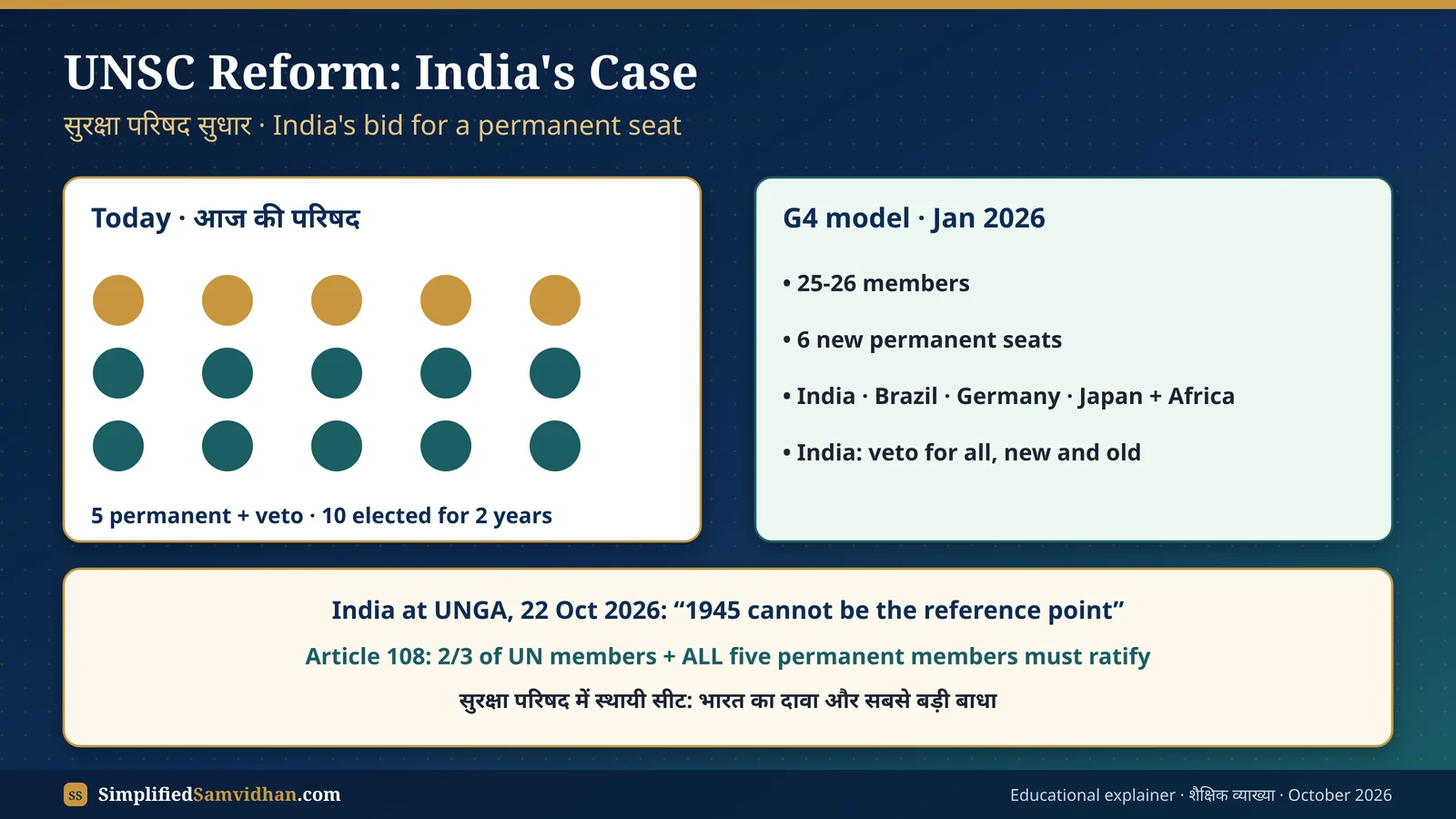
What India said at the UN on 22 October 2026
India's Permanent Representative to the UN, Ambassador P. Harish, spoke on Thursday, 22 October 2026 in the General Assembly debate on the "Question of equitable representation on and increase in the membership of the Security Council". He said authority that comes from a victory eight decades ago cannot make up for the lack of legitimacy of an unrepresentative Council, and that 1945 cannot remain the reference point for today's UN.
India asked for expansion in both permanent and non-permanent categories, warning that adding only rotating seats would entrench the status quo. On the veto, he said that as long as it exists, it must be held by all permanent members, new and old, because a two-tier permanent membership would institutionalise inequality. He noted that the Asia-Pacific has over 60% of the world's people but only one permanent member, and criticised the Intergovernmental Negotiations for running more than 15 years without a negotiating text. He hoped the 81st session would finally give the process "a text, a timeline and a destination". Reports differ slightly on exact wording; no reform decision was taken.
At a GlanceUN Security Council at a Glance: Key Facts 2026
| Point | Fact |
|---|---|
| Members | 15: 5 permanent (P5) + 10 non-permanent elected for two-year terms |
| P5 (veto powers) | China, France, Russia, United Kingdom, United States |
| Elections | Non-permanent members are elected by the General Assembly with a two-thirds majority |
| Veto | Article 27(3): substantive decisions need 9 votes including the concurring votes of the P5 (abstention is not a veto by practice) |
| Last enlargement | 1965 (from 11 to 15 members); permanent seats never changed |
| India's record | Eight terms as non-permanent member, the latest in 2021-22; candidate for 2028-29 |
Think of the Security Council as the managing committee of a housing society formed in 1945. Five families who won a big fight became permanent members and each got a key that can block any decision. Today the society has four times more flats, and one of the biggest families, India, still has to stand for election every time to sit on the committee for two years.
🏠 Everyday analogy
If a cricket board picked its permanent selectors in 1945 and never changed them, players from new teams would never have a lasting voice, however many matches they won. That is India's complaint about the Council.
🇮🇳 Real Indian example
India is among the largest contributors of troops to UN peacekeeping, from Congo to South Sudan, yet it has no permanent say when the Council decides where those soldiers go.
HistoryUNSC Reform Timeline: From 1945 to the 2026 Debate
| Year | Event |
|---|---|
| 1945 | UN Charter signed in San Francisco; UNSC created with 11 members: 5 permanent (with veto) and 6 non-permanent. India is a founding member. |
| 1963-65 | The only enlargement so far: General Assembly amends Article 23; from 1965 the Council has 15 members (10 non-permanent). |
| 1971 | The People's Republic of China takes the Chinese seat, including the permanent seat. |
| 2005 | G4 (India, Brazil, Germany, Japan) tables its reform plan; the African Union adopts the Ezulwini Consensus; Uniting for Consensus (Italy, Pakistan and others) opposes new permanent seats. |
| 2009 | Intergovernmental Negotiations (IGN) on Council reform begin in the General Assembly. |
| 2021-22 | India's eighth term as a non-permanent member. |
| Jan 2026 | G4 presents its model at the IGN: a Council of 25-26 members with six new permanent seats. |
| 22 Oct 2026 | India tells the General Assembly that 1945 cannot remain the only reference point and asks for a text, a timeline and a destination. |
Official TextUN Charter Articles 23 and 108, and Article 51 of the Constitution
Charter of the United Nations, Article 23(1).
The Security Council shall consist of fifteen Members of the United Nations. The Republic of China, France, the Union of Soviet Socialist Republics, the United Kingdom of Great Britain and Northern Ireland, and the United States of America shall be permanent members of the Security Council. The General Assembly shall elect ten other Members of the United Nations to be non-permanent members of the Security Council, due regard being specially paid, in the first instance to the contribution of Members of the United Nations to the maintenance of international peace and security and to the other purposes of the Organization, and also to equitable geographical distribution.
Article 108. Amendments.
Amendments to the present Charter shall come into force for all Members of the United Nations when they have been adopted by a vote of two thirds of the members of the General Assembly and ratified in accordance with their respective constitutional processes by two thirds of the Members of the United Nations, including all the permanent members of the Security Council.
Constitution of India, Article 51. Promotion of international peace and security.
The State shall endeavour to (a) promote international peace and security; (b) maintain just and honourable relations between nations; (c) foster respect for international law and treaty obligations in the dealings of organised peoples with one another; and (d) encourage settlement of international disputes by arbitration.
Article 253. Legislation for giving effect to international agreements.
Notwithstanding anything in the foregoing provisions of this Chapter, Parliament has power to make any law for the whole or any part of the territory of India for implementing any treaty, agreement or convention with any other country or countries or any decision made at any international conference, association or other body.
- Article 108 is the real hurdle: any new permanent seat needs two-thirds of all 193 members to vote for it and two-thirds to ratify, including all five permanent members. So each P5 country can block reform.
- Article 23 still names the "Republic of China" and the "USSR"; the seats passed to the People's Republic of China (1971) and Russia (1991) without any amendment.
- Article 51(a) and (c) of our Constitution ask the State to promote international peace and respect for international law: the basis of India's UN diplomacy. It is a Directive Principle and not enforceable in court.
Why It MattersIndia's Case for a Permanent Seat: Strengths vs Hurdles
India's strengths
- World's most populous country and a top-5 economy
- Long record in UN peacekeeping
- Founding member; eight Council terms
- Public backing from the US, UK, France and Russia at various times
Hurdles
- Article 108 needs every P5 member, and China has not backed India
- Uniting for Consensus, led by Italy and including Pakistan, opposes new permanent seats
- Disputes over the veto for new members
- IGN still has no negotiating text
- 1Text
IGN members agree on a single negotiating text instead of position papers.
- 2Vote in the General Assembly
Two-thirds of the 193 members (129) must adopt a Charter amendment.
- 3Ratification
Two-thirds of members, including all five permanent members, ratify through their own constitutional process.
- 4New Council
Only then do new seats come into force, as happened with the 1965 enlargement.
UPSC CornerUNSC Reform for UPSC Prelims and Mains
- Prelims: UNSC has 15 members; 10 non-permanent are elected for two years by a two-thirds vote of the General Assembly; a retiring member cannot be re-elected immediately.
- Prelims: Charter amendments need Article 108: two-thirds adoption plus two-thirds ratification including all P5.
- Prelims: G4 = India, Brazil, Germany, Japan; Ezulwini Consensus = African Union position (2005).
- Mains (GS II): "The Security Council reflects the world of 1945, not of today." Examine India's case for permanent membership and the obstacles to it.
Practice MCQTest Yourself: UNSC Reform: India's Case for a Permanent Seat
With reference to the UN Security Council, consider the following statements: (1) It has 10 non-permanent members elected for two-year terms. (2) An amendment to the UN Charter needs ratification by two-thirds of UN members, including all permanent members of the Security Council. (3) The Council has been enlarged twice since 1945. Which of the statements given above is/are correct?
Doubts ClearedFrequently Asked Questions
What did India say about UNSC reform on 22 October 2026?
Ambassador P. Harish told the General Assembly that 1945 cannot remain the reference point for today's UN, asked for new permanent and non-permanent seats, and said the veto, while it exists, must go to all permanent members, new and old.
Why doesn't India have a permanent seat?
The five permanent seats were fixed in 1945. Adding seats needs a Charter amendment under Article 108, which requires two-thirds of UN members including all five permanent members to ratify it.
Which countries support India's permanent seat?
The US, UK, France and Russia have publicly backed India at different times. China has not, and the Uniting for Consensus group, which includes Pakistan and Italy, opposes any new permanent seats.
What is the G4?
A group of India, Brazil, Germany and Japan that support each other's bids for permanent seats. In January 2026 it presented a model for a Council of 25-26 members with six new permanent seats.
What is the IGN?
The Intergovernmental Negotiations, held in the UN General Assembly since 2009, where members discuss Council reform. India says it still has no negotiating text, timeline or end goal.
Sources and further readingSources We Checked
Facts checked against the reports below on 25 October 2026. News reports differ slightly on the exact words of India's statement; check the UN record for the verbatim text.
- ANI: "1945 cannot remain reference point for today's UN": India calls for meaningful UNSC reforms (23 Oct 2026)
- ETV Bharat: Organisation founded 80 years ago struggling to deliver peace today: India on need for UNSC reforms (23 Oct 2026)
- News On AIR: G4 nations present model for early action to restructure UNSC (22 Jan 2026)
- News On AIR: India sharpens demand for United Nations Security Council reform (21 Feb 2026)
- United Nations: Charter of the United Nations, Chapter V (Security Council) and Chapter XVIII (Amendments)