FSSAI Draft Bans Added Sugar in Infant Food up to 6 Months: What Parents and Companies Must Know
Babies do not need sugar. India's food regulator now wants the law to say so: a draft rule would stop companies from adding table sugar (sucrose) or fructose to food made for infants up to six months. Here is the rule, the reason, and how anyone can comment before it becomes final.
What FSSAI proposed
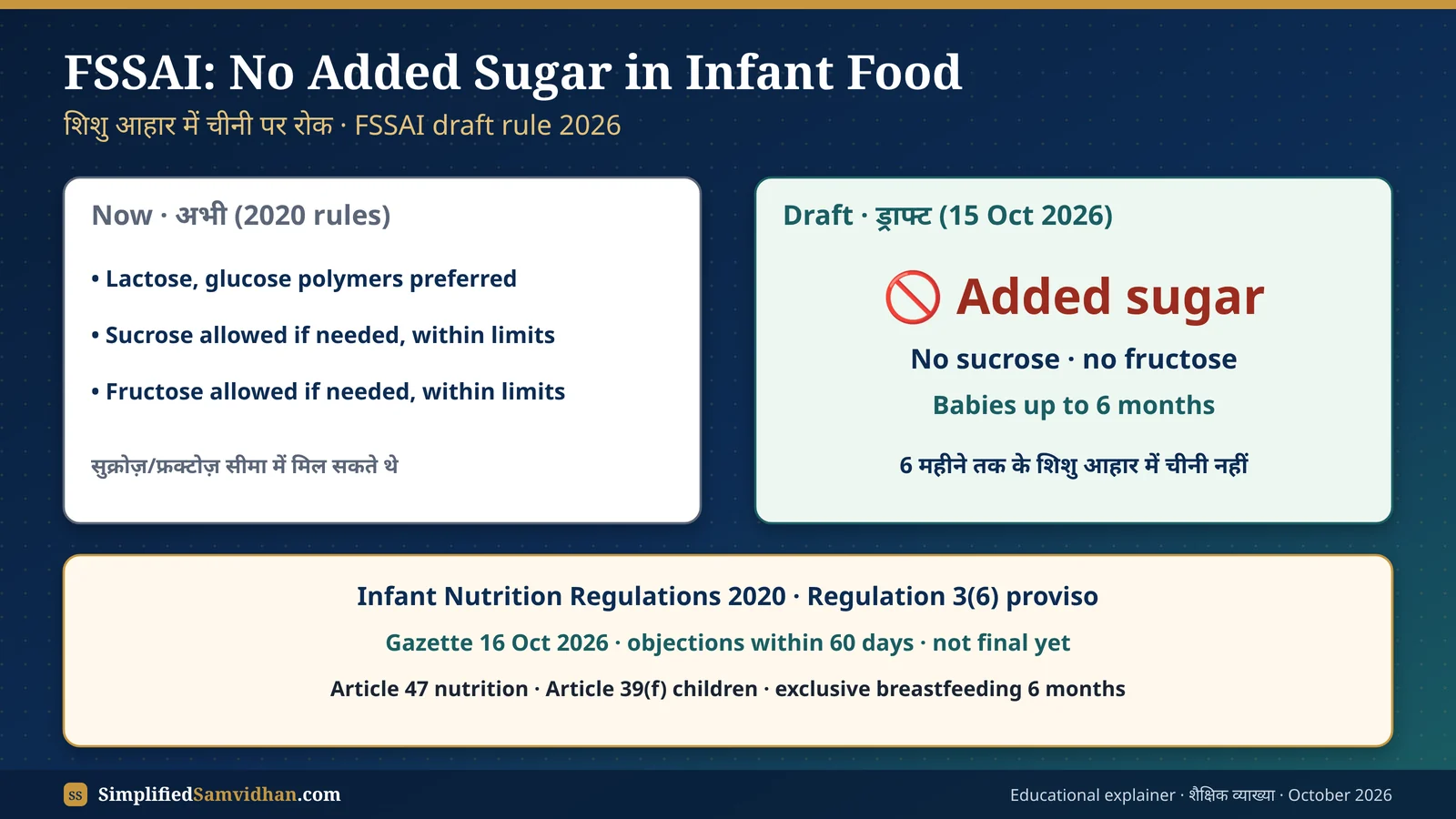
On 15 October 2026 the Food Safety and Standards Authority of India (FSSAI) notified a draft amendment to the Food Safety and Standards (Foods for Infant Nutrition) Regulations, 2020; it appeared in the Gazette of India on 16 October. It adds a proviso under Regulation 3(6) so that sucrose and fructose shall not be added to foods for infants up to six months of age.
Today the 2020 rules prefer lactose and glucose polymers as the carbohydrate, and allow sucrose or fructose only where needed and within limits. FSSAI links the change to exclusive breastfeeding for the first six months and to preventing early sugar habits and childhood obesity. Anyone can send objections and suggestions within 60 days. It is not final yet.
What ChangesFSSAI Added Sugar Rule for Infant Food: Before and After
| Point | Now (2020 rules) | Draft (Oct 2026) |
|---|---|---|
| Preferred carbohydrate | Lactose, glucose polymers | Same |
| Sucrose (table sugar) | Allowed when needed, within limits | Not to be added for infants up to 6 months |
| Fructose | Allowed when needed, within limits | Not to be added for infants up to 6 months |
| Who it binds | Every maker and seller of infant nutrition products in India | Same, after final notification |
| Status | In force | Draft; 60 days for public comments |
For the first six months a baby's best food is mother's milk, which already has natural sugar (lactose). Adding table sugar to formula teaches a sweet taste too early and adds empty calories. The draft simply says: if you make food for tiny babies, do not sweeten it.
🏠 Everyday analogy
It is like a school canteen rule that says the nursery section gets milk and fruit, never cola. Older students can choose; the youngest are protected by the rule itself.
🇮🇳 Real Indian example
A working mother in Pune who uses formula for her 4-month-old will, once the rule is final, find no added sucrose on the ingredient list of any brand sold in India.
Official TextArticle 47 and Article 39(f): The State's Duty on Nutrition
Constitution of India, Article 47. Duty of the State to raise the level of nutrition and the standard of living and to improve public health.
The State shall regard the raising of the level of nutrition and the standard of living of its people and the improvement of public health as among its primary duties …
Article 39(f). The State shall, in particular, direct its policy towards securing that children are given opportunities and facilities to develop in a healthy manner and in conditions of freedom and dignity …
- Food Safety and Standards Act, 2006: FSSAI frames regulations on food standards under Section 16 and Section 92; drafts are published for comments before final notification.
- Infant Milk Substitutes, Feeding Bottles and Infant Foods Act, 1992 (IMS Act): protects breastfeeding by banning advertisement and promotion of infant milk substitutes and feeding bottles.
- Article 21: the Supreme Court has read the right to health and nutrition into the right to life.
Benefits vs ConcernsBan on Added Sugar in Baby Food: Benefits vs Concerns
Benefits
- Supports exclusive breastfeeding advice of WHO and the Health Ministry
- Prevents an early taste for sugar and later obesity
- Same standard for all brands, Indian or foreign
Concerns raised
- Covers only up to 6 months; cereals for older babies are a separate question
- Labels and testing must be enforced in small towns too
- Companies need time to change recipes
What You Can DoHow to Read Baby Food Labels and Send Comments to FSSAI
- 1Check the ingredient list
Look for sucrose, sugar, fructose, glucose syrup or honey. For babies under one year, honey is unsafe.
- 2Follow the doctor on feeding
Exclusive breastfeeding for six months is the standard advice; use formula on medical advice.
- 3Send your comments
Objections and suggestions on the draft can be sent to FSSAI within 60 days of its publication, as stated in the draft notice.
- 4Report unsafe food
Use FSSAI's Food Safety Connect app or the helpline 1800-112-100 to complain about unsafe or mislabelled food.
UPSC CornerFSSAI Infant Food Sugar Rule for UPSC Prelims and Mains
- Prelims: FSSAI is a statutory body under the FSS Act, 2006, under the Ministry of Health and Family Welfare.
- Prelims: the IMS Act, 1992 was amended in 2003; it bans promotion of infant milk substitutes.
- Mains (GS II, Health): "Regulating processed food for children is part of the State's duty under Article 47." Discuss with POSHAN Abhiyaan and the obesity data of NFHS-5.
- Mains (GS III): food labelling, front-of-pack warnings and the role of regulators.
Practice MCQTest Yourself: FSSAI Draft: No Added Sugar in Infant Food
With reference to the FSSAI draft amendment of October 2026 to the Foods for Infant Nutrition Regulations, 2020, consider the following statements: (1) It proposes that sucrose and fructose shall not be added to food for infants up to six months. (2) It bans lactose in infant formula. (3) It has been notified in final form with immediate effect. Which of the statements given above is/are correct?
Doubts ClearedFrequently Asked Questions
What has FSSAI proposed on sugar in baby food?
A draft amendment of 15 October 2026 says sucrose and fructose shall not be added to food for infants up to six months of age.
Is the added sugar ban in infant food already in force?
No. It is a draft. FSSAI has invited objections and suggestions for 60 days before notifying the final rule.
Which regulations does it change?
The Food Safety and Standards (Foods for Infant Nutrition) Regulations, 2020, by adding a proviso under Regulation 3(6).
Which constitutional provision supports this rule?
Article 47 makes raising the level of nutrition and improving public health a primary duty of the State; Article 39(f) protects the healthy development of children.
Does the rule cover cereals for older babies?
The draft is about food for infants up to six months. Foods for older infants and toddlers are covered by other parts of the regulations.
Sources and further readingSources We Checked
Facts checked against the reports below on 23 October 2026. The draft's exact wording should be read on the FSSAI website.
- Business Today: FSSAI moves to ban added sugar for infants under 6 months (17 Oct 2026)
- Deccan Chronicle: FSSAI notifies draft amendment to infant nutrition regulations
- Nutrition Insight: India's food safety watchdog proposes ban on added sugars in infant formula
- FSSAI: draft notifications and regulations
- Constitution of India (Legislative Department)