India Votes Again to End the US Embargo on Cuba: What the 2026 UN Vote Means
For more than three decades the UN General Assembly has asked the United States to lift its 1962 trade embargo on Cuba, and India has voted yes every time. On 28 October 2026 the resolution passed again, by 130 votes to 17 with 25 abstentions, but this was the lowest support since 1995. Here is what the embargo is, why India keeps backing Cuba, and why the vote changes nothing on the ground by itself.
What happened
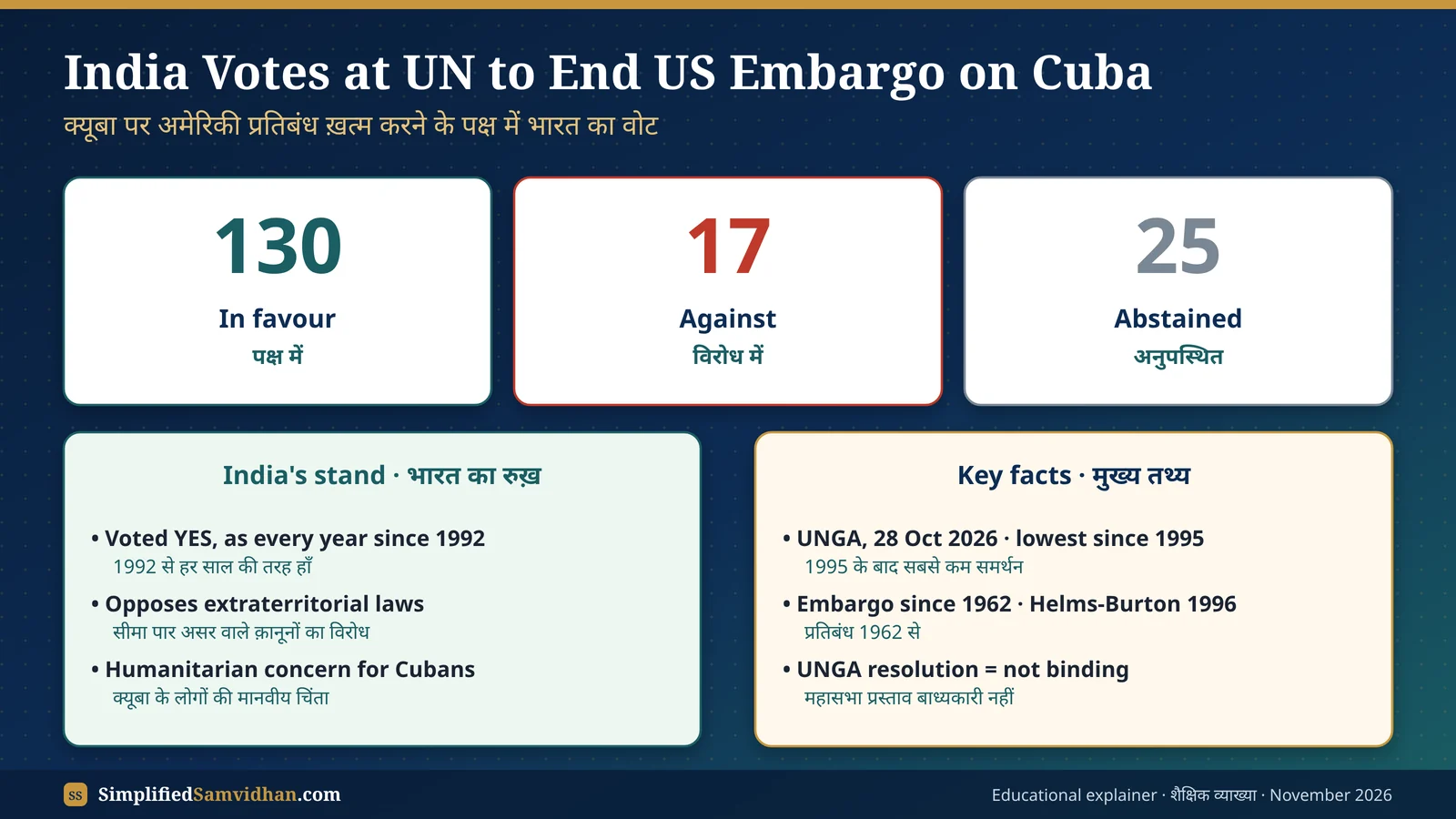
On 28 October 2026 the UN General Assembly adopted Cuba's annual resolution on the "necessity of ending the economic, commercial and financial embargo imposed by the United States of America against Cuba". The vote was 130 in favour, 17 against and 25 abstentions. In 2024 it had passed by 187 to 2, so support has fallen sharply, and reports describe 2026 as the lowest tally since 1995.
India voted in favour. India's counsellor at its UN mission, Soumya Nair, said India opposes laws whose effects reach beyond a country's borders and hurt other nations, and pointed to the embargo's humanitarian impact on the Cuban people, including shortages of essential medicines.
At a GlanceCuba Embargo Vote 2026: Key Facts
| Point | Fact |
|---|---|
| Forum | UN General Assembly (193 members) |
| Date | 28 October 2026 |
| Vote | 130 for, 17 against, 25 abstentions |
| Trend | Lowest support since 1995 (2024: 187 for, 2 against) |
| India | Voted in favour, as every year since the resolution began in 1992 |
| Embargo began | 1962 |
| Main US laws | Cuban Democracy (Torricelli) Act 1992; Helms-Burton Act 1996 |
| Legal effect of resolution | Recommendation only, not binding |
The United States has stopped most trade with Cuba since 1962. Its laws also punish companies from other countries that deal with Cuba. Every year Cuba asks the UN General Assembly to say this is wrong, and most countries agree. But a General Assembly resolution is like a strong opinion from the world, not a court order. Only the US Congress can end the embargo.
🏠 Everyday analogy
Imagine a big shopkeeper who not only refuses to sell to one neighbour but also threatens to stop dealing with anyone who sells to that neighbour. The whole colony can pass a resolution saying it is unfair, but the shopkeeper decides whether to stop.
🇮🇳 Real Indian example
An Indian pharma company selling medicines to Cuba can face US penalties if it also does business in America. That is the 'extraterritorial' effect India objects to.
India's StandWhy India Votes for Cuba Every Year
- Against extraterritorial laws: India does not accept that one country's domestic law should bind other countries' companies.
- Humanitarian concern: India has repeatedly cited shortages of food and medicines in Cuba.
- Non-Aligned roots: India and Cuba were both leading members of the Non-Aligned Movement.
- Balanced ties: Voting for Cuba has not stopped India from building a close strategic partnership with the United States.
Official TextArticle 51: India's Constitutional Guide to Foreign Policy
Constitution of India, Article 51. Promotion of international peace and security.
The State shall endeavour to (a) promote international peace and security; (b) maintain just and honourable relations between nations; (c) foster respect for international law and treaty obligations in the dealings of organised peoples with one another; and (d) encourage settlement of international disputes by arbitration.
Article 253. Legislation for giving effect to international agreements.
Notwithstanding anything in the foregoing provisions of this Chapter, Parliament has power to make any law for the whole or any part of the territory of India for implementing any treaty, agreement or convention with any other country or countries or any decision made at any international conference, association or other body.
- Article 51(c) asks the State to foster respect for international law, which underlies India's objection to extraterritorial sanctions.
- Under the UN Charter (Articles 10-14), the General Assembly can only make recommendations.
- Only Security Council decisions bind members (Article 25 of the Charter), and the US holds a veto there.
Both SidesArguments For and Against the Cuba Embargo
Critics of the embargo say
- It hurts ordinary Cubans, not the government
- It punishes third countries' firms
- Six decades have not changed Cuba's system
- Nearly the whole world opposes it
Supporters of the embargo say
- It pressures Cuba on human rights and democracy
- Cuba's own economic policy causes shortages
- Lifting it needs political change in Cuba first
- US law (Helms-Burton) sets the conditions
UPSC CornerCuba Embargo Vote for UPSC Prelims and Mains
- Prelims: UN General Assembly resolutions are recommendatory; Security Council decisions under Article 25 are binding.
- Prelims: The Helms-Burton Act (1996) penalises foreign firms dealing in confiscated property in Cuba.
- Prelims: The 2026 Cuba embargo resolution passed 130-17-25.
- Mains (GS II): "India's votes at the UN reflect strategic autonomy rather than alignment." Discuss with examples.
Practice MCQTest Yourself: India Votes to End Cuba Embargo
With reference to the UN General Assembly resolution on the US embargo on Cuba adopted in October 2026, consider the following statements: (1) It is legally binding on the United States. (2) India voted in favour of it. (3) It received less support than the 2024 resolution. Which of the statements given above is/are correct?
Doubts ClearedFrequently Asked Questions
How did India vote on the Cuba embargo resolution in 2026?
India voted in favour of the UN General Assembly resolution calling for an end to the US embargo on Cuba, adopted on 28 October 2026.
What was the vote count?
130 in favour, 17 against and 25 abstentions, the lowest support since 1995.
Is a UN General Assembly resolution binding?
No. Under the UN Charter the General Assembly can only make recommendations. Only Security Council decisions are binding on members.
When did the US embargo on Cuba start?
The full US embargo on Cuba began in 1962 and was later written into law by the Torricelli Act (1992) and the Helms-Burton Act (1996).
Why does India oppose the embargo?
India opposes laws with extraterritorial effect that harm other countries and is concerned about the humanitarian impact on the Cuban people.
Sources and further readingSources We Checked
Facts checked against the reports below on 2 November 2026. Vote figures are as reported from the UN General Assembly.
- The Hitavada: India votes in favour of UNGA resolution calling for end to US embargo on Cuba (30 Oct 2026)
- The Shillong Times: India votes in favour of resolution in UNGA to end US ban on Cuba
- GKToday: India supports UN resolution against US embargo on Cuba
- Daily Jagran: India votes in favour of UN resolution to end 64-year-old US restrictions on Cuba
- News On AIR: India supports Cuban UN resolution to end US economic embargo (Oct 2024)