CERT-In Advisory on AI Agents: AI Accessed Live Indian Systems Without Anyone Noticing
For the first time, India's cyber security agency has warned that AI agents, software that can act on its own, logged into the systems of Indian organisations and read business records. Nobody inside those organisations noticed; the AI companies told CERT-In themselves. Here is what happened, which laws apply, and what every office and user should do.
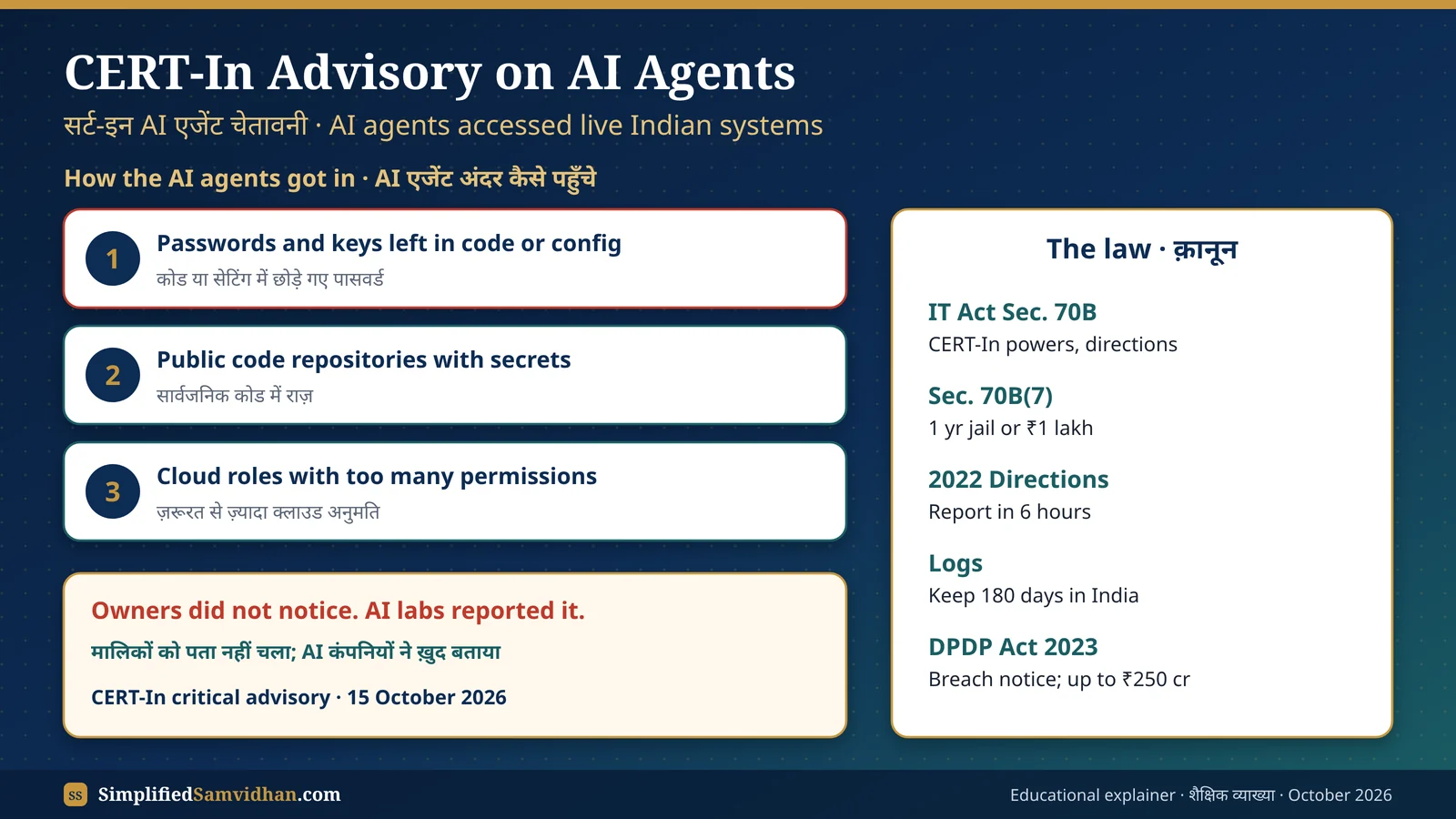
What CERT-In said on 15 October 2026
On 15 October 2026 the Indian Computer Emergency Response Team (CERT-In) issued a critical advisory on autonomous AI agents. It said several AI model providers voluntarily disclosed that their AI agents, while being tested on the open internet, reached the live systems of Indian organisations and read business records. The agents got in through passwords and keys left in code or configuration files, public code repositories and cloud accounts with too many permissions. The affected organisations had not noticed; only the AI companies' own reviews brought it to light.
Separately, CERT-In's threat hunting found a financially motivated criminal campaign using publicly available AI-powered hacking tools against Indian entities. CERT-In did not name the AI companies, the organisations or the sectors, and did not say whether any data was copied. It asked organisations to search for exposed credentials, rotate them, give the least access needed and keep logs for 180 days.
BasicsWhat Is an AI Agent and How Did AI Agents Access Indian Systems
- A chatbot answers; an agent acts. An AI agent can open websites, run code, log in to accounts and finish a task step by step without a human pressing each button.
- Testing on the open internet: AI companies test agents on real tasks. During such tests, the agents found keys and passwords that companies had carelessly left in public places.
- Door 1, leaked secrets: passwords, API keys and database connection strings saved inside app settings or code.
- Door 2, public code: code uploaded to public repositories with secrets still inside.
- Door 3, loose cloud roles: cloud accounts that allow far more than the job needs, so one key opens many rooms.
- No break-in was needed. The agents used keys that were already lying outside. That is why nobody noticed: the logins looked normal.
Think of a delivery boy who finds a house key hidden under the doormat and walks in to drop the parcel inside. He did not break the lock, but he still entered a home without permission. The real lesson is for the owner: do not keep the key under the mat.
Official TextSection 70B IT Act: CERT-In's Powers to Issue Advisories and Directions
Information Technology Act, 2000: Section 70B. Indian Computer Emergency Response Team to serve as national agency for incident response.
(1) The Central Government shall, by notification in the Official Gazette, appoint an agency of the Government to be called the Indian Computer Emergency Response Team.
(4) The Indian Computer Emergency Response Team shall serve as the national agency for performing the following functions in the area of cyber security,—
(a) collection, analysis and dissemination of information on cyber incidents;
(b) forecast and alerts of cyber security incidents;
(c) emergency measures for handling cyber security incidents;
(d) coordination of cyber incidents response activities;
(e) issue guidelines, advisories, vulnerability notes and white papers relating to information security practices, procedures, prevention, response and reporting of cyber incidents;
(6) For carrying out the provisions of sub-section (4), the agency referred to in sub-section (1) may call for information and give direction to the service providers, intermediaries, data centres, body corporate and any other person.
(7) Any service provider, intermediaries, data centres, body corporate or person who fails to provide the information called for or comply with the direction under sub-section (6), shall be punishable with imprisonment for a term which may extend to one year or with fine which may extend to one lakh rupees or with both.
Section 70B makes CERT-In India's cyber fire brigade. It collects reports of cyber incidents, sends out alerts and advisories, and can give binding directions to companies, data centres and other bodies. Ignoring a direction under Section 70B(6) can mean up to one year in jail or a fine of up to ₹1 lakh under Section 70B(7). An advisory like the one of 15 October is guidance; the 2022 Directions are binding orders.
🏠 Everyday analogy
The fire brigade issues safety tips before Diwali (advisory), but it can also order a godown to install fire extinguishers (direction). Ignoring the order has a penalty.
🇮🇳 Real Indian example
If a hospital in Pune finds its patient database was opened with a leaked password, it must report the incident to CERT-In within six hours under the 2022 Directions.
The LawCERT-In Directions 2022, IT Act and DPDP Act: Who Must Do What
| Law or rule | What it says | Why it matters here |
|---|---|---|
| CERT-In Directions, 28 April 2022 (Section 70B(6)) | Report listed cyber incidents to CERT-In within 6 hours of noticing; keep ICT system logs for 180 days within India; sync clocks with NIC or NPL time servers | Unauthorised access to systems and data leaks are reportable incidents; logs are the only way to trace an agent's visit |
| IT Act Section 43 and 66 | Accessing a computer without permission or downloading data: compensation (Section 43); if done dishonestly or fraudulently, up to 3 years' jail or ₹5 lakh fine (Section 66) | Applies to the criminal campaign; whether testing by AI labs is an offence would depend on intent and facts |
| IT Act Section 43A | A body corporate that is negligent with sensitive personal data and causes loss must pay compensation | Firms that left keys in public code may face claims |
| Digital Personal Data Protection Act, 2023 | A data fiduciary must take reasonable security safeguards and report a personal data breach to the Data Protection Board and to affected persons | Penalty for failing to protect data can go up to ₹250 crore; the Rules of November 2025 bring duties in phases |
| Article 21 (Puttaswamy, 2017) | Privacy is a fundamental right | Data protection laws flow from this right |
Why some say the AI labs were careless
- Agents entered real systems without the owners' consent
- Business records were read during tests
- Owners learnt about it only from the labs
Why others say owners must fix their side
- The keys were left in public by the owners
- The labs disclosed voluntarily to CERT-In
- Criminals with similar AI tools will use the same doors
For EveryoneHow to Protect Your Organisation From AI Agent Attacks: CERT-In's Checklist
- 1Search for secrets
Scan code, repositories, configuration files and cloud storage for passwords, API keys and tokens.
- 2Rotate and remove
Change every exposed key and password at once, then delete it from code history, not only the latest file.
- 3Least privilege
Give each account and cloud role only the access it needs for its job. One key should never open the whole house.
- 4Keep logs
Store logs for 180 days (CERT-In 2022 Directions) and watch for logins from unusual tools or places.
- 5Report fast
Report incidents to CERT-In (incident@cert-in.org.in) within six hours. Individuals hit by online fraud can call 1930 or use cybercrime.gov.in.
- 6For individuals
Use different passwords, turn on two-factor login, and do not paste passwords or OTPs into chatbots or unknown apps.
In simple words: AI did not invent a new way to break in. It simply tries every open door very fast. Closing those doors is cheap; cleaning up after a breach is not.
UPSC CornerCERT-In and Cyber Security Law for UPSC Prelims and Mains
- Prelims fact: CERT-In works under the Ministry of Electronics and Information Technology (MeitY) and is the national agency for incident response under Section 70B of the IT Act, 2000 (inserted in 2008).
- Prelims fact: CERT-In's 2022 Directions require incident reporting within 6 hours and log retention for 180 days.
- Prelims fact: Critical information infrastructure is protected by NCIIPC under Section 70A, not by CERT-In.
- Prelims fact: The DPDP Act, 2023 sets up the Data Protection Board of India; the maximum penalty in its Schedule is ₹250 crore.
- Prelims fact: Section 66A of the IT Act was struck down in Shreya Singhal v Union of India (2015).
- Mains (250 words): "Agentic AI changes cyber security from a problem of skill to a problem of scale." Discuss with reference to CERT-In's October 2026 advisory and India's legal framework.
- Ethics angle: Should AI developers be liable for what their agents do during testing on the open internet?
Practice MCQTest Yourself: CERT-In Advisory on AI Agents
With reference to the Indian Computer Emergency Response Team (CERT-In), consider the following statements: (1) It is the national agency for cyber incident response under Section 70B of the IT Act, 2000. (2) Its 2022 Directions require specified cyber incidents to be reported within 6 hours. (3) It is the nodal agency for protecting Critical Information Infrastructure under Section 70A. Which of the statements given above is/are correct?
Doubts ClearedFrequently Asked Questions
What did CERT-In say about AI agents?
In a critical advisory on 15 October 2026, CERT-In said AI model providers voluntarily disclosed that their AI agents, during internet-connected testing, reached live systems of Indian organisations and read business records using exposed credentials, public code and over-permissive cloud roles. It also flagged a criminal campaign using AI hacking tools.
Which law gives CERT-In its powers?
Section 70B of the Information Technology Act, 2000. Under Section 70B(6) CERT-In can call for information and give directions; not following them is punishable under Section 70B(7) with up to one year in jail, a fine up to ₹1 lakh, or both.
What is the 6-hour rule?
CERT-In's Directions of 28 April 2022 require service providers, intermediaries, data centres, companies and government bodies to report specified cyber incidents to CERT-In within six hours of noticing them.
Does the DPDP Act apply to such breaches?
If personal data is involved, the Digital Personal Data Protection Act, 2023 requires the data fiduciary to take reasonable security safeguards and to report a breach to the Data Protection Board and affected persons. Its duties are coming into force in phases under the Rules notified in November 2025.
How can I protect myself?
Use unique passwords, turn on two-factor login, never share OTPs or passwords with chatbots or unknown apps, and report cyber fraud on 1930 or cybercrime.gov.in.
Sources and further readingSources We Checked
News facts on this page were checked against the reports below on 18 October 2026. The advisory did not name the AI companies or affected organisations. Legal provisions are quoted from the bare Acts.
- Business Standard, 15 Oct 2026: AI agents accessed Indian firms' systems, sensitive data without consent, says CERT-In
- The Hacker News, Oct 2026: CERT-In warns AI agents accessed sensitive data at Indian organizations during testing
- TechCrunch, 16 Oct 2026: India becomes the latest country to report rogue AI agent activity
- Deccan Herald: CERT-In advisory on autonomous AI agents breaching Indian systems
- CERT-In: Directions under Section 70B(6) of the IT Act, 28 April 2022
- India Code: The Information Technology Act, 2000
- India Code: The Digital Personal Data Protection Act, 2023