Israel Election 2026 Result: A Hung Knesset and What It Means for India
Israel voted on 27 October 2026 in its first general election since the 7 October 2023 Hamas attack. With all votes counted, Prime Minister Benjamin Netanyahu's bloc has 53 of 120 seats, short of the 61 needed to rule. His rivals led by Gadi Eisenkot have 48, and Arab parties won a record 19. Here is how Israel will now pick a government, how its system differs from India's, and why the result matters for New Delhi.
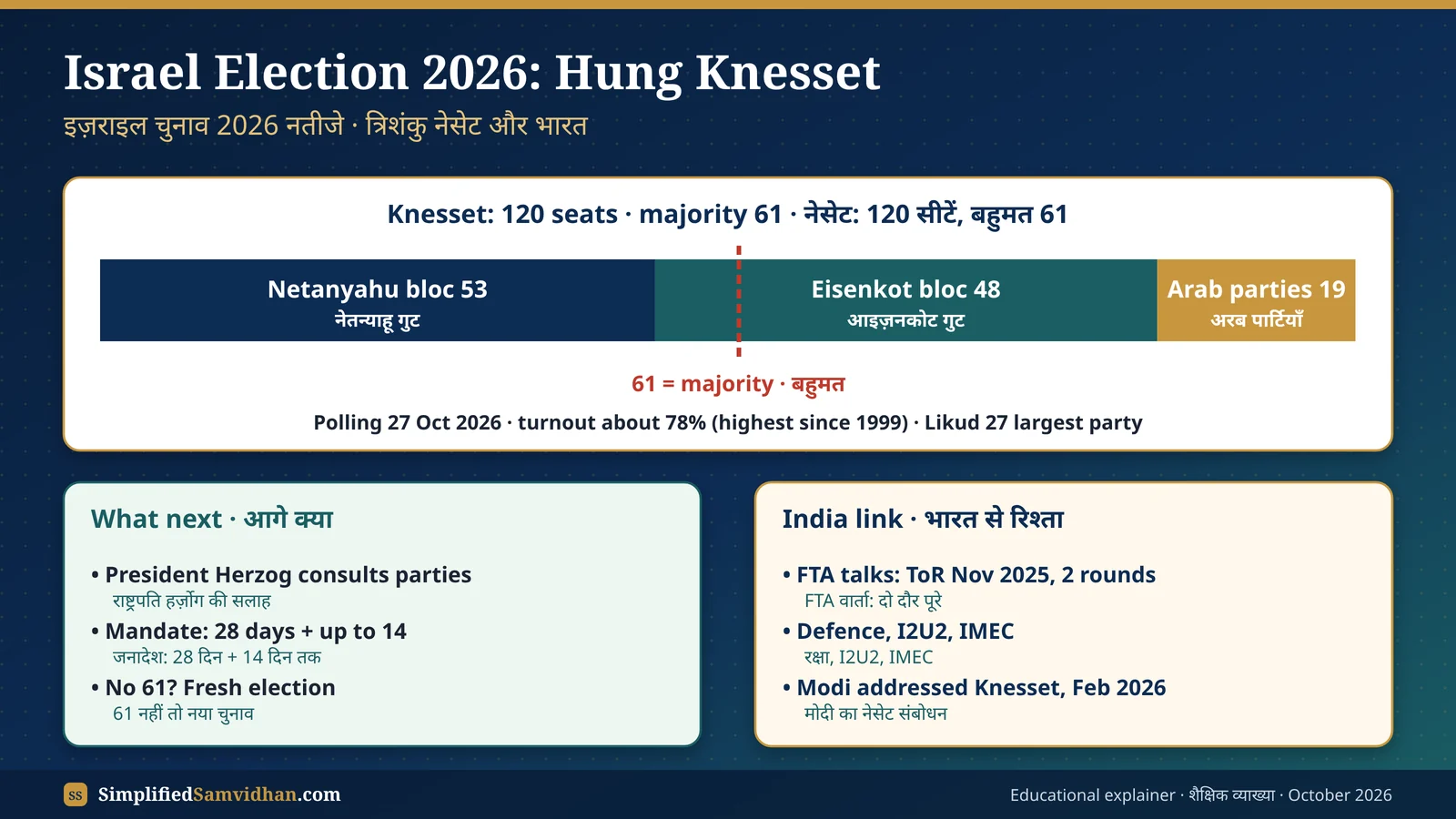
Where things stand on 30 October 2026
Counting of the 27 October 2026 Knesset election was completed on 29 October. Reported seats: Netanyahu's bloc 53 (Likud 27, still the largest single party, with its far-right and ultra-Orthodox allies), the Eisenkot-led change bloc 48 (Eisenkot's Yashar 21, Naftali Bennett's Beyachad 12 and others) and Arab-led parties 19 (Joint List 11, Ra'am 8). No bloc reached 61.
Turnout was about 78%, the highest since 1999, and Arab turnout was reported at about 80% against 53% in 2022. The Central Elections Committee will publish the official result after integrity checks; then President Isaac Herzog will consult the parties and give one member the task of forming a government. Israel's Shin Bet is investigating claims of foreign money behind the Arab-sector turnout; officials have rejected claims of widespread irregularities. When we checked, India's Ministry of External Affairs had not issued a statement on the result.
At a GlanceIsrael Election 2026 Result: Key Facts
| Point | Fact |
|---|---|
| Election | 26th Knesset (Israel's parliament), polling on 27 October 2026 |
| Total seats / majority | 120 seats; 61 needed for a majority |
| Netanyahu's bloc | 53 seats (Likud 27, largest party) |
| Change bloc (Gadi Eisenkot) | 48 seats (Yashar 21, Bennett's Beyachad 12, others) |
| Arab-led parties | 19 seats, a record (Joint List 11, Ra'am 8) |
| Turnout | About 78%, highest since 1999 |
| System | Party-list proportional representation, whole country one constituency, 3.25% threshold |
| Next step | President Isaac Herzog consults parties and gives the mandate to form a government |
Israel does not have constituencies like India's 543 Lok Sabha seats. People vote for a party list, and each party gets seats in proportion to its votes, if it crosses 3.25%. So many small parties enter parliament, and no single party has ever won 61 seats alone. Governments are always coalitions.
🏠 Everyday analogy
Think of a housing society committee of 120 members where you need 61 votes to pass anything. If the biggest group has 53 friends and the rival group has 48, the 19 members who sit with neither group decide who becomes secretary.
🇮🇳 Real Indian example
India saw something similar in 1989, 1996 and 1998, when no party had a Lok Sabha majority and the President had to judge who could form a stable government.
How It WorksHow Israel Forms a Government After a Hung Knesset
- 1Official results
The Central Elections Committee publishes final results after integrity checks.
- 2President's consultations
President Isaac Herzog meets every party in the new Knesset and asks whom they recommend as Prime Minister.
- 3The mandate
He gives one member, usually the one with the most recommendations, 28 days to form a coalition, extendable by up to 14 days.
- 4Second chance
If that fails, the President can give the task to another member, or the Knesset itself can back a candidate.
- 5New election
If no one can win the confidence of 61 members, Israel goes to a fresh election.
- 6Swearing-in
The government takes office once the Knesset passes a vote of confidence.
The role of Israel's President here is like that of India's President after a hung Lok Sabha: the President invites the person most likely to command a majority, and that person must then prove it on the floor of the House.
Why It MattersWhat the Israel Election Means for India
- Defence: Israel is one of India's top defence suppliers and partners (missiles, drones, radars, Barak-8 air defence developed with DRDO). Such ties have run under every Israeli government, left or right.
- Trade deal: India and Israel signed the Terms of Reference for a Free Trade Agreement in November 2025 and held two negotiating rounds in 2026. A long coalition deadlock could slow these talks.
- Investment: the Bilateral Investment Agreement signed in September 2025 gives investors protection and arbitration; it does not depend on who governs.
- Workers: thousands of Indian construction and care workers have gone to Israel under government-to-government arrangements since 2023-24.
- West Asia: projects such as I2U2 and the India-Middle East-Europe Economic Corridor (IMEC) need calm in the region; a new Israeli government's policy on Gaza and the region will matter.
- India's balance: India keeps strong ties with Israel and also supports a two-state solution with an independent Palestine; that policy does not change with the election.
| Year | India-Israel milestone |
|---|---|
| 1950 | India recognises Israel (17 September 1950). |
| 1992 | Full diplomatic relations established (29 January 1992). |
| 2017 | Narendra Modi becomes the first Indian PM to visit Israel; ties upgraded to a Strategic Partnership. |
| 2021 | I2U2 (India, Israel, UAE, USA) grouping formed; first leaders' summit in July 2022. |
| Sep 2025 | India and Israel sign a Bilateral Investment Agreement in New Delhi. |
| Nov 2025 | Terms of Reference for an India-Israel Free Trade Agreement signed. |
| 25 Feb 2026 | PM Modi addresses a special plenary of the Knesset in Jerusalem. |
| Feb and Jul 2026 | First and second rounds of FTA negotiations held in New Delhi. |
| 27 Oct 2026 | Israel votes for the 26th Knesset; no bloc wins a majority. |
Official TextArticle 51 and Article 253: India's Foreign Policy in the Constitution
Constitution of India, Article 51. Promotion of international peace and security.
The State shall endeavour to (a) promote international peace and security; (b) maintain just and honourable relations between nations; (c) foster respect for international law and treaty obligations in the dealings of organised peoples with one another; and (d) encourage settlement of international disputes by arbitration.
Article 253. Legislation for giving effect to international agreements.
Notwithstanding anything in the foregoing provisions of this Chapter, Parliament has power to make any law for the whole or any part of the territory of India for implementing any treaty, agreement or convention with any other country or countries or any decision made at any international conference, association or other body.
- Foreign affairs, diplomatic relations and treaties are Union List subjects (Entries 10 and 14), so only the Centre deals with Israel or any other country.
- Article 51 (a Directive Principle) asks India to promote international peace and keep "just and honourable relations between nations"; this is why India talks to all sides in West Asia.
- Article 75(3): in India, as in Israel, the Council of Ministers is collectively responsible to the lower house, so a government survives only while it keeps a majority.
CompareIsrael's Knesset vs India's Lok Sabha
Israel (Knesset)
- 120 members, one house
- Party-list proportional representation
- Whole country is one constituency
- 3.25% vote threshold to win seats
- No written constitution; Basic Laws instead
India (Lok Sabha)
- 543 elected members, plus Rajya Sabha
- First-past-the-post in each constituency
- 543 constituencies
- No threshold; most votes in a seat wins
- Written Constitution, the world's longest
UPSC CornerIsrael Election 2026 for UPSC Prelims and Mains
- Prelims: Knesset = Israel's unicameral parliament, 120 members, 61 for majority, elected by party-list PR with a 3.25% threshold.
- Prelims: Israel has no single written constitution; its Basic Laws do that job.
- Prelims: India recognised Israel in 1950 and opened full diplomatic ties in 1992; I2U2 = India, Israel, UAE, USA.
- Prelims: Modi was the first Indian PM to visit Israel (2017) and addressed the Knesset on 25 February 2026.
- Mains (GS II): "India's West Asia policy is a balance between strategic ties with Israel and support for Palestine." Examine in the light of the 2026 Israeli election.
Practice MCQTest Yourself: Israel Election 2026: Hung Knesset
With reference to Israel's general election held in October 2026, consider the following statements: (1) The Knesset has 120 members and a majority requires 61. (2) Members are elected from single-member constituencies on the first-past-the-post system, as in India. (3) Arab-led parties won a record number of seats. Which of the statements given above is/are correct?
Doubts ClearedFrequently Asked Questions
Who won the Israel election 2026?
No one won a majority. Netanyahu's Likud is the largest party with 27 seats and his bloc has 53 of 120. The Eisenkot-led bloc has 48 and Arab parties 19. A government needs 61.
When was the Israel election held?
Polling was held on 27 October 2026 for the 26th Knesset. Counting was completed on 29 October 2026.
What happens after a hung Knesset?
President Isaac Herzog consults all parties and gives one member up to 28 days, extendable by 14, to form a coalition. If nobody can win 61 votes, Israel may hold another election.
Will the Israel election change India-Israel relations?
Unlikely in basics. Defence, technology, farming and trade ties with Israel have continued under governments of all colours. A long deadlock could slow the India-Israel FTA talks.
How is Israel's election system different from India's?
Israel uses one nationwide constituency and party-list proportional representation with a 3.25% threshold. India uses 543 single-member constituencies where the candidate with the most votes wins.
Sources and further readingSources We Checked
Facts checked against the reports below on 30 October 2026. Seat numbers are as reported after the full count; official publication by Israel's Central Elections Committee may adjust them slightly. We will update this page when a government is formed.
- Israel Hayom: Israel's 2026 election results released (29 Oct 2026)
- ANI: Israel election, 100% of votes counted, Netanyahu bloc gets 53 seats, Likud largest party (30 Oct 2026)
- Times of Israel: Netanyahu bloc has 53 seats, Eisenkot's 48; Arab parties surge to 19
- Al Jazeera: Israel election turnout hits 77.7%, highest since 1999 (27 Oct 2026)
- CNN: The final Israeli election results are in. Netanyahu hasn't won (28 Oct 2026)
- PIB: India and Israel conclude second round of negotiations for proposed Free Trade Agreement (July 2026)
- News On AIR: India, Israel sign Bilateral Investment Agreement in New Delhi (8 Sep 2025)