India-EFTA TEPA and India-Liechtenstein Relations: What the Prince Alois Visit Means
Liechtenstein is one of the smallest countries in Europe, about 40,000 people between Switzerland and Austria. Yet its Hereditary Prince Alois was given a state visit and talks with PM Modi on 27 October 2026. The reason is a trade deal: the India-EFTA TEPA, under which four rich European countries have promised USD 100 billion of investment and 1 million jobs in India. Here is the visit, the deal and the law in simple words.
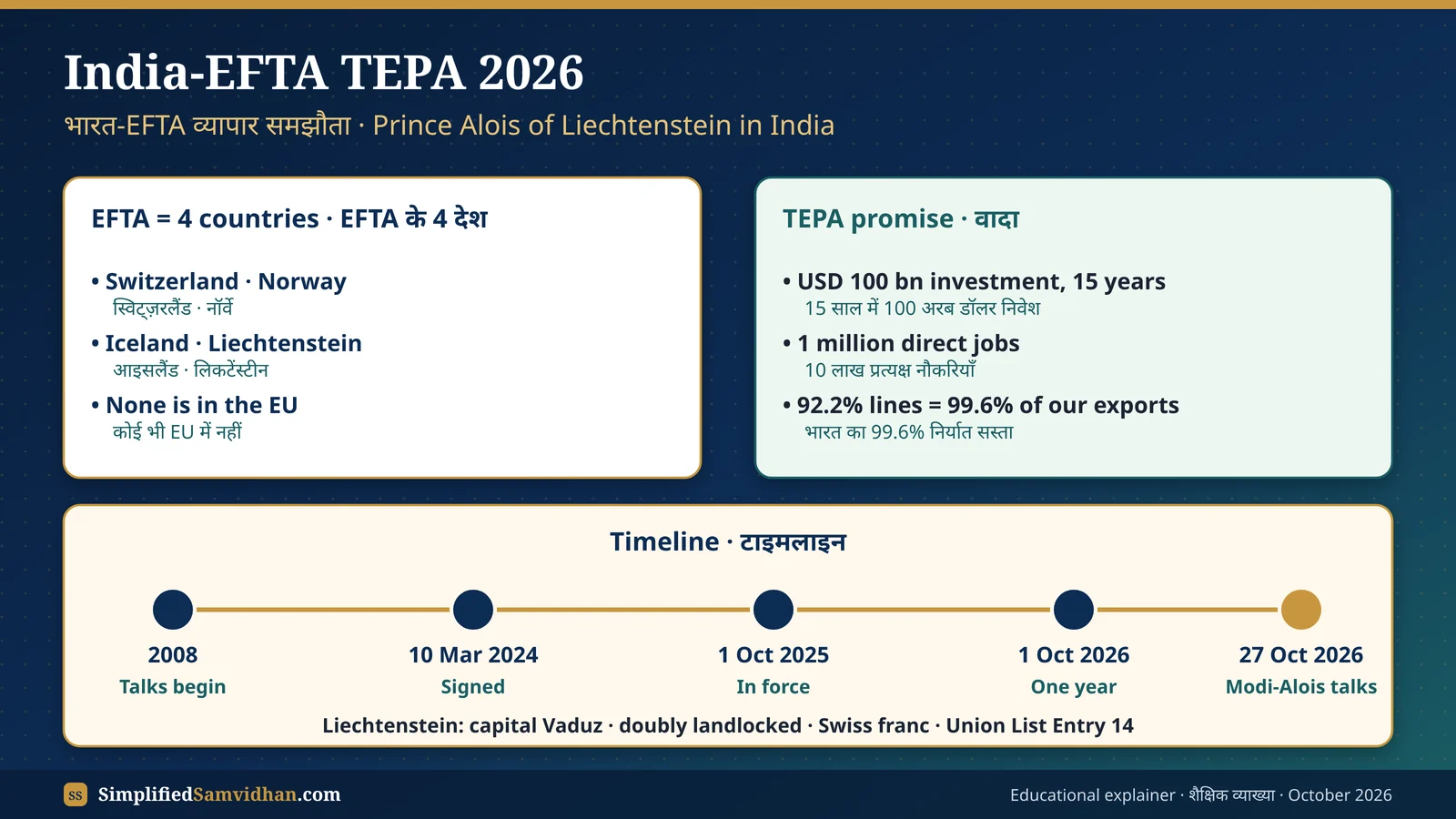
What happened on 27 October 2026
Hereditary Prince Alois of Liechtenstein and Hereditary Princess Sophie are on a state visit to India from 25 to 28 October 2026. On 27 October External Affairs Minister S. Jaishankar called on the Prince in the morning, and PM Narendra Modi held delegation-level talks with him at Hyderabad House, New Delhi. According to the MEA, the leaders reviewed cooperation in trade and investment, innovation, science and technology, skill development and people-to-people ties, and backed reform of multilateral bodies including the United Nations. The Prince also paid homage to Mahatma Gandhi at Raj Ghat.
The MEA's Secretary (West), Sibi George, summed up the focus as Trade, Technology and Talent. Jaishankar said ties are gaining momentum from the opportunities opened by the India-EFTA TEPA, which completed one year in force on 1 October 2026. No new agreement or MoU was reported from the talks when we checked on 28 October.
At a GlanceIndia-EFTA TEPA at a Glance: Key Facts
| Point | Fact |
|---|---|
| Full name | India-EFTA Trade and Economic Partnership Agreement (TEPA) |
| EFTA members | Switzerland, Norway, Iceland and Liechtenstein (none is in the European Union) |
| Signed / in force | Signed 10 March 2024 in New Delhi; in force from 1 October 2025 |
| Investment pledge | EFTA countries aim to raise investment in India by USD 100 billion in 15 years (USD 50 billion in the first 10), the first such binding pledge in any Indian FTA |
| Jobs | Target of 1 million direct jobs in India |
| EFTA's tariff offer | 92.2% of its tariff lines, covering 99.6% of India's exports |
| India's tariff offer | 82.7% of its tariff lines, covering 95.3% of EFTA's exports; duty on gold, the biggest import, unchanged |
| Kept out by India | Sensitive farm goods such as dairy, soya, coal and some agricultural products |
TEPA is a give-and-take deal. India lowers import duty on many Swiss and Norwegian goods, such as machines, watches, medicines and chocolates, in steps over up to 10 years. In return EFTA countries let almost all Indian goods in cheaply and, unusually, promise to bring investment and jobs into India.
🏠 Everyday analogy
Think of a big housing society letting a small, rich neighbourhood use its market. The neighbourhood does not just sell goods; it promises to build factories inside the society and hire its young people. If the factories do not come in time, the society can take back some of the discounts.
🇮🇳 Real Indian example
A Swiss machine-tool maker setting up a plant in Pune, or a Norwegian green-shipping firm working with an Indian shipyard, is the kind of investment TEPA counts towards the USD 100 billion target.
The VisitWho Is Prince Alois and Why Liechtenstein Matters
- Liechtenstein is a constitutional monarchy in the Alps between Switzerland and Austria. Capital: Vaduz. It uses the Swiss franc and is one of only two doubly landlocked countries in the world (the other is Uzbekistan).
- The head of state is Prince Hans-Adam II. Since 15 August 2004 his son, Hereditary Prince Alois, has acted as regent and handles day-to-day affairs of state.
- It is small in size but rich: a strong finance, precision-engineering and dental-products industry, and one of the world's highest incomes per person.
- Unlike Switzerland, Liechtenstein is in the European Economic Area (EEA) with Norway and Iceland, so it links EFTA and EU markets.
- For India, the visit keeps up the push to turn TEPA's investment promise into real projects, and builds support for India's positions on UN reform.
| Year | Event |
|---|---|
| 1960 | EFTA is founded by the Stockholm Convention; today it has four members: Iceland, Liechtenstein, Norway and Switzerland. |
| 1991 | Liechtenstein joins EFTA (it joined the UN in 1990). |
| 15 Aug 2004 | Hereditary Prince Alois becomes regent and runs day-to-day state affairs for his father, Prince Hans-Adam II. |
| 2008 | India and EFTA begin talks on a trade and investment agreement. |
| 10 Mar 2024 | India-EFTA Trade and Economic Partnership Agreement (TEPA) signed in New Delhi. |
| 1 Oct 2025 | TEPA comes into force, India's first FTA with developed European countries. |
| 1 Oct 2026 | TEPA completes one year in force. |
| 25-28 Oct 2026 | State visit of Hereditary Prince Alois and Hereditary Princess Sophie to India. |
| 27 Oct 2026 | EAM Jaishankar calls on the Prince; PM Modi holds talks with him at Hyderabad House. |
How It WorksHow the TEPA Investment Promise Works
- 1Pledge
EFTA states aim to raise foreign direct investment from their countries into India by USD 50 billion in 10 years and another USD 50 billion in the next 5 years.
- 2Facilitation
India runs an India-EFTA Desk to help EFTA companies find projects and clear approvals.
- 3Review
A joint committee checks progress on investment and jobs at fixed intervals.
- 4Remedy
If the targets are not met, India can, after consultations, rebalance or withdraw some of its tariff concessions.
- 5Phased duty cuts
India's duty cuts start at once on some goods and phase in over 5, 7 or 10 years on others.
Governments cannot force private firms to invest. So TEPA uses a promise with a safety valve: EFTA countries commit to promote investment, and India keeps the right to take back tariff benefits if the investment does not come.
Official TextArticle 51, Article 253 and Union List Entry 14: Treaties in the Constitution
Constitution of India, Article 51. Promotion of international peace and security.
The State shall endeavour to (a) promote international peace and security; (b) maintain just and honourable relations between nations; (c) foster respect for international law and treaty obligations in the dealings of organised peoples with one another; and (d) encourage settlement of international disputes by arbitration.
Article 253. Legislation for giving effect to international agreements.
Notwithstanding anything in the foregoing provisions of this Chapter, Parliament has power to make any law for the whole or any part of the territory of India for implementing any treaty, agreement or convention with any other country or countries or any decision made at any international conference, association or other body.
- Article 73 with Union List Entry 14 (entering into treaties and agreements with foreign countries) lets the Union government sign trade deals like TEPA. Entry 41 covers trade and commerce with foreign countries.
- India's FTAs are signed by the executive and approved by the Union Cabinet; there is no rule that Parliament must ratify them.
- Article 253 lets Parliament make a law to carry out a treaty where one is needed; customs duty cuts are notified under the Customs Act, 1962 and the Customs Tariff Act, 1975.
- Article 51 (Directive Principle) asks the State to foster respect for treaty obligations in dealings between nations.
Why It MattersIndia-EFTA TEPA: Gains vs Concerns
Gains for India
- First FTA with a binding investment and jobs target
- Almost all Indian exports get cheaper entry to rich markets
- Swiss and Nordic technology in pharma, machinery, green energy and shipping
- Indian professionals: services commitments in IT, education and business services
Concerns
- Investment targets depend on private companies
- Swiss food and pharma imports can compete with Indian firms
- Data exclusivity and patent concerns raised by health groups
- Gold, the main import, gives little benefit to trade balance
UPSC CornerIndia-EFTA TEPA for UPSC Prelims and Mains
- Prelims: EFTA = Iceland, Liechtenstein, Norway, Switzerland; TEPA signed 10 March 2024, in force 1 October 2025.
- Prelims: USD 100 billion investment in 15 years and 1 million direct jobs; first binding investment pledge in an Indian FTA.
- Prelims: Liechtenstein: capital Vaduz, doubly landlocked (with Uzbekistan), currency Swiss franc, EEA member.
- Mains (GS II/III): "New-generation trade agreements link market access to investment and jobs." Examine with reference to the India-EFTA TEPA.
Practice MCQTest Yourself: India-EFTA TEPA: Liechtenstein's Prince Alois Visit
With reference to the India-EFTA Trade and Economic Partnership Agreement (TEPA), consider the following statements: (1) All members of EFTA are also members of the European Union. (2) The agreement contains a commitment to raise investment in India by USD 100 billion over 15 years. (3) Liechtenstein is a member of EFTA. Which of the statements given above is/are correct?
Doubts ClearedFrequently Asked Questions
What is India-EFTA TEPA?
It is a trade and investment agreement between India and the four EFTA countries: Switzerland, Norway, Iceland and Liechtenstein. It was signed on 10 March 2024 and came into force on 1 October 2025.
Which countries are in EFTA?
Four: Switzerland, Norway, Iceland and Liechtenstein. None of them is a member of the European Union.
What is the USD 100 billion promise in TEPA?
EFTA countries aim to raise investment in India by USD 100 billion over 15 years and help create 1 million direct jobs. If this does not happen, India can rebalance its tariff concessions after consultations.
Why did Liechtenstein's Prince Alois visit India?
Hereditary Prince Alois made a state visit from 25 to 28 October 2026 to deepen trade, investment, technology and skills ties under the TEPA. He held talks with PM Modi at Hyderabad House on 27 October.
Will Swiss watches and chocolates become cheaper in India?
Duties on many such goods are being cut in phases over up to 10 years under TEPA, so prices can fall gradually, but final prices also depend on companies, GST and exchange rates.
Sources and further readingSources We Checked
Facts checked against the reports below on 28 October 2026. TEPA figures are from the Government of India's explainer and trade reports. No MoU from the 27 October talks had been reported when we checked.
- ANI: India-Liechtenstein ties get boost during Hereditary Prince Alois' visit (27 Oct 2026)
- ThePrint: PM Modi, Liechtenstein's Prince Alois hold talks to boost ties (27 Oct 2026)
- ETV Bharat: PM Modi and Liechtenstein's Prince Alois hold talks to boost ties (27 Oct 2026)
- Open: India-Liechtenstein ties get a TEPA boost (Oct 2026)
- PIB: India-EFTA Trade and Economic Partnership Agreement, explainer (Oct 2025)
- India Briefing: India-EFTA trade pact comes into effect 1 October 2025
- IANS: India-EFTA TEPA marks two years (10 Mar 2026)
- Ministry of External Affairs: video briefings list (special briefing on the Liechtenstein state visit, 27 Oct 2026)