Elon Musk Parenting Quote and Indian Law: What Parents Owe Children, and What Children Owe Parents
"My children didn't choose to be born. I chose to have children. They owe me nothing. I owe them everything." This line, credited to Elon Musk, is being shared widely again. It sounds like a personal philosophy, but Indian law has a clear answer to the same question. Here it is, in simple words.
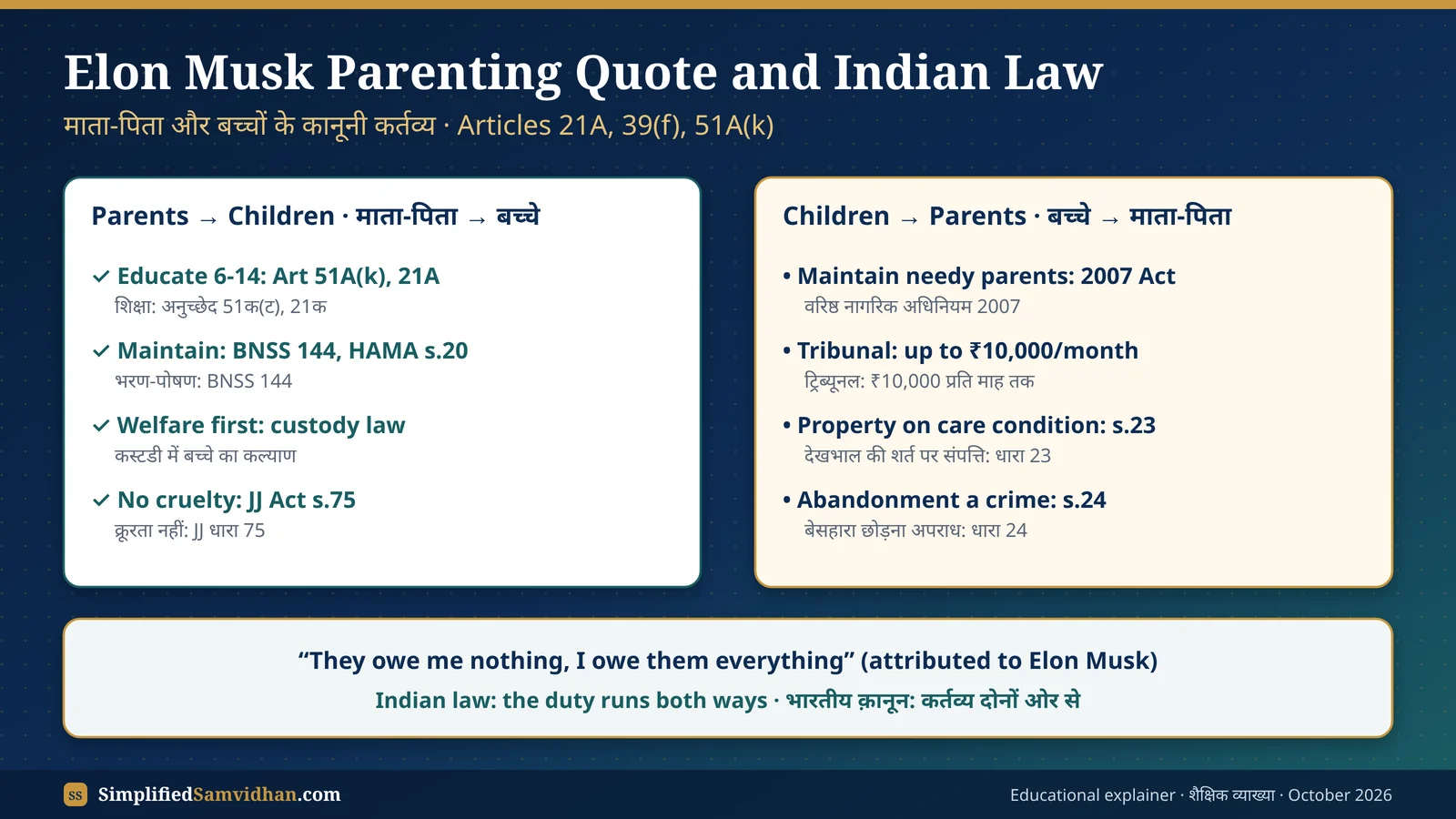
The quote, and what we could verify
The words being shared are: "My children didn't choose to be born, I chose to have children. They owe me nothing, I owe them everything." They are widely attributed to Elon Musk, the head of Tesla and SpaceX, and have circulated on X and quote sites since at least December 2023; they are trending again on Indian social media in October 2026.
A note on accuracy: we could not find the original interview, speech or post in which Mr Musk said these words, so this page treats the line as a quote attributed to him. Whoever said it first, it raises a real legal question that this page answers: under Indian law, what do parents owe their children, and do children owe their parents anything?
The Idea"They Owe Me Nothing": The Parenting Idea Behind the Viral Quote
The quote makes one simple point: a child never asked to be born, so the responsibility sits with the parent who chose to have the child. The child does not "repay" the parent for food, school or love; that is what parenthood is.
Indian law agrees with the first half fully. Parents (and the State) have real, enforceable duties towards children. But on the second half Indian law takes a different view: once children grow up, the law expects them to look after parents who cannot look after themselves.
🏠 Everyday analogy
Think of a bank account that runs in two phases. In childhood only the parents deposit: care, food and schooling. In old age the law can ask grown-up children to make deposits back, but only if the parents truly need it.
🇮🇳 Real Indian example
A Lucknow couple pay for their son's engineering degree; that is their duty, and he owes them no "fee". Thirty years later, if the father is sick and has no pension, the same son can be ordered by a Tribunal to pay monthly maintenance.
Official TextArticles 21A, 39(f) and 51A(k): The Constitution on Parents' Duty Towards Children
Article 21A. Right to education.
The State shall provide free and compulsory education to all children of the age of six to fourteen years in such manner as the State may, by law, determine.
Article 39(f). Certain principles of policy to be followed by the State.
The State shall, in particular, direct its policy towards securing that children are given opportunities and facilities to develop in a healthy manner and in conditions of freedom and dignity and that childhood and youth are protected against exploitation and against moral and material abandonment.
Article 51A(k). Fundamental duties.
It shall be the duty of every citizen of India who is a parent or guardian to provide opportunities for education to his child or, as the case may be, ward between the age of six and fourteen years.
Article 21A (added by the 86th Amendment, 2002) makes education from 6 to 14 a Fundamental Right; the Right to Education Act, 2009 puts it into practice. Article 51A(k), added by the same amendment, turns it into a Fundamental Duty of every parent or guardian. Article 39(f) asks the State to protect children from exploitation and from "moral and material abandonment", and Article 21 (right to life with dignity) covers children as fully as adults.
So the Constitution's message matches the quote's first half: a child is owed care, education and dignity, by parents and by the State.
Parents' DutiesParents' Duty Towards Children Under Indian Law
| Duty | Law | What it means |
|---|---|---|
| Educate the child (6-14) | Article 51A(k); Article 21A; RTE Act 2009 | Send the child to school; the State must give free schooling |
| Maintain (feed, house, clothe) the child | BNSS Section 144 (old CrPC 125) | A Magistrate can order a parent with means to pay monthly maintenance for a minor child |
| Maintain children, for Hindus | Hindu Adoptions and Maintenance Act 1956, Section 20 | Father and mother must maintain minor children; an unmarried daughter until marriage if she cannot maintain herself |
| Put the child's welfare first | Hindu Minority and Guardianship Act 1956, s.13; Guardians and Wards Act 1890, s.17 | In custody fights, the child's welfare beats the parents' wishes |
| Do not harm or neglect the child | Juvenile Justice Act 2015, Section 75 | Cruelty or wilful neglect by a person in charge of a child is a crime |
| Do not send the child to hazardous work | Article 24; Child Labour (Prohibition and Regulation) Act 1986 | No child below 14 in any occupation (except family help after school) |
These are legal duties, not just moral ones. A parent who has the means but refuses to maintain a child can be ordered by a court to pay every month, and cruelty or neglect can lead to a criminal case.
Children's DutiesDo Children Owe Their Parents? The Senior Citizens Act 2007 and BNSS Section 144
- Maintenance and Welfare of Parents and Senior Citizens Act, 2007: an adult child (son, daughter, grandson or granddaughter) must maintain a parent who cannot maintain himself or herself, so the parent can lead a normal life.
- Maintenance Tribunal: a parent can apply to the Tribunal (usually headed by the SDM), which should decide within 90 days and can order monthly maintenance (capped at ₹10,000 a month under Section 9).
- Property given on a promise of care (Section 23): if parents transfer property on the condition that the child will look after them and the child fails, the Tribunal can declare the transfer void.
- Abandonment is a crime (Section 24): leaving a senior citizen with the intention of abandoning them is punishable with up to 3 months in jail, a fine of up to ₹5,000, or both.
- BNSS Section 144(1)(d): any person with sufficient means who neglects a father or mother unable to maintain themselves can be ordered to pay maintenance; the Hindu Adoptions and Maintenance Act, Section 20 says the same for aged or infirm parents.
The viral quote
- Children did not choose to be born
- Parents owe children everything
- Children owe parents nothing
Indian law
- Agrees: the child's welfare comes first
- Agrees: care, education and maintenance are legal duties
- Differs: adult children must maintain parents who cannot maintain themselves
Landmark CasesLandmark Supreme Court Cases on Children's Rights and Parents' Maintenance
| Case | Year | What the Supreme Court said |
|---|---|---|
| Lakshmi Kant Pandey v Union of India | 1984 | Laid down safeguards for adoption, putting the child's welfare first |
| Unni Krishnan v State of Andhra Pradesh | 1993 | Right to education up to 14 flows from Article 21; led to Article 21A |
| M.C. Mehta v State of Tamil Nadu | 1996 | Directions to end child labour in hazardous work and fund the children's education |
| Gita Hariharan v Reserve Bank of India | 1999 | A mother can act as natural guardian; the child's welfare is the guiding test |
| Nil Ratan Kundu v Abhijit Kundu | 2008 | In custody, the child's welfare is the paramount consideration, not the parents' rights |
| S. Vanitha v Deputy Commissioner, Bengaluru | 2020 | The Senior Citizens Act protects parents, but cannot be used to evict a wife from the shared household |
| Sudesh Chhikara v Ramti Devi | 2022 | Section 23 applies only if the transfer was made on a condition of care that the child then broke |
UPSC CornerParents' and Children's Rights in India for UPSC Prelims and Mains
- Prelims fact: Article 21A and Article 51A(k) were both added by the 86th Constitutional Amendment Act, 2002.
- Prelims fact: Article 51A(k) is the eleventh Fundamental Duty; the other ten came with the 42nd Amendment, 1976.
- Prelims fact: Article 39(f) (protection of children from exploitation and abandonment) was inserted by the 42nd Amendment, 1976.
- Prelims fact: Maintenance of wives, children and parents is in Section 144 of the BNSS, 2023 (old Section 125 CrPC).
- Prelims fact: India ratified the UN Convention on the Rights of the Child in 1992.
- Mains (150 words): "Parenthood is a duty, not an investment." Discuss with reference to the constitutional and statutory duties of parents and children in India.
Practice MCQTest Yourself: Musk's Parenting Quote vs Indian Law
Consider the following statements: (1) Under Article 51A(k), it is the duty of a parent or guardian to provide opportunities for education to a child between six and fourteen years. (2) Under the Maintenance and Welfare of Parents and Senior Citizens Act, 2007, a minor child can be ordered to maintain a parent. (3) Article 39(f) protects childhood and youth against moral and material abandonment. Which of the statements given above is/are correct?
Doubts ClearedFrequently Asked Questions
What did Elon Musk say about his children?
The quote attributed to him is: "My children didn't choose to be born, I chose to have children. They owe me nothing, I owe them everything." It has circulated online since at least December 2023; we could not find the original interview or post.
Do children have a legal duty to look after their parents in India?
Yes. Under the Maintenance and Welfare of Parents and Senior Citizens Act, 2007 and Section 144 of the BNSS, an adult child with means must maintain a parent who cannot maintain himself or herself. A Tribunal can order monthly maintenance.
What are parents' legal duties towards children in India?
Parents must educate children aged 6 to 14 (Article 51A(k)), maintain minor children (BNSS Section 144; Hindu Adoptions and Maintenance Act, Section 20), put the child's welfare first in custody matters, and not neglect or harm the child (Juvenile Justice Act, Section 75).
Can parents take back property given to their children?
Under Section 23 of the Senior Citizens Act, 2007, if parents transferred property on the condition that the child would look after them and the child fails to do so, the Tribunal can declare the transfer void.
Is abandoning old parents a crime in India?
Yes. Under Section 24 of the Senior Citizens Act, 2007, a person who has care of a senior citizen and leaves them with the intention of abandoning them can get up to three months in jail, a fine of up to ₹5,000, or both.
Sources and further readingSources We Checked
The quote was checked on 20 October 2026; it is widely attributed to Elon Musk but we found no primary source, so it is presented as attributed. Legal text is quoted from the Constitution of India; statutes are summarised in plain words.
- Goodreads: quote attributed to Elon Musk, "My children didn't choose to be born, I chose to have children..."
- X (Musk Quotes account), post of 17 December 2023 sharing the quote
- Upsocl: Elon Musk: "My children didn't choose to be born. I chose to have children..."
- Constitution of India (Legislative Department)
- Maintenance and Welfare of Parents and Senior Citizens Act, 2007 (India Code)
- UN Convention on the Rights of the Child, 1989 (OHCHR)