FSSAI Rules for Perishable Food: What the New Advisory Means for Paneer, Khoa, Meat and Fish
The festival season means sweets made of khoa and paneer, and long journeys for milk, meat and fish in hot trucks. On 15 October 2026 the food regulator FSSAI told every food business to keep these foods cold, clean and traceable from the farm to your plate. Here is what the advisory says, the law behind it, and what you can do if you are sold spoiled food.
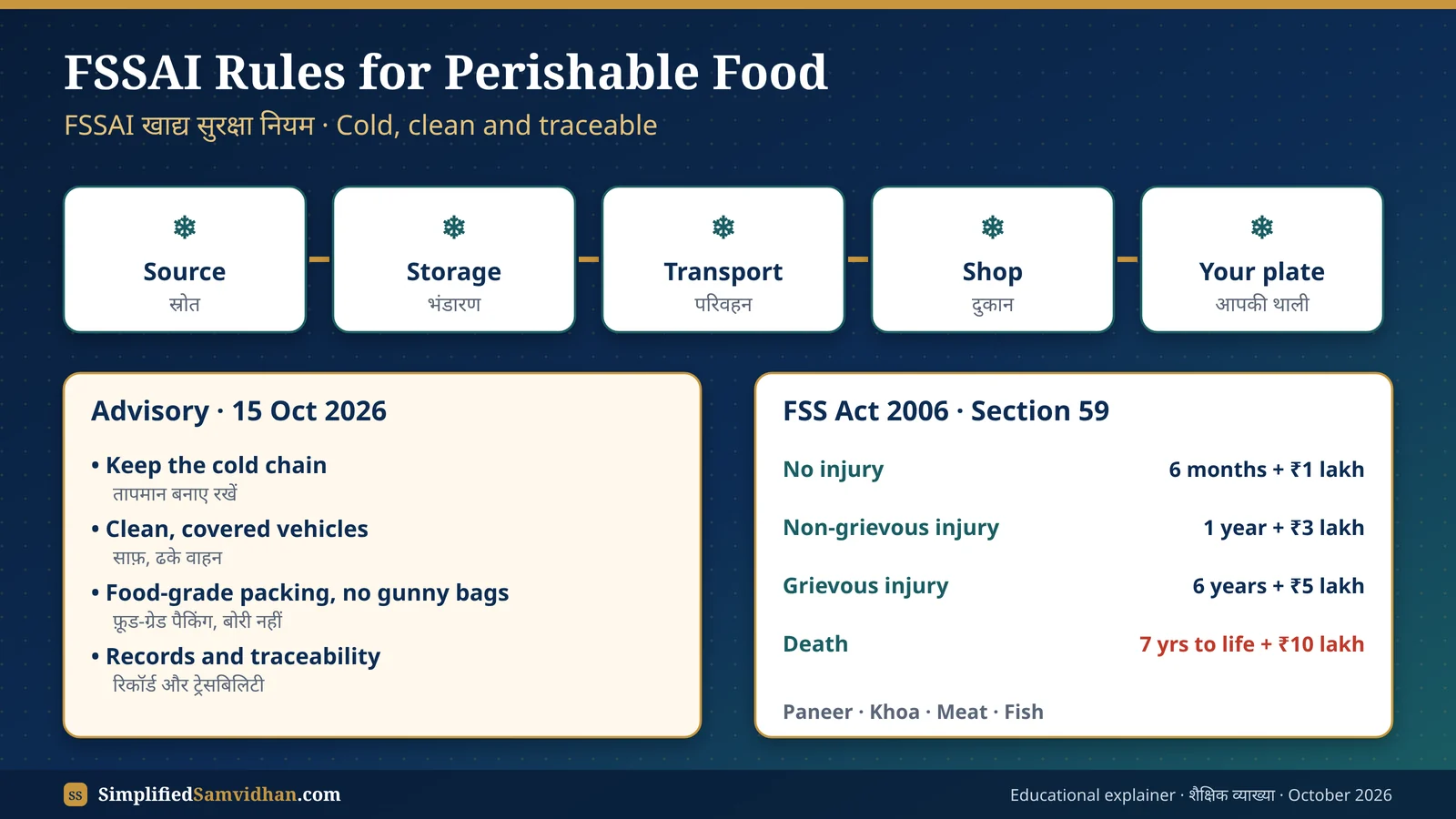
What FSSAI said on 15 October 2026
The Food Safety and Standards Authority of India (FSSAI) issued an advisory dated 15 October 2026 on the handling, storage and transport of perishable foods, naming khoa, paneer, meat and fish. It asks food businesses to keep the right temperature through the whole supply chain, from sourcing to delivery, to use clean, covered and hygienic vehicles, and to pack food only in food-grade material, not gunny bags or other non-food-grade coverings.
Businesses must keep records so that every consignment can be traced, and show invoices and documents to the food safety authority when asked. The advisory relies on existing rules, mainly the hygiene and sanitary requirements in Schedule 4 of the Food Safety and Standards (Licensing and Registration of Food Businesses) Regulations, 2011, and asks State food safety officers to keep strict vigilance and act against violations.
The AdvisoryFSSAI Rules for Perishable Food: The Five Duties in the October 2026 Advisory
- 1Keep it cold
Maintain the required temperature at every stage: collection, storage, transport and delivery.
- 2Clean vehicles
Use clean, covered vehicles suitable for food; no carrying food with chemicals or waste.
- 3Food-grade packing
Pack in food-grade material; gunny bags and non-food-grade covers are not allowed.
- 4Keep records
Maintain invoices and records so that each consignment can be traced back to its source.
- 5Inspections
State food safety officers to stay vigilant and take action under the FSS Act against violators.
Paneer, khoa, meat and fish are perishable: bacteria grow fast in them when they are warm. A truck of paneer that stands in the sun for six hours can look fine and still make people sick. The advisory says the "cold chain" must never break, and every packet must have a paper trail.
🏠 Everyday analogy
A cold chain is like a relay race with an ice cube. If any runner holds it too long in a warm hand, it melts, and it does not matter how fast the others ran.
🇮🇳 Real Indian example
Before Diwali, food officers in many cities seize hundreds of kilos of khoa that arrives in unrefrigerated buses from other States, often with no bill. Under this advisory, missing records and unsafe transport are themselves red flags.
Official TextArticle 47 and Section 26 of the Food Safety and Standards Act, 2006
Constitution of India, Article 47. Duty of the State to raise the level of nutrition and the standard of living and to improve public health.
The State shall regard the raising of the level of nutrition and the standard of living of its people and the improvement of public health as among its primary duties ...
Food Safety and Standards Act, 2006, Section 26(1). Responsibilities of the food business operator.
Every food business operator shall ensure that the articles of food satisfy the requirements of this Act and the rules and regulations made thereunder at all stages of production, processing, import, distribution and sale within the businesses under his control.
Article 47 is a Directive Principle: it tells the State that improving public health is one of its primary duties. Courts have also read the right to safe food into the right to life under Article 21. The FSS Act, 2006 turns this into law: under Section 26, the food business operator (the dairy, the transporter, the shop) is responsible for keeping food safe at every stage, not only at the factory.
PenaltiesPunishment for Unsafe Food in India Under the FSS Act, 2006
| If unsafe food causes ... | Punishment under Section 59 |
|---|---|
| No injury | Up to 6 months in jail and fine up to ₹1 lakh |
| Non-grievous injury | Up to 1 year in jail and fine up to ₹3 lakh |
| Grievous injury | Up to 6 years in jail and fine up to ₹5 lakh |
| Death | Not less than 7 years, up to life imprisonment, and fine not less than ₹10 lakh |
For ConsumersHow to Complain About Spoiled or Adulterated Food in India
- 1Check the label and bill
Packed food must show the FSSAI licence or registration number; ask for a bill at sweet shops and meat stalls.
- 2Complain to FSSAI
Use the Food Safety Connect app or portal of FSSAI, or the FSSAI consumer helpline.
- 3Go to the local officer
Every district has a Designated Officer and Food Safety Officers under the State Commissioner of Food Safety.
- 4Get it tested
Under Section 40 of the FSS Act, a consumer can get a food sample analysed by an accredited lab on payment; the fee is refunded if the food fails.
- 5Seek compensation
File a case before the Consumer Commission under the Consumer Protection Act, 2019 for loss or illness.
Duties of food businesses
- Cold, clean, covered transport
- Food-grade packing
- Records and traceability
- Valid FSSAI licence or registration
Rights of consumers
- Safe food under Article 21 and the FSS Act
- Complain to FSSAI or food officer
- Get food tested
- Compensation from Consumer Commission
UPSC CornerFSSAI and Food Safety Law for UPSC Prelims and Mains
- Prelims fact: FSSAI is a statutory body set up under the Food Safety and Standards Act, 2006, under the Ministry of Health and Family Welfare.
- Prelims fact: The FSS Act, 2006 consolidated older food laws, including the Prevention of Food Adulteration Act, 1954.
- Prelims fact: Article 47 (a Directive Principle) makes improvement of public health a primary duty of the State.
- Prelims fact: Each State has a Commissioner of Food Safety (Section 30 of the FSS Act) who enforces the law locally.
- Prelims fact: Under Section 59, unsafe food causing death is punishable with at least 7 years and up to life imprisonment.
- Mains (150 words): "Food safety in India fails in the supply chain, not in the statute book." Discuss with reference to FSSAI's 2026 advisory on perishable foods.
Practice MCQTest Yourself: FSSAI Rules for Perishable Food
Consider the following statements about the Food Safety and Standards Authority of India (FSSAI): (1) It is a statutory body established under the Food Safety and Standards Act, 2006. (2) It functions under the Ministry of Consumer Affairs, Food and Public Distribution. (3) Under the FSS Act, sale of unsafe food that causes death is punishable with imprisonment that may extend to life. Which of the statements given above is/are correct?
Doubts ClearedFrequently Asked Questions
What did FSSAI's October 2026 advisory say?
The advisory dated 15 October 2026 asks food businesses handling khoa, paneer, meat and fish to maintain the required temperature across the supply chain, use clean and covered vehicles, use food-grade packaging instead of gunny bags, and keep records so that each consignment can be traced. State food safety officers were asked to keep strict vigilance.
Is the FSSAI advisory a new law?
No. It is an advisory that reminds businesses of existing duties, mainly under the Food Safety and Standards Act, 2006 and Schedule 4 of the Licensing and Registration Regulations, 2011. Breaking those rules can still lead to penalties and prosecution.
What is the punishment for selling unsafe food in India?
Under Section 59 of the FSS Act, it ranges from up to 6 months' jail and ₹1 lakh fine (no injury) to at least 7 years and up to life imprisonment with a fine of at least ₹10 lakh if the food causes death.
How can I complain about adulterated paneer or khoa?
Complain through FSSAI's Food Safety Connect app or portal, or to your district's Food Safety Officer. You can also get a sample tested under Section 40 of the FSS Act and approach the Consumer Commission for compensation.
Which ministry does FSSAI come under?
FSSAI is a statutory authority under the Ministry of Health and Family Welfare, Government of India.
Sources and further readingSources We Checked
News facts on this page were checked against the reports below on 19 October 2026. Read the FSSAI advisory for exact conditions. Legal text is quoted from the Constitution of India and the Food Safety and Standards Act, 2006.
- Telangana Today: FSSAI issues fresh advisory on storage and transport of perishable foods
- Storyboard18: FSSAI issues advisory on storage, transport of perishable foods, including paneer, meat and fish
- Kashmir Reader: FSSAI orders temperature-controlled transport for perishable foods
- Food Safety and Standards Act, 2006 (India Code)
- FSSAI official website
- Constitution of India (Legislative Department)