Yes Bank AT1 Bonds Verdict: Why the Supreme Court Quashed the ₹8,415 Crore Write-off
In March 2020, while rescuing Yes Bank, its RBI-appointed administrator wiped out ₹8,415 crore of AT1 bonds, turning thousands of investors' money to zero overnight. On 15 October 2026 the Supreme Court said that write-off was not legal. Here is what AT1 bonds are, what the Court decided, the law behind it, and what every small investor should learn from the Yes Bank AT1 bonds case.
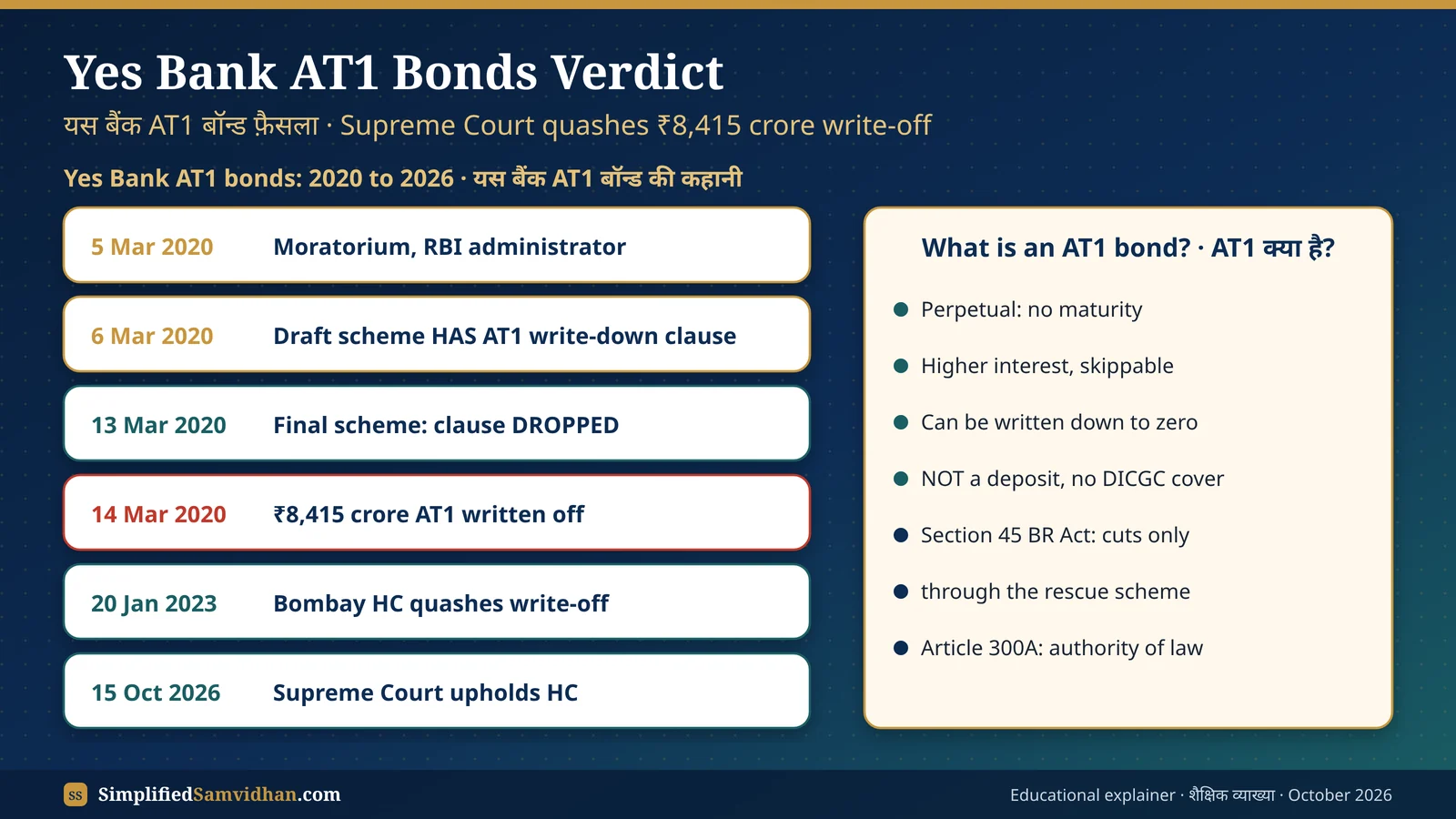
What the Supreme Court decided on 15 October 2026
On 15 October 2026 a bench of Justices Dipankar Datta and Augustine George Masih dismissed the appeals of Yes Bank, the Reserve Bank of India and the Union Government and upheld the Bombay High Court's judgment of 20 January 2023, which had quashed the write-off of ₹8,415 crore of Additional Tier 1 (AT1) bonds.
Why: As reported, the Court held that the administrator had no authority to write off the bonds because the final reconstruction scheme did not provide for it. The draft scheme of March 2020 had a clause allowing a full write-down; after objections, the final scheme dropped it, yet the administrator ordered the write-off anyway. Reports also say the Court criticised the RBI's role as a "mere bystander" and rejected the argument that restoring the bonds would harm the wider banking system. The ruling is about the authority and process in this case; it does not abolish the loss-absorbing nature of AT1 bonds in general. What exactly Yes Bank must now pay or restore, and how, was not clear from early reports.
BasicsWhat Are AT1 Bonds? Additional Tier 1 Bonds Explained
AT1 (Additional Tier 1) bonds are special bonds that banks issue to build up their capital under the global Basel III rules, which the RBI applies in India. They pay a higher interest than normal bonds because they carry extra risk:
- Perpetual: no fixed maturity date. The bank may buy them back (a "call"), but you cannot demand your money back.
- Interest can be skipped: the bank can stop paying the coupon if it is in trouble.
- Loss-absorbing: if the bank's capital falls below a set trigger, or the regulator decides the bank has reached the point of non-viability, the bonds can be converted into shares or written down, even to zero.
- Low in the queue: AT1 holders are paid after depositors and ordinary creditors if the bank fails.
A fixed deposit is like lending money to a friend with a fixed return date. An AT1 bond is more like becoming a partner who agreed to take the first hit if the shop runs into losses. You get more interest for taking that risk, but you can lose everything.
🏠 Everyday analogy
Think of a building with a shock absorber at the bottom. In an earthquake the shock absorber is crushed first so the building (depositors) survives. AT1 bonds are the bank's shock absorber.
🇮🇳 Real Indian example
Many Yes Bank AT1 bonds were sold to retail customers, including senior citizens, as if they were almost as safe as fixed deposits. When the bank collapsed in March 2020, they were the first to be wiped out.
BackgroundYes Bank AT1 Bonds Case: Timeline from 2020 to 2026
| Date | What happened |
|---|---|
| 5 Mar 2020 | RBI superseded Yes Bank's board, appointed an administrator (Prashant Kumar), and the Centre placed the bank under a moratorium with a ₹50,000 withdrawal limit. |
| 6 Mar 2020 | RBI published a draft reconstruction scheme. It contained a clause for writing down AT1 bonds. |
| 13 Mar 2020 | The final Yes Bank Ltd. Reconstruction Scheme, 2020 was notified. The AT1 clause was not in it. SBI and other banks put in fresh capital. |
| 14 Mar 2020 | The administrator wrote off AT1 bonds worth ₹8,415 crore. |
| Apr 2021 | SEBI imposed a ₹25 crore penalty on Yes Bank over the sale of AT1 bonds to retail investors. |
| 20 Jan 2023 | Bombay High Court quashed the write-off on petitions led by bondholders and their trustee. |
| Mar 2023 | Supreme Court stayed the High Court's judgment while hearing the appeals. |
| 15 Oct 2026 | Supreme Court (Justices Dipankar Datta and A.G. Masih) dismissed the appeals and upheld the High Court. |
Official TextSection 45 Banking Regulation Act and Article 300A: The Law in the Yes Bank AT1 Case
Banking Regulation Act, 1949: Section 45. Power of Reserve Bank to apply to Central Government for suspension of business by a banking company and to prepare scheme of reconstitution or amalgamation.
(4) During the period of moratorium or if the Reserve Bank is satisfied that—
(a) in the public interest; or
(b) in the interests of the depositors; or
(c) in order to secure the proper management of the banking company; or
(d) in the interests of the banking system of the country as a whole,
it is necessary so to do, the Reserve Bank may prepare a scheme—
(i) for the reconstruction of the banking company, or
(ii) for the amalgamation of the banking company with any other banking institution.
(5) The scheme aforesaid may contain provisions for all or any of the following matters, namely:— …
(e) the reduction of the interest or rights which the members, depositors and other creditors may have in or against the banking company before its reconstruction or amalgamation to such extent as the Reserve Bank considers necessary in the public interest or in the interests of the members, depositors and other creditors or for the maintenance of the business of the banking company;
Constitution of India: Article 300A. Persons not to be deprived of property save by authority of law.
No person shall be deprived of his property save by authority of law.
Section 45 lets the RBI prepare a rescue scheme for a failing bank, and that scheme may reduce the rights of shareholders, depositors and creditors. So the law does give a power to cut investors' rights, but only through the scheme. In Yes Bank's case the final scheme said nothing about AT1 bonds, so the administrator's write-off had no legal backing. That links to Article 300A: your property, including money you invested, can be taken away only by authority of law, not by an officer's decision that the law did not allow.
🏠 Everyday analogy
A society's general body passes a rule on how to share repair costs. The secretary cannot later charge one family extra on his own, just because an early draft of the rule had that idea.
🇮🇳 Real Indian example
The draft Yes Bank scheme had an AT1 write-down clause; the final scheme did not. The next day the administrator wrote the bonds off anyway. Both the High Court and the Supreme Court said this went beyond his powers.
The DebateYes Bank AT1 Bonds: Arguments of Bondholders vs RBI and Yes Bank
Bondholders (won)
- The final scheme had no AT1 write-down clause, so the administrator had no power
- The write-off came after the scheme was notified, when the bank was being rescued, not failing
- Many retail investors were mis-sold the bonds as safe products
- Taking property without legal authority violates Article 300A
Yes Bank, RBI and the Centre (lost)
- AT1 bonds are governed by RBI's Basel III rules and the bond contract, which allow write-down
- The write-off was needed before SBI and other banks put in money
- About ₹1.81 lakh crore of AT1 bonds are outstanding across Indian banks; reversing the write-off could unsettle the market
- Investors knew AT1 bonds were high-risk
World parallel: In March 2023 Swiss regulator FINMA wrote off about $17 billion of Credit Suisse AT1 bonds during its takeover by UBS, while shareholders got something. That too was challenged in court. AT1 risk is real worldwide.
For CitizensAT1 Bonds Investor Awareness: 6 Lessons From the Yes Bank Case
- 1Know what you are buying
Ask in writing: Is this a fixed deposit, a normal bond, or an AT1/perpetual bond? AT1 is not a deposit and has no DICGC insurance.
- 2High interest means high risk
If a bank product pays much more than an FD, find out why. In AT1 the extra interest is the price of possible total loss.
- 3Deposit insurance is only for deposits
DICGC covers bank deposits up to ₹5 lakh per depositor per bank. Bonds, shares and mutual funds are not covered.
- 4Mis-selling is a complaint
If a bank officer sold you a risky product as "safe as FD", complain to the bank, then the RBI Ombudsman (cms.rbi.org.in) or SEBI SCORES (scores.sebi.gov.in) for securities.
- 5Ticket size rules changed
After the Yes Bank episode SEBI raised the minimum investment for privately placed AT1 bonds to ₹1 crore, to keep small investors away from them.
- 6Courts check legality, not losses
The 2026 verdict helps Yes Bank's AT1 holders because the write-off lacked legal authority. It does not mean every AT1 loss can be reversed.
In simple words: never treat a high-interest bank bond like a fixed deposit. Read the product name, ask about risk, and keep a written record of what you were told.
UPSC CornerYes Bank AT1 Bonds for UPSC Prelims and Mains
- Prelims fact: AT1 bonds are part of a bank's Tier 1 capital under Basel III; they are perpetual, have discretionary coupons and absorb losses through write-down or conversion.
- Prelims fact: Section 45 of the Banking Regulation Act, 1949 allows a moratorium and an RBI-prepared scheme of reconstruction or amalgamation of a bank.
- Prelims fact: Right to property is a constitutional right under Article 300A (moved out of Part III by the 44th Amendment, 1978), not a Fundamental Right.
- Prelims fact: DICGC (a subsidiary of RBI) insures bank deposits up to ₹5 lakh per depositor per bank; bonds are not covered.
- Mains (250 words): "Bank rescues must balance financial stability with the rule of law." Discuss with reference to the Supreme Court's 2026 verdict on the Yes Bank AT1 bond write-off.
- Mains (150 words): What are AT1 bonds? Why is their sale to retail investors a concern for financial consumer protection in India?
- Ethics angle: Mis-selling of complex financial products to senior citizens: whose responsibility is it, the bank officer's, the bank's or the regulator's?
Practice MCQTest Yourself: Yes Bank AT1 Bonds Verdict
With reference to Additional Tier 1 (AT1) bonds, consider the following statements: (1) They are perpetual bonds with no fixed maturity date. (2) They are insured by DICGC up to ₹5 lakh like bank deposits. (3) They can be written down if the issuing bank reaches the point of non-viability. Which of the statements given above is/are correct?
Doubts ClearedFrequently Asked Questions
What is the Yes Bank AT1 bonds case?
In March 2020, during Yes Bank's rescue, its RBI-appointed administrator wrote off AT1 bonds worth ₹8,415 crore. Bondholders challenged it. The Bombay High Court quashed the write-off on 20 January 2023, and on 15 October 2026 the Supreme Court dismissed the appeals of Yes Bank, the RBI and the Centre.
Why did the Supreme Court quash the AT1 write-off?
As reported, the Court held that the administrator had no authority to write off the bonds because the final Yes Bank Reconstruction Scheme, 2020 did not provide for it. The draft scheme had such a clause, but it was dropped from the final scheme.
What are AT1 bonds in simple words?
AT1 (Additional Tier 1) bonds are high-interest, perpetual bonds that banks issue to strengthen their capital. In return for higher interest, investors accept that the bonds can be written down or converted to shares if the bank gets into serious trouble.
Are AT1 bonds safe like fixed deposits?
No. They are not deposits, are not covered by DICGC deposit insurance, have no maturity date, and can lose their entire value. SEBI now requires a minimum investment of ₹1 crore for privately placed AT1 bonds.
Will Yes Bank AT1 bondholders get their money back?
The Supreme Court has upheld the order quashing the write-off, which restores the bondholders' legal position. Exactly how and when Yes Bank will restore or pay the bondholders was not clear from early reports and depends on the judgment's directions and further steps.
Sources and further readingSources We Checked
News facts on this page were checked against the reports below on 17 October 2026. The full judgment text was not available to us when this page was written. This page is for education, not investment advice.
- Bar & Bench, 15 Oct 2026: Supreme Court upholds quashing of Yes Bank's ₹8,415 crore AT1 bond write-off
- ThePrint: Yes Bank AT-1 bonds: why SC ruled against Rs 8,415 cr write-off and called RBI 'mere bystander'
- IBC Laws: Yes Bank Ltd. and Anr. vs. Axis Trustee Services Ltd. and Ors. (Supreme Court)
- LawChakra: Supreme Court upholds Bombay HC verdict quashing Yes Bank AT1 bond write-off
- Business Standard, Apr 2021: SEBI imposes Rs 25 cr penalty on Yes Bank in AT1 bonds case