India-New Zealand FTA 2026: What Changes Now That It Is in Force
The India-New Zealand Free Trade Agreement came into force on 20 October 2026. New Zealand now charges no customs duty on any Indian product, while India has opened most of its market but kept dairy, sugar and edible oils out. Here is what the deal says, why dairy decided the talks for 15 years, and what it means for exporters, farmers and students.
What happened on 20 October 2026
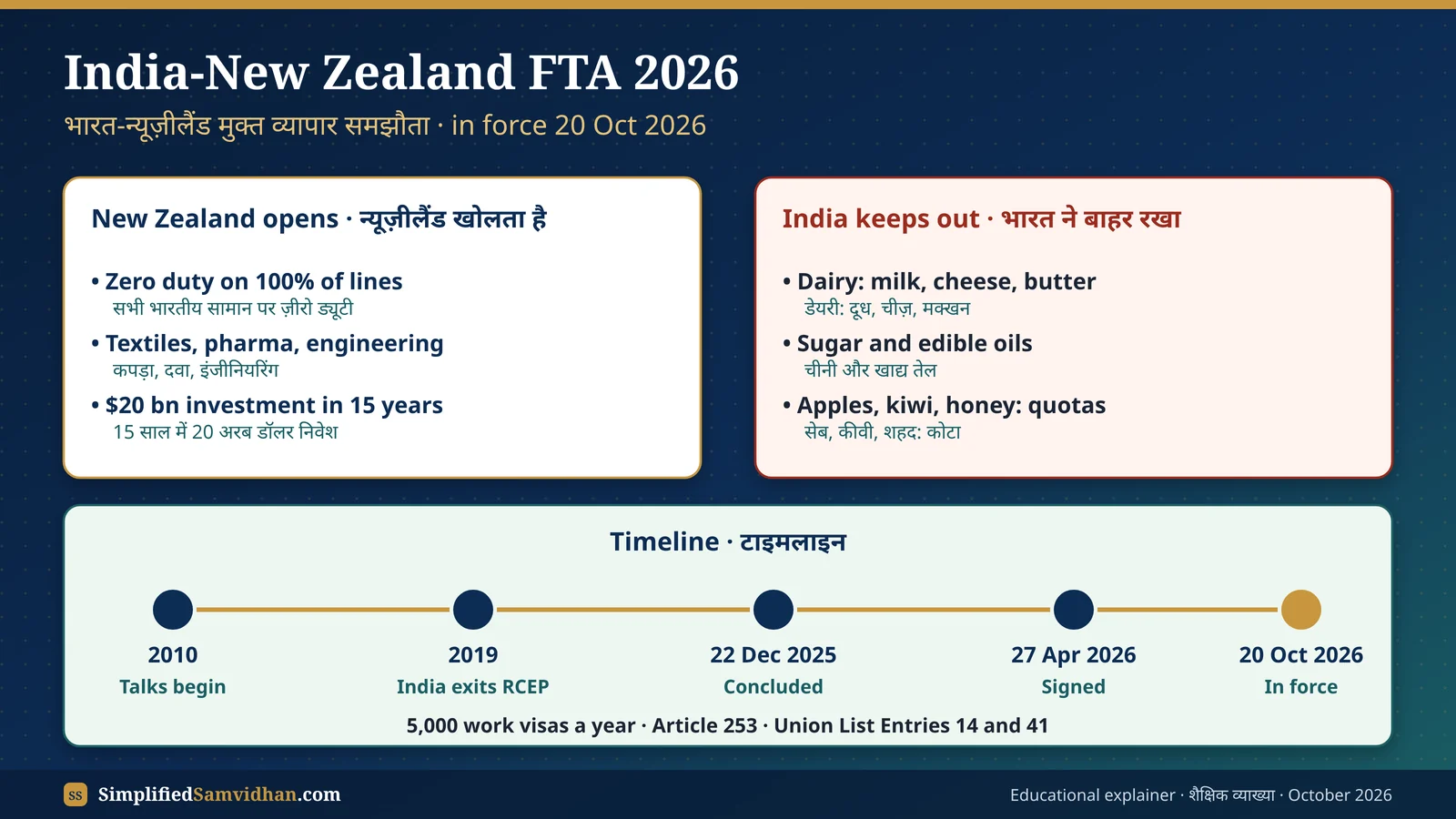
The India-New Zealand Free Trade Agreement (FTA) came into force on Tuesday, 20 October 2026, after both countries finished their domestic approval steps. It was signed on 27 April 2026 at Bharat Mandapam, New Delhi, by Commerce Minister Piyush Goyal and New Zealand's Trade Minister Todd McClay. A day earlier, on 19 October, the two customs services signed a pact to exchange certificate-of-origin data electronically.
From day one, New Zealand removed duty on 100% of its tariff lines for Indian goods (8,284 product lines, as reported). India gives preferential access on about 70% of its tariff lines, covering about 95% of New Zealand's exports, much of it phased in over years; McClay said 57% of New Zealand's exports enter India duty-free from day one. Dairy, sugar and edible oils stay out of India's offer. Bilateral trade was about $1.15 billion in 2025-26.
At a GlanceIndia-New Zealand FTA at a Glance: Key Facts 2026
| Point | Fact |
|---|---|
| Signed / in force | 27 April 2026, New Delhi / 20 October 2026 |
| New Zealand's offer | Zero duty on all Indian goods (100% of tariff lines) from day one |
| India's offer | Preferential access on about 70% of tariff lines (about 95% of NZ exports), many phased in |
| Kept out by India | Dairy (milk, cheese, butter, yoghurt, whey), sugar, edible oils, some farm and industrial goods |
| Under quotas | Apples, kiwifruit, Manuka honey and milk albumins enter only within fixed quotas |
| Investment | New Zealand to facilitate about $20 billion of investment in India over 15 years |
| People | 5,000 Temporary Employment Entry visas and 1,000 working holiday visas a year; student and post-study work rights; AYUSH and yoga professionals |
| Services | About 118 service sectors opened to Indian providers (as reported) |
| Trade now | About $1.15 billion in 2025-26 |
An FTA is a deal in which two countries agree to cut or remove the tax (customs duty) they charge on each other's goods. New Zealand has removed this tax on every Indian product. India has removed or cut it on most New Zealand products, but not on milk products, because crores of small Indian farmers live on dairy and New Zealand is one of the world's biggest milk exporters.
🏠 Everyday analogy
Think of two shopkeepers in a market. One says: "Bring anything to my shop, no entry fee." The other says: "Most of my gates are open too, but my milk counter stays closed, because my whole family depends on it."
🇮🇳 Real Indian example
A garment maker in Tiruppur or an auto-parts firm in Pune can now sell in New Zealand without customs duty, while a dairy farmer in Anand or Karnal does not have to compete with cheap New Zealand milk powder.
HistoryIndia-New Zealand FTA Timeline: From 2010 Talks to the 2026 Deal
| Year | Event |
|---|---|
| 1952 | India and New Zealand establish diplomatic relations; both are Commonwealth members. |
| 2010-2015 | First round of FTA talks (launched 2010) stalls after about ten rounds, mainly over dairy. |
| Nov 2019 | India walks out of RCEP, the Asia-Pacific mega trade deal that New Zealand is part of. |
| 16 Mar 2025 | PM Christopher Luxon visits India; the two sides relaunch FTA negotiations. |
| 22 Dec 2025 | PM Modi and PM Luxon announce the conclusion of talks. |
| 27 Apr 2026 | Piyush Goyal and Todd McClay sign the FTA at Bharat Mandapam, New Delhi. |
| 19 Oct 2026 | Customs chiefs sign a pact for electronic exchange of origin data under the FTA. |
| 20 Oct 2026 | The FTA comes into force. |
How It WorksHow the India-New Zealand FTA Works: From Signing to Use
- 1Negotiation and signing
The Commerce Ministry negotiates; the Union Cabinet approves; the minister signs (27 April 2026).
- 2Entry into force
Each side completes its domestic process; the agreement starts on an agreed date (20 October 2026).
- 3Customs notifications
India's Finance Ministry notifies the lower duty rates under the Customs Tariff Act, 1975.
- 4Rules of origin
Only goods that really originate in India or New Zealand get the lower duty; exporters need a certificate of origin, now shared electronically.
- 5Review
Joint committees review the deal; tariff cuts on many items phase in over several years.
In India, a trade agreement is signed by the government (the executive). Parliament does not vote on it unless a new law is needed. The lower duties start only when the Finance Ministry issues customs notifications.
Official TextArticle 51 and Article 253: The Constitution and Trade Treaties
Constitution of India, Article 51. Promotion of international peace and security.
The State shall endeavour to (a) promote international peace and security; (b) maintain just and honourable relations between nations; (c) foster respect for international law and treaty obligations in the dealings of organised peoples with one another; and (d) encourage settlement of international disputes by arbitration.
Article 253. Legislation for giving effect to international agreements.
Notwithstanding anything in the foregoing provisions of this Chapter, Parliament has power to make any law for the whole or any part of the territory of India for implementing any treaty, agreement or convention with any other country or countries or any decision made at any international conference, association or other body.
- Article 73 extends the Union's executive power to matters on which Parliament can make laws, including Union List Entry 10 (foreign affairs), Entry 14 (entering into treaties and agreements) and Entry 41 (trade and commerce with foreign countries).
- Article 253 lets Parliament make a law to implement a treaty, even on a State List subject, if one is needed.
- Article 51(c) asks the State to foster respect for international law and treaty obligations. It is a Directive Principle and cannot be enforced in court.
Why It MattersIndia-New Zealand FTA: Gains vs Concerns
Gains for India
- Zero duty for textiles, leather, engineering goods, pharma, gems and jewellery
- A pledge of $20 billion investment over 15 years
- Work visas, working holiday visas and student mobility
- A foothold in the Pacific and a partner in the Indo-Pacific
Concerns
- New Zealand is a small market: trade is only about $1.15 billion
- Apple and kiwi growers watch the quotas closely
- Investment figure is a promotion goal, not a binding transfer
- Trade fell about 11% in 2025-26
UPSC CornerIndia-New Zealand FTA for UPSC Prelims and Mains
- Prelims: Signed 27 April 2026, in force 20 October 2026; dairy excluded; New Zealand's capital is Wellington.
- Prelims: New Zealand is a member of RCEP and CPTPP; India is in neither. India left RCEP in November 2019.
- Prelims: Union List Entry 14 (treaties) and Entry 41 (foreign trade); Article 253 for implementing laws.
- Mains (GS II/III): "India's new FTAs protect agriculture while opening manufacturing and services." Discuss with the New Zealand, UK and EFTA deals as examples.
Practice MCQTest Yourself: India-New Zealand FTA: In Force From 20 October
With reference to the India-New Zealand Free Trade Agreement, consider the following statements: (1) It came into force on 20 October 2026. (2) India has given New Zealand duty-free access for milk powder and cheese. (3) New Zealand has removed customs duty on all its tariff lines for Indian goods. Which of the statements given above is/are correct?
Doubts ClearedFrequently Asked Questions
When did the India-New Zealand FTA come into force?
On 20 October 2026. It was concluded on 22 December 2025 and signed in New Delhi on 27 April 2026.
Is dairy included in the India-New Zealand FTA?
No. India kept dairy products such as milk, cheese, butter, yoghurt and whey out of its tariff cuts, along with sugar and edible oils. India only promised to consult New Zealand if it gives dairy access to a comparable country in future.
What do Indian exporters get?
New Zealand charges zero customs duty on all Indian goods from day one, which helps textiles, leather, engineering goods, pharma and jewellery.
What visas does the FTA offer to Indians?
As reported, 5,000 Temporary Employment Entry visas and 1,000 working holiday visas a year, plus work rights for students and post-study work for some graduates.
Does Parliament approve India's FTAs?
No vote is needed. Trade agreements are signed by the Union government under Article 73 and Union List Entries 14 and 41; Parliament makes a law under Article 253 only if implementation needs one.
Sources and further readingSources We Checked
Facts checked against the reports below on 26 October 2026. Figures such as tariff lines and visa numbers are as reported by the governments and media; check the official agreement text on the Commerce Ministry website for exact schedules.
- ANI: India-New Zealand FTA comes into force; leaders welcome expanded trade and investment opportunities (20 Oct 2026)
- The Tribune: India-New Zealand FTA comes into force, offers zero-duty access for Indian goods, new visa pathways (20 Oct 2026)
- Manorama Yearbook: India-New Zealand FTA comes into force, explained (21 Oct 2026)
- eDairy News: India-New Zealand FTA takes effect as India shields domestic dairy sector
- Business Standard: India, New Zealand sign pact for electronic exchange of trade origin data (Oct 2026)
- New Zealand Government (Beehive): Historic NZ-India FTA signed in New Delhi (27 Apr 2026)
- New Zealand MFAT: Summary of the New Zealand-India Free Trade Agreement
- Al Jazeera: India and New Zealand conclude free trade agreement (22 Dec 2025)