The 3-Hour Takedown Rule: How India Now Polices Social Media and AI Content
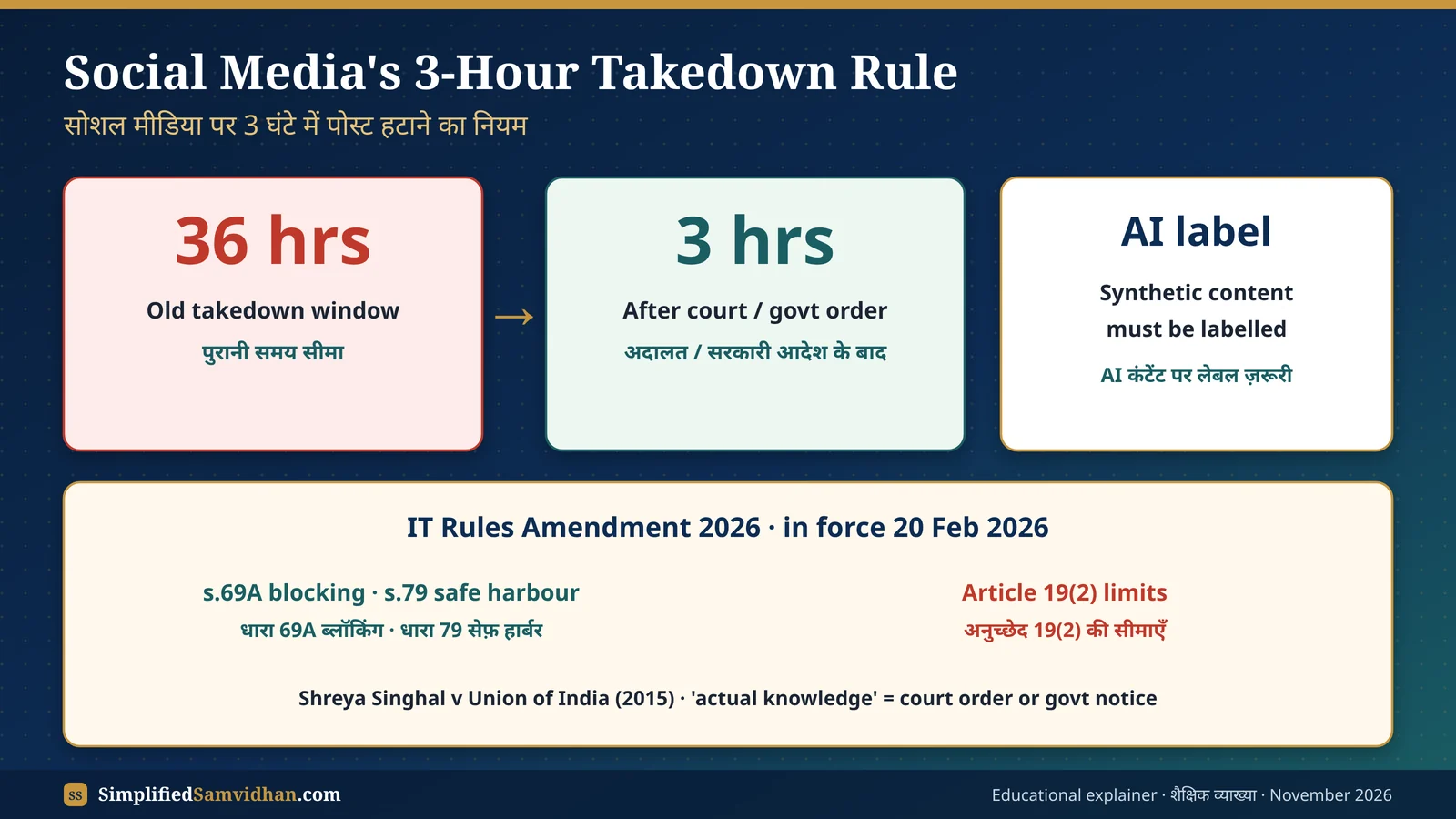
A post can reach millions in three hours. That is now also the time a social media platform gets to remove it once a court or the government flags it as unlawful. Under the IT Rules Amendment, 2026, in force since 20 February 2026, the old 36-hour window has shrunk to 3 hours, and AI-made content must carry a visible label. As the rules complete nine months, the debate on speed versus free speech is back in the news. Here is what the rules say and what they mean for you.
What the rules say
The Ministry of Electronics and IT (MeitY) notified the Information Technology (Intermediary Guidelines and Digital Media Ethics Code) Amendment Rules, 2026 (G.S.R. 120(E)) on 10 February 2026. They came into force on 20 February 2026. The main change: once a platform gets a court order or an authorised government notice about unlawful content, it must take it down within 3 hours, instead of the earlier 36 hours. Reports say even tighter limits apply to the most harmful content, such as non-consensual intimate images.
The rules also define "synthetically generated information", meaning AI-made or AI-altered audio, video or images that look real, such as deepfakes. Such content must carry a clear label and embedded metadata showing its origin, and large platforms must ask users to declare when they upload it.
At a GlanceIT Rules Amendment 2026: Key Facts
| Point | Fact |
|---|---|
| Rules | IT (Intermediary Guidelines and Digital Media Ethics Code) Amendment Rules, 2026 |
| Notified | 10 February 2026, G.S.R. 120(E), by MeitY under Section 87 of the IT Act |
| In force | 20 February 2026 |
| Takedown time | 3 hours after a court order or authorised government notice (earlier 36 hours) |
| AI content | 'Synthetically generated information' must be labelled and carry provenance metadata |
| Penalty for not complying | Platform can lose 'safe harbour' protection under Section 79 |
| Key case | Shreya Singhal v Union of India (2015) |
Platforms like Instagram, YouTube or X are 'intermediaries': they carry what users post. The law protects them from being punished for users' posts, but only if they follow the government's rules. One rule now is speed: if a court or an authorised officer says a post is illegal, it must go within 3 hours. Another is honesty: if a video or photo is made by AI, it must say so.
🏠 Everyday analogy
A newspaper vendor is not punished for every article in the paper he sells. But if the police officially tell him a particular issue is banned, he must pull it off his stall quickly, or he loses that protection.
🇮🇳 Real Indian example
A deepfake video showing a politician saying something they never said goes viral during an election. Under the rule, once the platform receives a valid order it has 3 hours to remove it, and the video should have carried an 'AI-generated' label in the first place.
How It WorksFrom Complaint to Takedown: The 3-Hour Process
- 1Unlawful content found
A court, or an officer authorised by the government, identifies a post as unlawful.
- 2Order or notice
The platform receives a court order or a notice under the IT Act and Rules.
- 33-hour clock
The platform must remove or disable access within 3 hours.
- 4Records kept
The platform keeps records for investigation as the Rules require.
- 5Challenge
The user or platform can challenge the order before the courts.
Official TextArticle 19(1)(a) and 19(2): The Constitutional Limits
Constitution of India, Article 19(1)(a) and 19(2).
(1) All citizens shall have the right (a) to freedom of speech and expression;
(2) Nothing in sub-clause (a) of clause (1) shall affect the operation of any existing law, or prevent the State from making any law, in so far as such law imposes reasonable restrictions on the exercise of the right conferred by the said sub-clause in the interests of the sovereignty and integrity of India, the security of the State, friendly relations with foreign States, public order, decency or morality or in relation to contempt of court, defamation or incitement to an offence.
- Section 69A, IT Act: lets the Centre block content on grounds similar to Article 19(2), with written reasons.
- Section 79, IT Act: gives intermediaries 'safe harbour' from liability for users' content if they observe due diligence.
- Shreya Singhal (2015): the Supreme Court struck down Section 66A, upheld Section 69A, and held that a platform must act on 'actual knowledge' only through a court order or a government notification.
- Any takedown must fit one of the grounds in Article 19(2); 'offensive' or 'annoying' alone is not enough.
Both Sides3-Hour Rule: Safety vs Free Speech
Supporters say
- Deepfakes and fake news spread in minutes, not days
- Victims of intimate image abuse need fast relief
- Labels help people know what is real
- Big platforms have the money and staff to act quickly
Critics say
- 3 hours leaves no time to check if an order is lawful
- Platforms may remove more than needed to stay safe
- Smaller platforms and startups may struggle
- Must still pass the Shreya Singhal and Article 19(2) test
UPSC CornerIT Rules Amendment 2026 for UPSC Prelims and Mains
- Prelims: Section 79 of the IT Act deals with intermediary 'safe harbour'; Section 69A with blocking of content.
- Prelims: Shreya Singhal v Union of India (2015) struck down Section 66A of the IT Act.
- Prelims: The 2026 amendment introduced the term 'synthetically generated information' for AI-made content.
- Mains (GS II): "Speed of takedown must not come at the cost of due process." Examine the 3-hour rule in the light of Article 19.
Practice MCQTest Yourself: Social Media's 3-Hour Rule
With reference to the IT Rules Amendment, 2026, consider the following statements: (1) Platforms must remove unlawful content within 3 hours of a court order or authorised government notice. (2) AI-generated content that looks real must be labelled. (3) The rules were made under Section 66A of the IT Act. Which of the statements given above is/are correct?
Doubts ClearedFrequently Asked Questions
What is the 3-hour takedown rule?
Under the IT Rules Amendment 2026, a social media platform must remove unlawful content within 3 hours of receiving a court order or an authorised government notice.
When did the 3-hour rule come into force?
The amendment was notified on 10 February 2026 and came into force on 20 February 2026.
What was the earlier time limit?
36 hours.
Does AI-generated content need a label?
Yes. 'Synthetically generated information' that looks real must carry a clear label and provenance metadata.
Can the government remove any post it dislikes?
No. A takedown must fall within the grounds of Article 19(2) and follow the IT Act procedure, and it can be challenged in court.
Sources and further readingSources We Checked
Facts checked against the reports below on 2 November 2026. Reported time limits for special categories vary between sources; the Gazette notification G.S.R. 120(E) is the final word.
- LiveLaw: Centre notifies IT Rules amendment to regulate AI-generated content; platforms must take down illegal content within 3 hours
- Vajiram and Ravi: IT Rules Amendment 2026, 3-hour rule, features, significance
- Vision IAS: Centre notifies IT Rules amendment, 3-hour takedown deadline for AI content
- Drishti IAS: Information Technology Amendment Rules, 2026