PM Samajik Sahayata Yojana: What Changes in India's Old-Age, Widow and Disability Pensions
About 3 crore of India's poorest elderly people, widows and persons with disabilities get a small monthly pension from the Centre. On 14 October 2026 the Union Cabinet extended this programme for five more years, gave it a new name, and opened the disability pension to many more people. Here is what changed, the constitutional promise behind it, and who can apply.
What the Cabinet decided on 14 October 2026
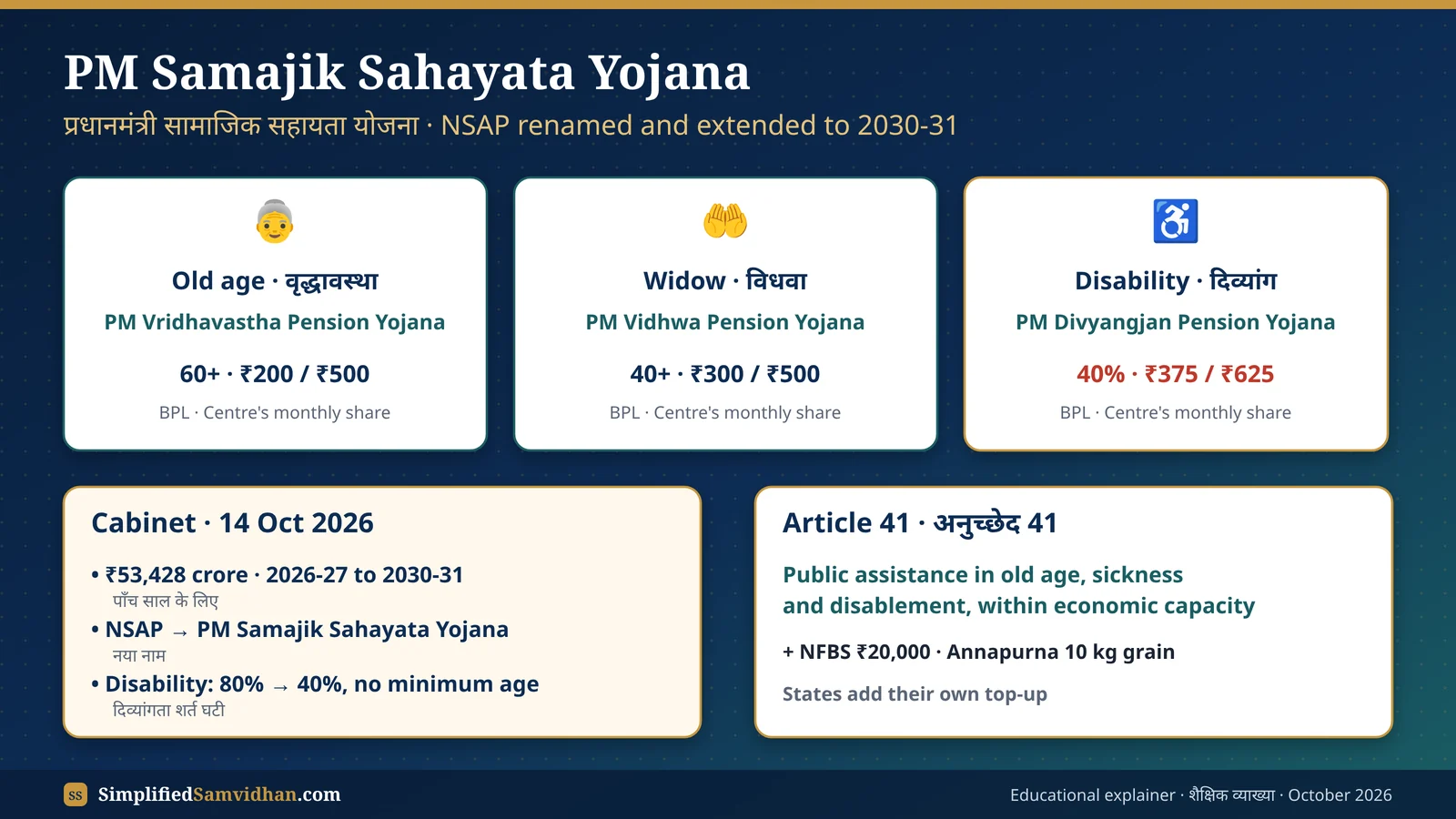
The Union Cabinet approved the continuation of the National Social Assistance Programme (NSAP) for five years, 2026-27 to 2030-31, with a total outlay of ₹53,428 crore. The programme is renamed the Pradhan Mantri Samajik Sahayata Yojana, and its three pensions, earlier named after Indira Gandhi, become the Pradhan Mantri Vridhavastha Pension Yojana (old age), Pradhan Mantri Vidhwa Pension Yojana (widows) and Pradhan Mantri Divyangjan Pension Yojana (disability).
The biggest change is in the disability pension: the benchmark disability falls from 80 percent to 40 percent, in line with the Rights of Persons with Disabilities Act, 2016, the minimum age is removed, and the monthly central amount rises to ₹375 (up to 79 years) and ₹625 (80 and above), from ₹300 and ₹500. Reports put total coverage at about 3.20 crore beneficiaries in all 36 States and UTs. The old-age and widow pensions continue in their existing form; detailed guidelines are due within three months.
The SchemePM Samajik Sahayata Yojana: The Five Parts of the Old NSAP
| Old name | New name (2026) | Who gets it (central norms) |
|---|---|---|
| IGNOAPS (old-age pension) | PM Vridhavastha Pension Yojana | BPL persons aged 60+: ₹200 a month (60-79), ₹500 (80+) |
| IGNWPS (widow pension) | PM Vidhwa Pension Yojana | BPL widows aged 40+: ₹300 a month (40-79), ₹500 (80+) |
| IGNDPS (disability pension) | PM Divyangjan Pension Yojana | BPL persons with 40%+ disability, any age: ₹375 (up to 79), ₹625 (80+) |
| NFBS (family benefit) | Part of the programme | One-time ₹20,000 to a BPL family when the main earner (18-59) dies |
| Annapurna | Part of the programme | 10 kg free food grains a month to eligible elderly not getting a pension |
Think of NSAP as a floor under the poorest families. It does not replace a salary, but it makes sure that an old person with no income, a widow with no support or a person with a serious disability gets something every month. The 2026 decision keeps this floor for five more years and makes the disability part much wider.
🏠 Everyday analogy
It is like the safety net under a circus trapeze. It does not make anyone a star, but it stops a fall from becoming a disaster.
🇮🇳 Real Indian example
A 12-year-old child with 50 percent locomotor disability in a BPL family could not get the central disability pension before, because the rule needed 80 percent disability and age 18. Under the new rules, the child qualifies.
Official TextArticle 41 and Entry 24 of the Concurrent List
Constitution of India, Article 41. Right to work, to education and to public assistance in certain cases.
The State shall, within the limits of its economic capacity and development, make effective provision for securing the right to work, to education and to public assistance in cases of unemployment, old age, sickness and disablement, and in other cases of undeserved want.
Seventh Schedule, List III (Concurrent List), Entry 24.
Welfare of labour, including conditions of work, provident funds, employers' liability, workmen's compensation, invalidity and old age pensions and maternity benefits.
Article 41 is a Directive Principle: it asks the State to give public assistance in old age, sickness and disablement, but only "within the limits of its economic capacity". Courts cannot force a pension under Article 41 alone, but NSAP is how the Centre puts this promise into practice. Old age pensions are also in Entry 24 of the Concurrent List, and relief of the disabled and unemployable is in Entry 9 of the State List, which is why States run and top up these pensions.
What ChangedDisability Pension Rules 2026: Old vs New
Before (IGNDPS)
- 80% disability needed
- Age 18 to 79 only
- ₹300 a month (18-79)
- ₹500 a month (80+)
After (PM Divyangjan Pension)
- 40% benchmark disability
- No minimum age
- ₹375 a month (up to 79)
- ₹625 a month (80+)
How to ApplyHow to Apply for Old-Age, Widow or Disability Pension
- 1Check eligibility
You must belong to a BPL household as per the State's list, and meet the age or disability rule.
- 2Get documents
Aadhaar, BPL proof, age proof; a death certificate for widow pension; a UDID card or disability certificate for disability pension.
- 3Apply locally
Apply at the Gram Panchayat or Block office in villages, or the municipal office in towns; many States also take online applications.
- 4Sanction and payment
After verification, the pension is paid by DBT into your bank or post office account.
- 5Track it
The NSAP portal (nsap.nic.in) lets you check beneficiary lists and payment status.
UPSC CornerNSAP and Article 41 for UPSC Prelims and Mains
- Prelims fact: NSAP was launched on 15 August 1995 as a Centrally Sponsored Scheme; it is run by the Ministry of Rural Development.
- Prelims fact: Article 41 (a Directive Principle) mentions public assistance in cases of unemployment, old age, sickness and disablement.
- Prelims fact: "Invalidity and old age pensions" are in Entry 24 of the Concurrent List; "relief of the disabled and unemployable" is in Entry 9 of the State List.
- Prelims fact: Under the RPwD Act, 2016, benchmark disability means at least 40 percent of a specified disability; the Act lists 21 disabilities.
- Prelims fact: The 2026 renaming: NSAP → PM Samajik Sahayata Yojana; IGNOAPS → PM Vridhavastha Pension Yojana; IGNDPS → PM Divyangjan Pension Yojana.
- Mains (150 words): "India's social pensions are a promise of Article 41 kept at a very low price." Examine with reference to the 2026 changes to NSAP.
Practice MCQTest Yourself: PM Samajik Sahayata Yojana: NSAP Renamed
With reference to the National Social Assistance Programme (NSAP), now renamed Pradhan Mantri Samajik Sahayata Yojana, consider the following statements: (1) It is implemented by the Ministry of Social Justice and Empowerment. (2) Under the October 2026 decision, the disability threshold for the central disability pension is lowered to 40 percent. (3) It gives effect to the Directive Principle in Article 41. Which of the statements given above is/are correct?
Doubts ClearedFrequently Asked Questions
What is the Pradhan Mantri Samajik Sahayata Yojana?
It is the new name of the National Social Assistance Programme (NSAP), given by the Union Cabinet on 14 October 2026 when it extended the programme for 2026-27 to 2030-31 with ₹53,428 crore. It covers old-age, widow and disability pensions, the National Family Benefit Scheme and Annapurna.
Has the old-age pension amount increased in 2026?
Reports on the Cabinet decision say the old-age and widow pensions continue in their existing form. The central share has been ₹200 a month (60-79 years) and ₹500 (80+), and States add their own top-up. The detailed guidelines, due within three months, will confirm any change.
What changed in the disability pension?
The disability pension, now the Pradhan Mantri Divyangjan Pension Yojana, needs 40 percent benchmark disability instead of 80 percent, has no minimum age, and pays ₹375 a month up to 79 years and ₹625 at 80 and above, up from ₹300 and ₹500.
Who can apply for NSAP pensions?
Persons from BPL households who meet the scheme's age, widowhood or disability conditions. Applications go to the Gram Panchayat, Block or municipal office or the State's online portal, and payment is made by DBT.
Which Article of the Constitution is linked to old-age pension?
Article 41, a Directive Principle, asks the State to provide public assistance in cases of old age, sickness and disablement within the limits of its economic capacity. Old-age pensions also appear in Entry 24 of the Concurrent List.
Sources and further readingSources We Checked
News facts on this page were checked against the PIB release and the reports below on 21 October 2026. Exact amounts and rules will be in the new guidelines; States may pay more than the central share.
- PM India (PIB): Cabinet approves continuation of the National Social Assistance Programme for five years from 2026-27 to 2030-31
- DD News: Cabinet approves Rs 53,428 crore social assistance programme, expands disability pension eligibility
- Business Standard: Cabinet extends social assistance scheme till FY31 with Rs 53,428 crore outlay
- Outlook Money: Pradhan Mantri Divyangjan Pension Yojana: what benefits does the scheme offer
- NSAP official website (Ministry of Rural Development)
- Constitution of India (Legislative Department)