Ethanol Blending Policy India: Why Oil Companies Have Shut Out Sugar-Based Ethanol for 2026-27
Every litre of petrol you buy in India now carries about one-fifth ethanol, much of it once made from sugarcane. On 16 October 2026 the oil companies' tender for the next ethanol year left sugar out completely. Why would a country push ethanol and then refuse ethanol from cane? The answer is a weak monsoon, costly sugar and the old food-vs-fuel question.
What the oil companies decided
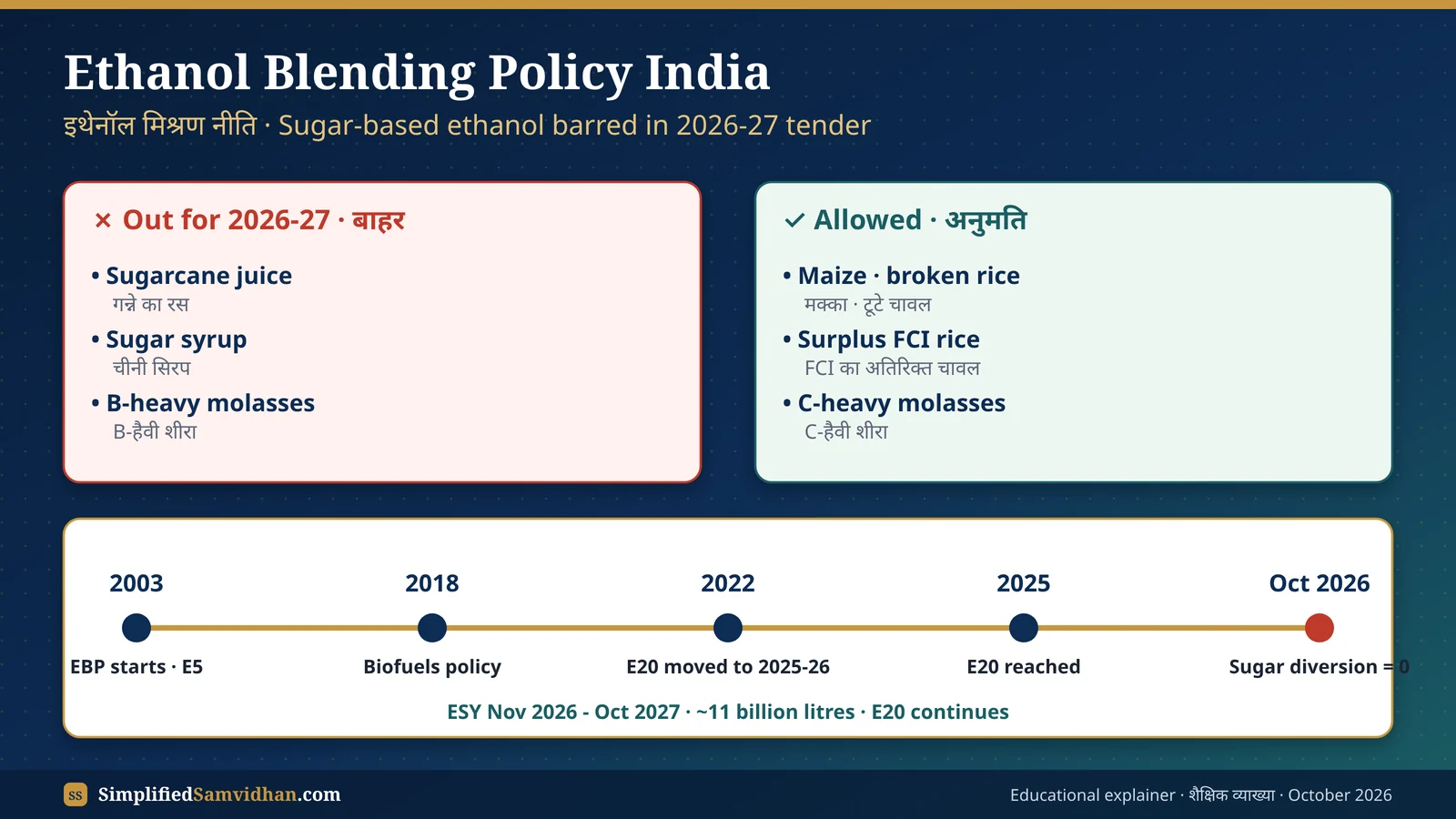
On 16 October 2026, Bharat Petroleum Corporation Ltd (BPCL), on behalf of the public sector oil marketing companies (OMCs), floated a tender for about 11 billion litres (1,100 crore litres) of ethanol for the 2026-27 ethanol supply year (November 2026 to October 2027) to keep up 20% blending in petrol.
Following the government's directions, the tender sets sugar diversion for ethanol at zero: ethanol made from sugarcane juice, sugar syrup and B-heavy molasses is not allowed. Bids are open only for ethanol from maize, damaged or broken rice, surplus FCI rice and C-heavy molasses, and the extra incentive for maize ethanol has been cut. Reports link the move to poor rainfall threatening cane output and record sugar prices.
The DecisionEthanol Blending Policy 2026-27: Which Feedstocks Are In and Which Are Out
Not allowed in 2026-27
- Sugarcane juice
- Sugar syrup
- B-heavy molasses (still has a lot of sugar)
- Any diversion of sugar to ethanol
Allowed in 2026-27
- Maize (incentive reduced)
- Damaged or broken rice
- Surplus rice from FCI
- C-heavy molasses (left after most sugar is taken out)
Sugarcane can be turned either into sugar for your kitchen or into ethanol for your car. In a good year there is enough for both. This year a weak monsoon has hit the crop and sugar is costly, so the government has said: first the kitchen, then the fuel tank. Mills can still sell ethanol made from the leftover C-heavy molasses, and grain distilleries will fill the gap.
🏠 Everyday analogy
A family with less milk in a dry month stops making paneer to sell and keeps the milk for the children's tea first. Paneer can wait; the morning cup cannot.
🇮🇳 Real Indian example
A sugar mill in Kolhapur that ran a juice-to-ethanol line in 2025 must now crush cane for sugar; it can still make some ethanol from C-heavy molasses, while a maize distillery in Bihar gets more orders.
Official TextEssential Commodities Act, Section 3 and Article 48A: The Legal Basis
Essential Commodities Act, 1955, Section 3(1). Powers to control production, supply, distribution, etc., of essential commodities.
If the Central Government is of opinion that it is necessary or expedient so to do for maintaining or increasing supplies of any essential commodity or for securing their equitable distribution and availability at fair prices, ... it may, by order, provide for regulating or prohibiting the production, supply and distribution thereof and trade and commerce therein.
Constitution of India, Article 48A. Protection and improvement of environment and safeguarding of forests and wild life.
The State shall endeavour to protect and improve the environment and to safeguard the forests and wild life of the country.
Sugar is an essential commodity. Under Section 3 of the Essential Commodities Act, the Centre issues control orders (like the Sugar Control Order) that can regulate or prohibit production and supply to keep prices fair. This is how the government has limited cane-juice ethanol before, for example in December 2023 for the 2023-24 season. On the other side, Article 48A (a Directive Principle) asks the State to protect the environment, which cleaner-burning ethanol supports. Policy has to balance both.
Policy TimelineEthanol Blended Petrol Programme in India: From E5 to E20
- 12003
The Ethanol Blended Petrol (EBP) programme begins with 5% blending in some States.
- 22018
The National Policy on Biofuels sets a 20% blending target for 2030 and allows ethanol from damaged grains, sugarcane juice and other feedstocks.
- 32022
The policy is amended to bring the E20 target forward to the 2025-26 ethanol supply year.
- 42025
India reaches about 20% average blending; E20 petrol becomes the norm at pumps.
- 5Oct 2026
The 2026-27 tender keeps E20 but sets sugar diversion at zero because of supply concerns.
The DebateFood vs Fuel: The Ethanol Debate in India
- Water: sugarcane is one of the thirstiest crops; critics say turning it into fuel deepens groundwater stress in Maharashtra and Karnataka.
- Food security: using FCI rice and maize for fuel can compete with the public distribution system and cattle and poultry feed, pushing up prices.
- Farmers and mills: ethanol payments help mills clear cane dues on time; sudden bans hurt mills that invested in juice-based plants.
- Vehicles: older vehicles not built for E20 may see small drops in mileage; the government says the effect is limited.
- The fix ahead: second-generation (2G) ethanol from crop waste such as paddy straw avoids the food-fuel clash and also reduces stubble burning.
| Feedstock | Type | Food clash? |
|---|---|---|
| Sugarcane juice / B-heavy molasses | 1st generation | High (sugar) |
| Maize, rice | 1st generation | Medium (grain, feed) |
| C-heavy molasses | By-product | Low |
| Paddy straw, crop residue (2G) | 2nd generation | None |
UPSC CornerEthanol Blending and Biofuel Policy for UPSC Prelims and Mains
- Prelims fact: The ethanol supply year runs from 1 November to 31 October.
- Prelims fact: The National Policy on Biofuels, 2018 was amended in 2022 to advance the 20% blending target to ESY 2025-26.
- Prelims fact: B-heavy molasses contains more fermentable sugar than C-heavy (final) molasses.
- Prelims fact: Section 3 of the Essential Commodities Act, 1955 empowers the Centre to regulate or prohibit production and supply of essential commodities.
- Prelims fact: Second-generation ethanol is made from lignocellulosic biomass such as crop residue; PM JI-VAN Yojana supports 2G plants.
- Mains (250 words): "India's ethanol policy must not trade food security for energy security." Examine in the light of the 2026-27 ethanol tender.
Practice MCQTest Yourself: Sugar Ethanol Out of 2026-27 Tender
With reference to India's ethanol blending programme, consider the following statements: (1) The ethanol supply year runs from November to October. (2) The 2026-27 tender of oil marketing companies allows ethanol made from sugarcane juice. (3) The National Policy on Biofuels was amended in 2022 to advance the 20% blending target to 2025-26. Which of the statements given above is/are correct?
Doubts ClearedFrequently Asked Questions
Why has sugar-based ethanol been barred for 2026-27?
Reports link it to poor rainfall threatening cane output and record sugar prices. Following government directions, the oil companies' tender of 16 October 2026 sets sugar diversion for ethanol at zero so that enough sugar stays available at fair prices.
Which ethanol is still allowed?
Ethanol made from maize, damaged or broken rice, surplus FCI rice and C-heavy molasses. Ethanol from sugarcane juice, sugar syrup and B-heavy molasses is not allowed in the 2026-27 tender.
Will petrol still have 20% ethanol?
Yes. The tender of about 11 billion litres for November 2026 to October 2027 is meant to keep 20% blending (E20) going, using grain-based ethanol and C-heavy molasses.
Under which law can the government restrict sugar use?
Section 3 of the Essential Commodities Act, 1955 lets the Centre issue orders regulating or prohibiting the production, supply and distribution of essential commodities like sugar. Control orders under it have been used before, for example in December 2023.
What is the food vs fuel debate?
It is the concern that using food crops such as sugarcane, rice and maize for fuel can raise food prices, strain water and compete with food security. Second-generation ethanol from crop waste is seen as a way out.
Sources and further readingSources We Checked
News facts on this page were checked against the reports below on 19 October 2026. Tender conditions may be revised; check the official tender document. Legal text is quoted from the Essential Commodities Act, 1955 and the Constitution of India.
- Business Standard: Centre sets sugar diversion for ethanol at zero in 2026-27 tender
- ETV Bharat: India bars sugar-based ethanol in 2026-27 tender, cuts maize incentive
- Daily Excelsior: India bars sugar-based ethanol in 2026-27 tender
- NextIAS: UPSC Headlines of the Day, 19 October 2026
- Essential Commodities Act, 1955 (India Code)
- Constitution of India (Legislative Department)