Governor Appointment Under Article 155: Six States Get New Governors, Here Is How the Office Works
On 12 October 2026 the President named Governors for six States in one go: two transfers and four new faces. Who chooses a Governor, for how long, and can a Governor be removed at any time? Here is the Constitution's answer in plain words, with the court cases and the Bills controversy that keep this office in the news.
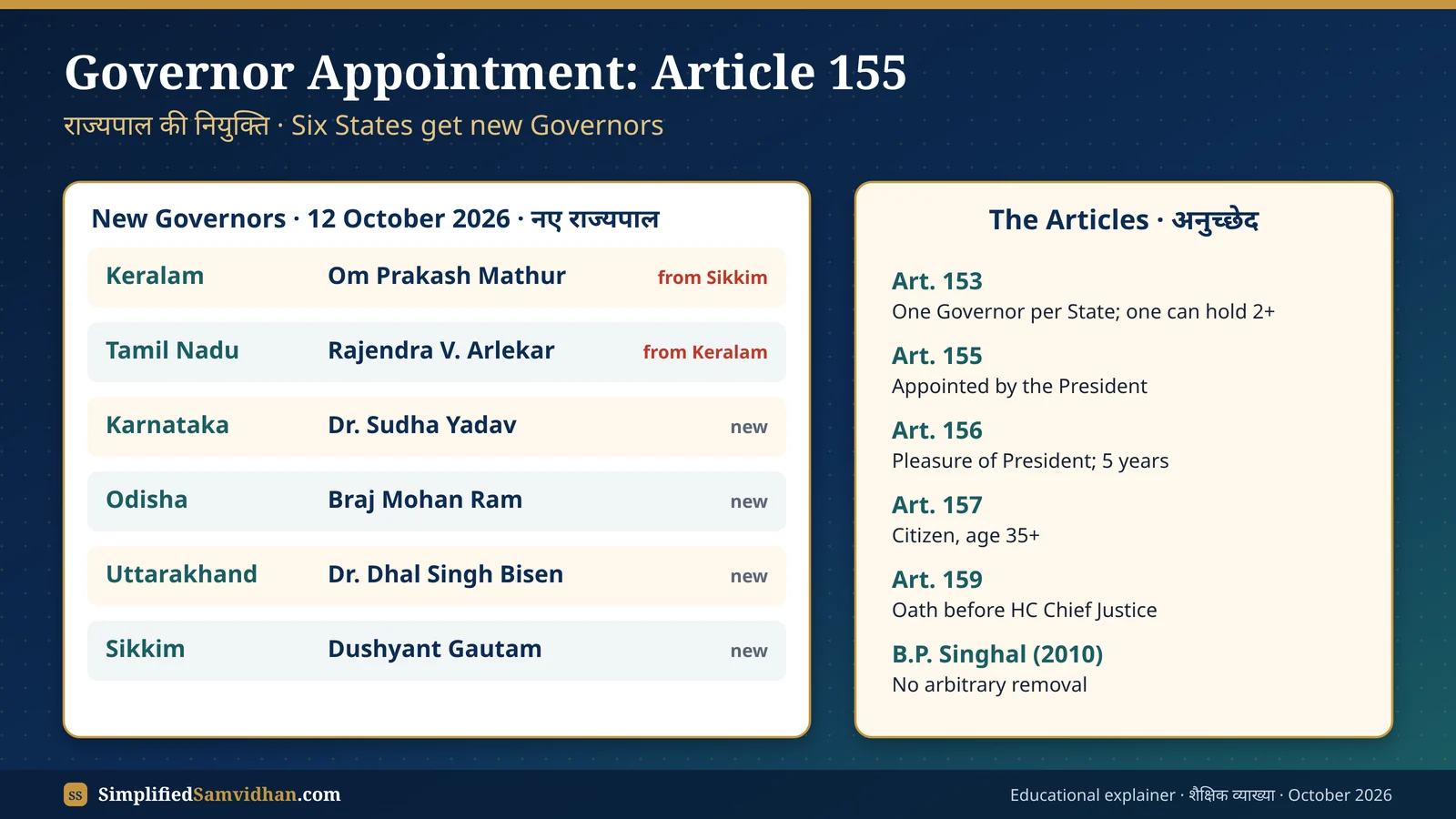
Who was appointed on 12 October 2026
A Rashtrapati Bhavan communiqué of 12 October 2026 announced Governors for six States. Om Prakash Mathur, Governor of Sikkim, moves to Keralam, and Rajendra Vishwanath Arlekar, Governor of Keralam, moves to Tamil Nadu, where he had held additional charge since 12 March 2026. Four new Governors were named: Dr. Sudha Yadav (Karnataka), Braj Mohan Ram (Odisha), Dr. Dhal Singh Bisen (Uttarakhand) and Dushyant Gautam (Sikkim).
The appointments take effect from the dates the appointees assume charge. Each new Governor takes oath before the Chief Justice of the State's High Court under Article 159. Keralam is Kerala's official name since the Kerala (Alteration of Name) Act, 2026 came into force on 25 August 2026.
Official TextArticles 153, 155, 156 and 157: Governor Appointment, Term and Qualifications
Constitution of India, Part VI, Chapter II: The Executive. The Governor.
153. Governors of States. There shall be a Governor for each State: Provided that nothing in this article shall prevent the appointment of the same person as Governor for two or more States.
155. Appointment of Governor. The Governor of a State shall be appointed by the President by warrant under his hand and seal.
156. Term of office of Governor. (1) The Governor shall hold office during the pleasure of the President.
(2) The Governor may, by writing under his hand addressed to the President, resign his office.
(3) Subject to the foregoing provisions of this article, a Governor shall hold office for a term of five years from the date on which he enters upon his office: Provided that a Governor shall, notwithstanding the expiration of his term, continue to hold office until his successor enters upon his office.
157. Qualifications for appointment as Governor. No person shall be eligible for appointment as Governor unless he is a citizen of India and has completed the age of thirty-five years.
Every State has a Governor, the constitutional head of the State, just as the President is for the Union. The President appoints the Governor by a signed and sealed warrant, which in practice means on the advice of the Union Council of Ministers. The usual term is five years, but the Governor serves "during the pleasure of the President", so the Union can move or remove a Governor earlier. One person can look after two States, as Arlekar did for Tamil Nadu.
🏠 Everyday analogy
The Governor is like the principal's representative posted in a branch school: appointed from the head office, but bound to run the branch by its own rule book, which is the State's elected government.
🇮🇳 Real Indian example
When Om Prakash Mathur moves from Gangtok to Thiruvananthapuram, he does not need a new election or a vote; a warrant from the President under Article 155 is enough.
How the Office WorksGovernor of a State: Qualifications, Oath, Immunity and Powers at a Glance
| Point | Article | What it means |
|---|---|---|
| Qualifications | 157 | Citizen of India, at least 35 years old |
| Conditions | 158 | Not a member of Parliament or a State Legislature; holds no other office of profit; free use of Raj Bhavan; salary cannot be cut during the term |
| Oath | 159 | Taken before the Chief Justice of the High Court (or the senior-most judge) |
| Pardons | 161 | Can pardon or reduce sentences for offences against State laws |
| Acts on advice | 163 | Acts on the advice of the Council of Ministers headed by the Chief Minister, except where the Constitution allows discretion |
| Appoints CM | 164 | Appoints the Chief Minister and, on the CM's advice, other ministers |
| Bills | 200 | Can assent, withhold assent, return a Bill (not a Money Bill) or reserve it for the President |
| Immunity | 361 | Not answerable to any court for official acts; no criminal case during the term |
Not elected: the Constituent Assembly dropped the idea of an elected Governor to avoid a clash between two elected heads in a parliamentary system. Our pages on Article 3 (new States and names) explain how Kerala became Keralam.
Case LawCan a Governor Be Removed Any Time? B.P. Singhal Case and the Pleasure Doctrine
- B.P. Singhal v Union of India (2010, five judges): the President's pleasure can be withdrawn at any time and without giving reasons, but not arbitrarily or for a mala fide reason. A Governor cannot be removed just because a new party comes to power at the Centre or because he is out of tune with its policies. A removal can be challenged in court if it is arbitrary.
- Sarkaria Commission (1988): the Governor should be an eminent person from outside the State, not an active politician in the recent past, and appointed after consulting the Chief Minister; the five-year term should not be cut short except for compelling reasons.
- Punchhi Commission (2010): suggested a fixed five-year term and removal only through a resolution of the State Legislature, along the lines of impeachment. This was not adopted.
- Shamsher Singh v State of Punjab (1974): the Governor is a constitutional head who acts on ministerial advice, except in the narrow areas of discretion.
"Pleasure" sounds like the Governor can be sent home on a whim. The Supreme Court said no: pleasure is not whim. Like a manager who can transfer an employee any time but not for a personal grudge, the Union must have a real, relevant reason.
In the NewsGovernor and State Bills: Article 200, Tamil Nadu Case and the Presidential Reference
Why States complain
- Governors kept Bills pending for months or years
- Appointed Governors can slow down an elected government
- Opposition-ruled States like Tamil Nadu, Kerala and Punjab went to court
Why the Union defends the office
- The Governor is a link between the Centre and the State
- Article 200 gives real options, including reserving a Bill for the President
- Fixed timelines are not written in the Constitution
- State of Tamil Nadu v Governor of Tamil Nadu (8 April 2025): a two-judge bench held that a Governor cannot sit on Bills indefinitely and set time limits for decisions.
- Presidential Reference under Article 143 (opinion of 20 November 2025): a five-judge bench advised that courts cannot impose fixed timelines or "deemed assent", but prolonged and unexplained inaction can be examined in a limited way.
- Why the October 2026 changes matter: Tamil Nadu, Karnataka and Keralam have seen sharp Governor-State friction, so the new Governors will be watched closely on assent to Bills and university appointments.
In simple words: the Governor is meant to be a referee, not a player. Most of the time the referee follows the rule book (ministerial advice). Trouble begins when the referee holds the ball too long.
UPSC CornerGovernor of a State for UPSC Prelims and Mains
- Prelims fact: Article 155: Governor appointed by the President by warrant under hand and seal; Article 156: holds office during the pleasure of the President, normally five years.
- Prelims fact: Article 153 proviso (added by the 7th Amendment, 1956) allows one person to be Governor of two or more States; Article 158(3A) then shares the salary between the States.
- Prelims fact: The oath of the Governor is administered by the Chief Justice of the High Court (Article 159), not by the President.
- Prelims fact: There is no impeachment procedure for a Governor in the Constitution.
- Prelims fact: Kerala's name was changed to Keralam by the Kerala (Alteration of Name) Act, 2026 under Article 3, in force from 25 August 2026.
- Mains (250 words): "The office of the Governor has become a point of friction in Indian federalism." Discuss with reference to B.P. Singhal (2010) and the 2025 rulings on assent to Bills.
- Mains (150 words): Examine the recommendations of the Sarkaria and Punchhi Commissions on the appointment and removal of Governors.
Practice MCQTest Yourself: Governor Appointment: Article 155
With reference to the Governor of a State in India, consider the following statements: (1) The Governor is appointed by the President by warrant under his hand and seal. (2) The oath of office of the Governor is administered by the President of India. (3) The same person can be appointed Governor of two or more States. Which of the statements given above is/are correct?
Doubts ClearedFrequently Asked Questions
Who appoints the Governor of a State?
The President of India, by warrant under his or her hand and seal (Article 155). In practice the President acts on the advice of the Union Council of Ministers headed by the Prime Minister.
What is the term of a Governor?
Five years from the date of taking charge (Article 156(3)), but the Governor holds office during the pleasure of the President, so the term can end earlier through transfer, removal or resignation. A Governor continues until a successor takes charge.
Can the President remove a Governor at any time?
Yes, the pleasure can be withdrawn without giving reasons, but in B.P. Singhal v Union of India (2010) the Supreme Court held that it cannot be exercised arbitrarily, unfairly or with mala fide intent, such as merely because a new party came to power at the Centre.
Which States got new Governors in October 2026?
On 12 October 2026: Om Prakash Mathur (Keralam), Rajendra Vishwanath Arlekar (Tamil Nadu), Dr. Sudha Yadav (Karnataka), Braj Mohan Ram (Odisha), Dr. Dhal Singh Bisen (Uttarakhand) and Dushyant Gautam (Sikkim).
Who administers the oath to a Governor?
The Chief Justice of the High Court exercising jurisdiction over the State, or in his absence the senior-most judge of that court (Article 159).
Sources and further readingSources We Checked
News facts on this page were checked against the reports below on 19 October 2026. Each appointment takes effect when the appointee assumes charge. Constitutional text is quoted from the Constitution of India.
- Business Today, 12 Oct 2026: President Murmu names new governors for Kerala, Tamil Nadu, Odisha and 3 other states
- All India Radio News: President Murmu appoints Governors in six states
- ANI, 13 Oct 2026: OBC-Dalit representation in focus as President Murmu appoints six Governors
- Manorama Yearbook, 13 Oct 2026: President Murmu appoints 6 Governors
- Onmanorama, 26 Aug 2026: It's official, Kerala is now Keralam as Centre notifies name change
- Constitution of India (Legislative Department)