India-Azerbaijan Relations 2026: Why Jaishankar's Baku Visit Is a Reset
On 23 October 2026 External Affairs Minister S. Jaishankar spent a day in Baku, meeting President Ilham Aliyev and Foreign Minister Jeyhun Bayramov. Seventeen months after Azerbaijan sided with Pakistan over Operation Sindoor, India is rebuilding the tie for trade routes and energy. Here is what was said, the history, and why it matters.
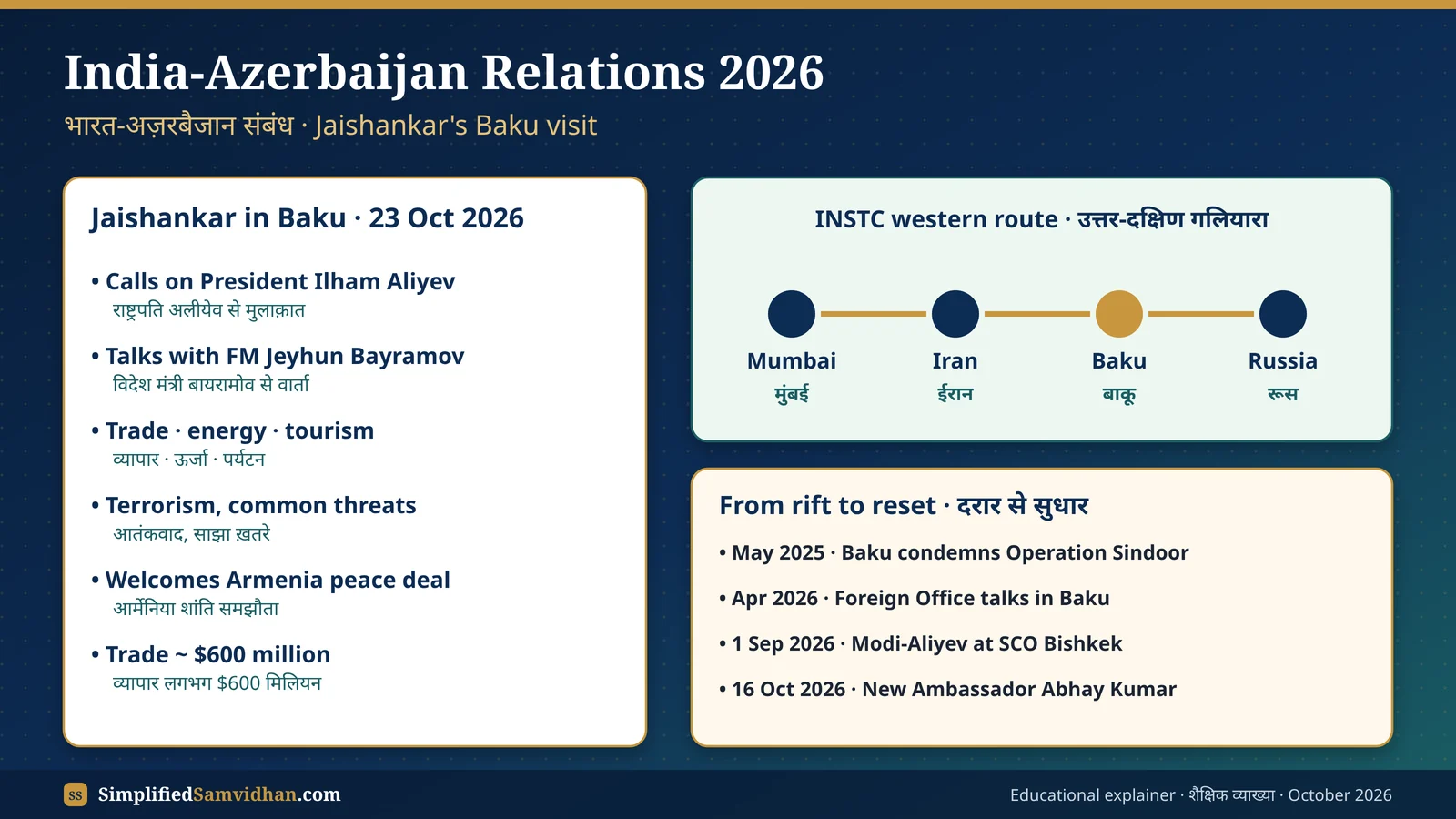
What happened in Baku on 23 October 2026
External Affairs Minister S. Jaishankar made a one-day visit to Baku on Friday, 23 October 2026. He first called on President Ilham Aliyev and conveyed greetings from President Murmu and PM Modi, then held talks with Foreign Minister Jeyhun Bayramov, which he called "very productive".
The talks covered trade, investment, energy, transport, tourism, education and culture. Azerbaijan's Foreign Ministry highlighted the North-South and East-West transport corridors, the Baku-Tbilisi-Kars railway and the Port of Baku. India's MEA said security, terrorism and common threats were discussed. Jaishankar welcomed the Armenia-Azerbaijan peace agreement and invited Bayramov to visit India. Bilateral trade was reported at about $600 million. No new agreement was reported signed.
At a GlanceIndia-Azerbaijan Relations at a Glance: Key Facts 2026
| Point | Fact |
|---|---|
| Capital and location | Baku, on the Caspian Sea; South Caucasus, between Russia, Iran, Georgia and Armenia |
| Leaders | President Ilham Aliyev; Foreign Minister Jeyhun Bayramov |
| Trade | About $600 million (reported Oct 2026); crude oil is the main Indian import |
| Energy | ONGC Videsh holds small stakes in the ACG oilfields and the BTC pipeline |
| Connectivity | INSTC western route (Russia-Azerbaijan-Iran) towards Chabahar and Mumbai |
| Friction | Azerbaijan's closeness to Turkey and Pakistan; India's defence ties with Armenia |
Think of Azerbaijan as a junction on a highway. Goods from Mumbai can go by sea to Iran, then by road and rail through Azerbaijan to Russia and Europe. This route, the INSTC, can be faster and cheaper than going through the Suez Canal. So even when India and Azerbaijan disagree on Pakistan, both gain from keeping the road open.
🏠 Everyday analogy
It is like two neighbours who argued over a cricket match but still share the only lane to the main road. They may not be best friends, but they need to keep talking so that the lane stays clear.
🇮🇳 Real Indian example
A tea exporter in Kolkata or a pharma company in Hyderabad could ship to Russia through Iran and Azerbaijan in fewer days than by the Suez route, if INSTC links work smoothly.
HistoryIndia-Azerbaijan Relations Timeline: From 1991 to the 2026 Reset
| Year | Event |
|---|---|
| 1991-92 | India recognises independent Azerbaijan after the Soviet Union breaks up; diplomatic relations follow in 1992. |
| 2000s | Azerbaijan joins the International North-South Transport Corridor (INSTC) idea; its western route runs Russia-Azerbaijan-Iran. |
| 2013 | ONGC Videsh buys small stakes in Azerbaijan's ACG oilfields and the Baku-Tbilisi-Ceyhan (BTC) pipeline. |
| 2020-23 | Azerbaijan-Armenia war over Nagorno-Karabakh; India supplies defence systems to Armenia, which irritates Baku. |
| May 2025 | Azerbaijan publicly condemns India's Operation Sindoor strikes on Pakistan; calls for a tourism boycott spread in India. |
| Apr 2026 | Secretary (West) Sibi George holds Foreign Office Consultations in Baku: the first high-level contact since Sindoor. |
| 1 Sep 2026 | PM Modi and President Aliyev exchange views at the SCO Summit in Bishkek. |
| 16 Oct 2026 | New Ambassador Abhay Kumar presents credentials to President Aliyev. |
| 23 Oct 2026 | EAM S. Jaishankar visits Baku, meets Aliyev and FM Jeyhun Bayramov. |
Official TextArticle 51 and Article 253: The Constitution and Foreign Policy
Constitution of India, Article 51. Promotion of international peace and security.
The State shall endeavour to (a) promote international peace and security; (b) maintain just and honourable relations between nations; (c) foster respect for international law and treaty obligations in the dealings of organised peoples with one another; and (d) encourage settlement of international disputes by arbitration.
Article 253. Legislation for giving effect to international agreements.
Notwithstanding anything in the foregoing provisions of this Chapter, Parliament has power to make any law for the whole or any part of the territory of India for implementing any treaty, agreement or convention with any other country or countries or any decision made at any international conference, association or other body.
- Article 73 and Entry 10 and 14 of the Union List give the Union executive power over foreign affairs and treaties.
- Article 51(b), to "maintain just and honourable relations between nations", fits a reset with a country that once took the other side.
- Article 51 is a Directive Principle: it guides policy but cannot be enforced in court.
Why It MattersWhy Azerbaijan Matters for India: Opportunities vs Challenges
Opportunities
- INSTC and East-West corridors to Russia, Central Asia and Europe
- Oil and gas supply and Indian energy investments
- Pharma, IT, tourism and student links
- A voice in the South Caucasus and the Caspian region
Challenges
- Azerbaijan's support for Pakistan on Kashmir and Sindoor
- Close Turkey-Azerbaijan-Pakistan alignment
- India's defence ties with Armenia
- Small trade base
UPSC CornerIndia-Azerbaijan Relations for UPSC Prelims and Mains
- Prelims: Baku lies on the Caspian Sea; Azerbaijan borders Russia, Georgia, Armenia, Iran and (via Nakhchivan) Turkey.
- Prelims: INSTC was agreed by India, Iran and Russia in 2000; its western branch runs through Azerbaijan.
- Mains (GS II): "Interests over grievances." Discuss India's reset with Azerbaijan after Operation Sindoor.
- Map: locate Baku, Nagorno-Karabakh, Nakhchivan, Bandar Abbas and Chabahar.
Practice MCQTest Yourself: India-Azerbaijan Relations: Jaishankar in Baku
With reference to Azerbaijan, consider the following statements: (1) Its capital Baku lies on the coast of the Caspian Sea. (2) The western route of the International North-South Transport Corridor passes through Azerbaijan. (3) Azerbaijan shares a land border with Afghanistan. Which of the statements given above is/are correct?
Doubts ClearedFrequently Asked Questions
Why did Jaishankar visit Azerbaijan?
To rebuild ties after the 2025 rift over Operation Sindoor. On 23 October 2026 he met President Aliyev and FM Bayramov to discuss trade, energy, transport corridors and terrorism.
Why were India-Azerbaijan ties strained?
In May 2025 Azerbaijan publicly condemned India's strikes on Pakistan during Operation Sindoor. Its closeness to Turkey and Pakistan, and India's defence sales to Armenia, add to the friction.
What is the INSTC?
The International North-South Transport Corridor, agreed by India, Iran and Russia in 2000, is a sea-rail-road route from Mumbai to Russia via Iran; its western branch passes through Azerbaijan.
What is the trade between India and Azerbaijan?
About $600 million, as reported during the October 2026 visit. Crude oil is the main item India buys.
Were any agreements signed in Baku?
No agreement was reported signed on 23 October 2026. Jaishankar invited Bayramov to visit India.
Sources and further readingSources We Checked
Facts checked against the reports below on 24 October 2026. Trade figures vary between sources because of oil price swings.
- ThePrint: Jaishankar talks cross-border terror, common threats with Azerbaijan counterpart (23 Oct 2026)
- ANI: EAM Jaishankar and Azerbaijan FM discuss connectivity, North-South transport corridors (23 Oct 2026)
- Free Press Journal: India-Azerbaijan trade reaches $600 million as Jaishankar meets Bayramov in Baku
- The Wire: India-Azerbaijan first high-level contact since Baku's condemnation of Operation Sindoor (April 2026)
- News On AIR: India's new Ambassador Abhay Kumar presents credentials to President Ilham Aliyev (17 Oct 2026)
- MEA: India-Azerbaijan bilateral brief (April 2026)