Keralam Takes Vigilance Sections Out of RTI: What Section 24(4) Allows and What It Does Not
A notification dated 22 October 2026 has put the T1 and T2 sections of Keralam's Vigilance and Anti-Corruption Bureau on the list of bodies outside the Right to Information Act. The government says secret probes need secrecy; critics say an anti-corruption unit cannot hide behind a clause meant for spy agencies. Here is the law in simple words.
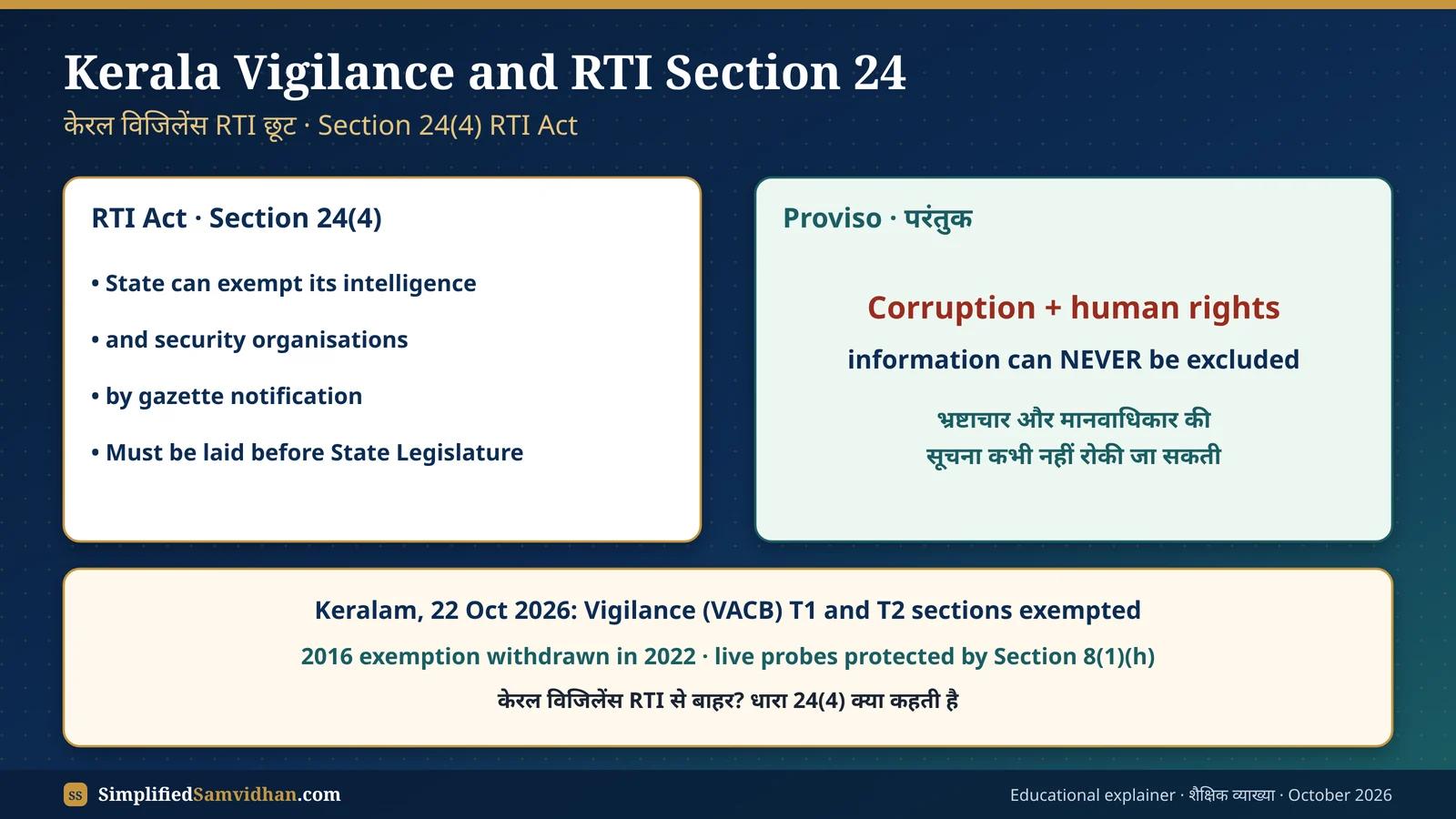
What Keralam decided in October 2026
The General Administration Department of Keralam issued a gazette notification dated 22 October 2026, made public on 23 October, adding the T1 and T2 sections of the Directorate of Vigilance and Anti-Corruption Bureau (VACB) to the list of state intelligence and security organisations exempted under Section 24(4) of the RTI Act. As reported, T1 handles sensitive high-level inquiries and secret files, and T2 handles source reports, surprise checks and intelligence analysis.
Home Minister Ramesh Chennithala defended the move, saying confidentiality is essential for Vigilance work. BJP leader K. Surendran and CPI(M) leader Pinarayi Vijayan accused the government of shielding corruption files. A similar 2016 exemption of the T branch was withdrawn in 2022 after it was challenged in the Kerala High Court. We found no court order on the 2026 notification when we checked on 25 October.
At a GlanceSection 24 RTI Act at a Glance: Key Facts
| Point | Fact |
|---|---|
| Section 24(1) | Central intelligence and security bodies listed in the Second Schedule (IB, RAW, NSG and others) are outside the Act |
| Section 24(4) | A State Government can exempt its own intelligence and security organisations by gazette notification |
| First proviso | Information on allegations of corruption and human rights violations can never be excluded |
| Human rights requests | Given only with State Information Commission approval, within 45 days |
| Section 24(5) | Every such notification must be laid before the State Legislature |
| Keralam 2026 | T1 and T2 sections of VACB added by notification of 22 October 2026 |
Think of the RTI Act as a glass wall around every government office. Section 24 allows a few rooms, like spy and security agencies, to have curtains. But even inside those rooms, one window must stay clear: anything about corruption or human rights violations. The debate in Keralam is whether an anti-corruption office should get curtains at all, and whether that clear window still works.
🏠 Everyday analogy
A school may lock the exam-paper room so that papers do not leak. But if a parent complains that the head teacher took bribes for admissions, the school cannot say the complaint file is in the locked room and refuse to show what happened.
🇮🇳 Real Indian example
A citizen in Thiruvananthapuram who asks whether a Vigilance inquiry against an officer was closed, and why, can still argue that the request is about a corruption allegation and falls under the first proviso of Section 24(4).
HistoryKerala Vigilance and RTI: Timeline from 2005 to 2026
| Year | Event |
|---|---|
| 2005 | RTI Act passed; Section 24 lets the Centre and States keep intelligence and security bodies outside it, except for corruption and human rights information. |
| 2006 | Kerala notifies its first list of exempt state organisations under Section 24(4). |
| 2016 | The Vigilance 'T' branch is exempted from RTI. |
| 2022 | After challenges in the Kerala High Court, the State withdraws the 2016 exemption. |
| 25 Aug 2026 | Kerala is officially renamed Keralam. |
| 22-23 Oct 2026 | New notification adds VACB's T1 and T2 sections to the exempt list; political row follows. |
Official TextSection 24(4), 24(5) and 8(1)(h) of the RTI Act, 2005
Right to Information Act, 2005, Section 24(4).
Nothing contained in this Act shall apply to such intelligence and security organisation being organisations established by the State Government, as that Government may, from time to time, by notification in the Official Gazette, specify:
Provided that the information pertaining to the allegations of corruption and human rights violations shall not be excluded under this sub-section:
Provided further that in the case of information sought for is in respect of allegations of violation of human rights, the information shall only be provided after the approval of the State Information Commission and, notwithstanding anything contained in section 7, such information shall be provided within forty-five days from the date of the receipt of request.
Section 24(5).
Every notification issued under sub-section (4) shall be laid before the State Legislature.
Section 8(1)(h).
Information which would impede the process of investigation or apprehension or prosecution of offenders.
- The right to information is part of the freedom of speech and expression under Article 19(1)(a), as the Supreme Court held in State of U.P. v. Raj Narain (1975) and S.P. Gupta v. Union of India (1981).
- Section 8(1)(h) already lets any office refuse information that would impede an investigation, without a blanket exemption.
- A Section 24(4) notification is a piece of delegated legislation, so it can be challenged in the High Court under Article 226 if it goes beyond what the Act allows.
Why It MattersKerala Vigilance RTI Exemption: Government vs Critics
Government's case
- Secret inquiries and source reports must stay confidential
- Leaks can alert the accused and endanger informers
- Section 24(4) expressly allows state intelligence units to be exempted
- The corruption proviso still applies in law
Critics' case
- VACB is an anti-corruption body, not a spy or security agency
- Most of its files are about corruption, which the proviso keeps open
- Section 8(1)(h) already protects live probes
- The same step was withdrawn in 2022 after court challenges
- 1Apply anyway
File your RTI with the VACB and say clearly that it concerns an allegation of corruption under the first proviso to Section 24(4).
- 2First appeal
If refused, file a first appeal within 30 days to the appellate authority. See our RTI first appeal format.
- 3Second appeal
Go to the Kerala State Information Commission within 90 days of the first appeal decision.
- 4Court
The notification itself can be challenged in the High Court under Article 226.
UPSC CornerRTI Act Section 24 for UPSC Prelims and Mains
- Prelims: Section 24 and the Second Schedule exclude intelligence and security organisations, but never for corruption and human rights information.
- Prelims: Human rights information from an exempt body needs Information Commission approval and is given within 45 days (not 30).
- Prelims: Section 24(5): State notifications are laid before the State Legislature.
- Mains (GS II): "Exemptions under Section 24 are turning into a back door to secrecy." Discuss with the Keralam Vigilance example.
Practice MCQTest Yourself: Kerala Vigilance Out of RTI: Section 24(4)
With reference to Section 24 of the Right to Information Act, 2005, consider the following statements: (1) A State Government can exempt intelligence and security organisations established by it through a notification in the Official Gazette. (2) Information relating to allegations of corruption cannot be excluded even for an exempted organisation. (3) Such State notifications must be laid before Parliament. Which of the statements given above is/are correct?
Doubts ClearedFrequently Asked Questions
Has Kerala removed Vigilance from the RTI Act?
Keralam has exempted only the T1 and T2 sections of the Vigilance and Anti-Corruption Bureau, by a notification dated 22 October 2026 under Section 24(4) of the RTI Act. The rest of the bureau remains under RTI.
What is Section 24(4) of the RTI Act?
It lets a State Government keep its own intelligence and security organisations outside the RTI Act by a gazette notification, except for information on corruption and human rights violations.
Can I still ask about corruption cases from the Vigilance department?
Yes, in law. The first proviso to Section 24(4) says information about allegations of corruption cannot be excluded. Details that would hamper a live investigation can still be refused under Section 8(1)(h).
Was this done before?
Yes. The Vigilance T branch was exempted in 2016, and that notification was withdrawn in 2022 after it was challenged in the Kerala High Court.
Can the notification be challenged?
Yes. As delegated legislation it can be challenged in the High Court under Article 226 if it goes beyond what Section 24(4) allows, for example by exempting a body that is not really an intelligence or security organisation.
Sources and further readingSources We Checked
Facts checked against the reports below on 25 October 2026. The notification's full text was not published online when checked; the description of the T1 and T2 sections is as reported.
- ThePrint: Keralam exempts Vigilance T sections from RTI Act; BJP alleges bid to shield corruption (23 Oct 2026)
- Onmanorama: Kerala takes Vigilance's T1, T2 sections out of RTI ambit (23 Oct 2026)
- The News Minute: Keralam govt exempts 'T' branch of Vigilance from RTI Act
- ThePrint: Vijayan slams Keralam govt over exemption of Vigilance sections from RTI (24 Oct 2026)
- India Code: Right to Information Act, 2005