India Re-elected President of the International Solar Alliance for a Third Term
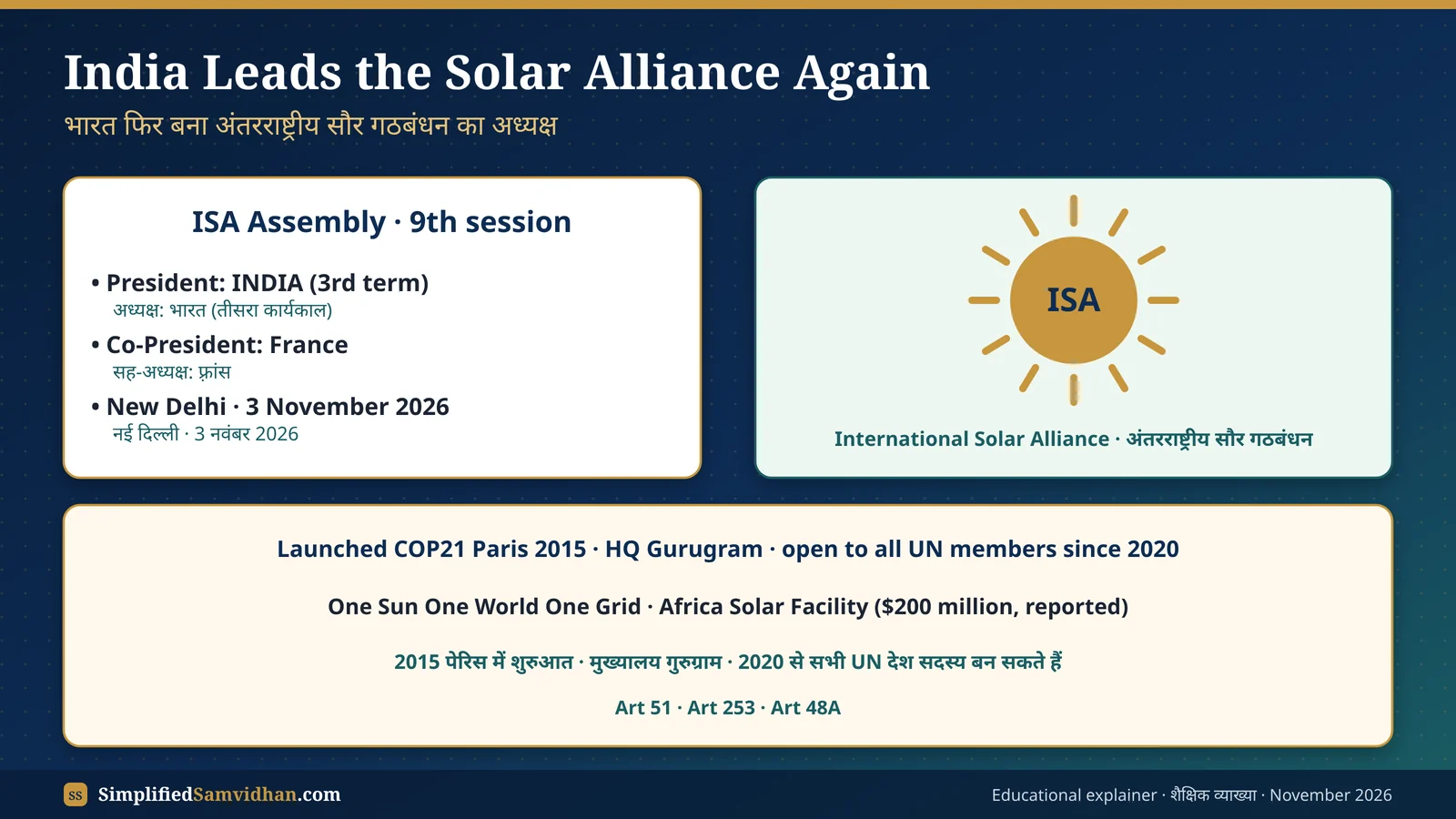
The International Solar Alliance (ISA) began as an idea India and France launched at the Paris climate summit in 2015. On 3 November 2026, at the ninth session of its Assembly in New Delhi, India was elected its President for a third straight term, with France again as Co-President. Here is what the ISA is, why it matters for India's energy and diplomacy, and the facts you need for exams.
What happened
The ninth session of the ISA Assembly, the alliance's top decision-making body, met in New Delhi during the Bharat Renewable Energy Summit 2026 (2-5 November). On 3 November, New and Renewable Energy Minister Pralhad Joshi announced that India had been elected President of the ISA for a third consecutive term, and congratulated France on being re-elected Co-President.
Joshi also highlighted the Africa Solar Facility, reported at $200 million, to help African countries attract solar investment, and an Indian contribution reported at about ₹225 crore for wider access to affordable solar power.
At a GlanceInternational Solar Alliance: Key Facts
| Point | Fact |
|---|---|
| Launched | 30 November 2015, at COP21 in Paris, by India and France |
| Legal basis | ISA Framework Agreement, in force since December 2017 |
| Headquarters | Gurugram, Haryana, India |
| Membership | Open to all UN member states since a 2020 amendment; reports cite about 130 signatory and member countries |
| President (2026) | India, third consecutive term |
| Co-President (2026) | France |
| Top body | ISA Assembly (ninth session, New Delhi, November 2026) |
| Flagship ideas | One Sun One World One Grid (OSOWOG); Africa Solar Facility |
Many sunny countries in Africa, Asia and Latin America cannot afford solar power because loans are costly and they lack experts. The ISA is a club where these countries pool demand, share know-how and get cheaper money for solar projects. India started it, hosts its office and now leads it again.
🏠 Everyday analogy
It is like a farmers' cooperative: one farmer buying one tractor pays full price, but a cooperative buying a hundred gets a discount, a mechanic and a bank loan.
🇮🇳 Real Indian example
A village in Malawi can get a solar mini-grid built with ISA support and Indian training, instead of waiting years for a power line.
TimelineHow the ISA Grew
- 12015
India and France launch the ISA at the Paris climate summit (COP21).
- 22017
The Framework Agreement enters into force; the ISA becomes a treaty-based body.
- 32018
The first ISA founding conference is held in New Delhi.
- 42020
Membership is opened to all UN member states, not only tropical ones.
- 52021
The Green Grids Initiative-One Sun One World One Grid is launched at COP26 in Glasgow.
- 62026
India is re-elected President for a third term; France stays Co-President.
Official TextArticles 51 and 253: The Constitution and India's Treaties
Constitution of India, Article 51. Promotion of international peace and security.
The State shall endeavour to (a) promote international peace and security; (b) maintain just and honourable relations between nations; (c) foster respect for international law and treaty obligations in the dealings of organised peoples with one another; and (d) encourage settlement of international disputes by arbitration.
Article 253. Legislation for giving effect to international agreements.
Notwithstanding anything in the foregoing provisions of this Chapter, Parliament has power to make any law for the whole or any part of the territory of India for implementing any treaty, agreement or convention with any other country or countries or any decision made at any international conference, association or other body.
- Joining the ISA Framework Agreement is an executive act of the Union; Article 253 lets Parliament make a law to implement a treaty if one is needed.
- Article 48A (Directive Principle) asks the State to protect and improve the environment; clean energy diplomacy supports it.
- The ISA is the first treaty-based international intergovernmental organisation to be headquartered in India.
Why It MattersISA: India's Gains vs Challenges
India's gains
- Leadership of the Global South on climate action
- Markets for Indian solar makers and engineers
- Soft power through training and projects in Africa
- Supports India's 500 GW non-fossil target by 2030
Challenges
- Limited funds compared with the scale of need
- Reliance on imported solar cells and panels
- Projects slow to reach the ground
- Competition with other climate funds and clubs
UPSC CornerInternational Solar Alliance for UPSC Prelims and Mains
- Prelims: The ISA was launched by India and France at COP21, Paris, in 2015; its headquarters is in Gurugram.
- Prelims: Since 2020 all UN member states can join, not only countries between the Tropics.
- Prelims: One Sun One World One Grid aims to link solar power across time zones.
- Mains (GS II/III): "The International Solar Alliance is India's most successful climate diplomacy initiative." Critically examine.
Practice MCQTest Yourself: India Leads the Solar Alliance Again
With reference to the International Solar Alliance, consider the following statements: (1) It was launched by India and France at COP21 in Paris. (2) Its headquarters is in Gurugram. (3) Only countries lying between the Tropics can become members. Which of the statements given above is/are correct?
Doubts ClearedFrequently Asked Questions
Who is the President of the International Solar Alliance in 2026?
India, elected for a third consecutive term on 3 November 2026. France is Co-President.
Where is the ISA headquartered?
In Gurugram, Haryana.
When was the ISA launched?
On 30 November 2015, at the COP21 climate summit in Paris, by India and France.
Can any country join the ISA?
Yes. Since a 2020 amendment, all UN member states can join.
What is One Sun One World One Grid?
An ISA-backed idea, launched with the UK as the Green Grids Initiative at COP26 in 2021, to connect solar power grids across regions and time zones.
Sources and further readingSources We Checked
Facts checked against the reports below on 4 November 2026. Funding figures are as reported from the minister's remarks.