Why the UN's Western Sahara Mission Ended: The Security Council Veto Explained
For 35 years a small UN mission called MINURSO watched over a ceasefire in Western Sahara, a desert territory in north-west Africa claimed by both Morocco and the Polisario Front. On 30 October 2026 the UN Security Council could not agree to extend it: a US draft was vetoed by Russia, and a Russian draft did not get enough votes. The mandate expired on 31 October. Here is how the veto works, why it matters and what India, a top peacekeeping nation, should take from it.
What happened
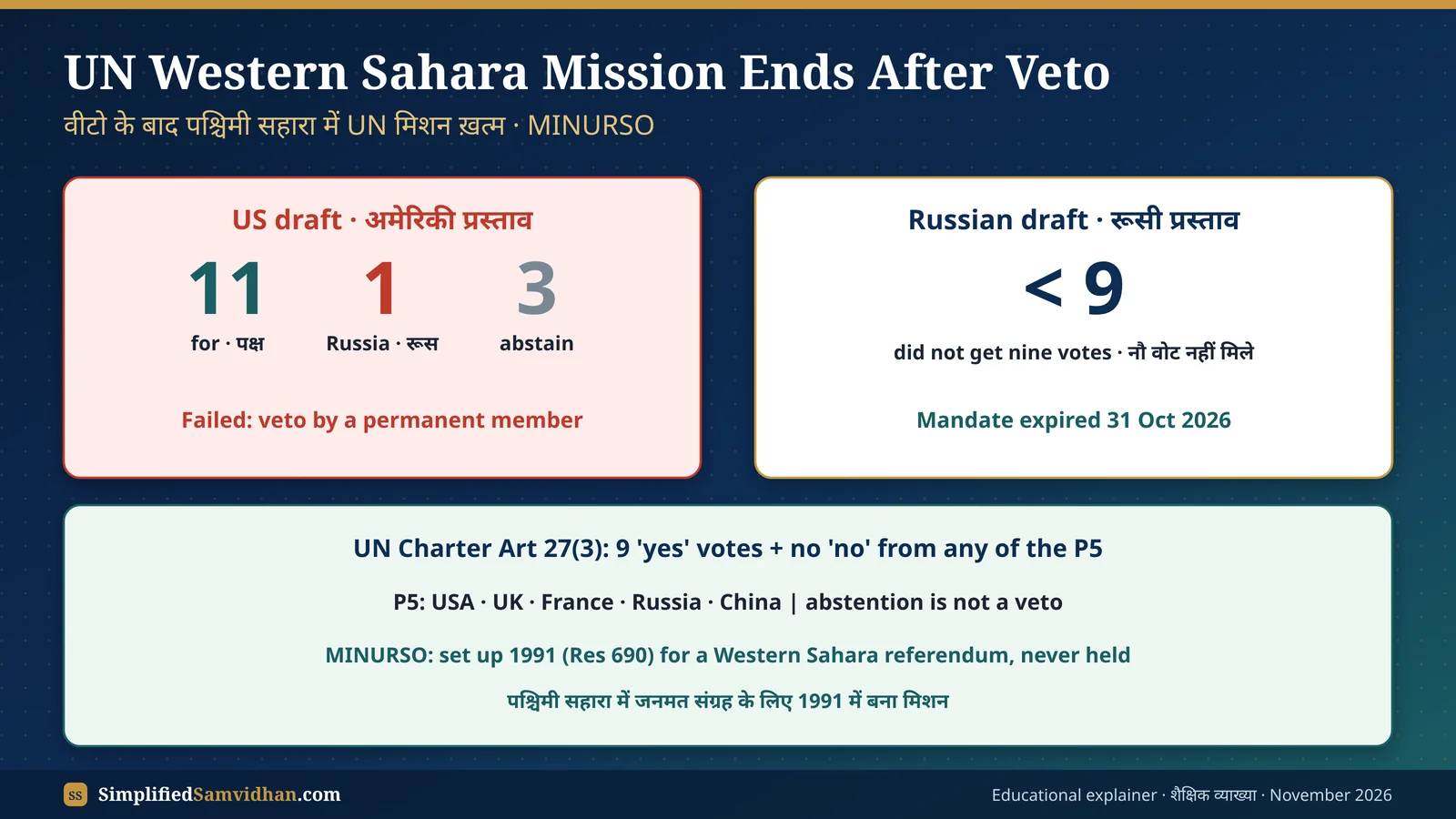
On 30 October 2026 the Security Council voted on two drafts to keep MINURSO going. A US-drafted text, which would have renewed the mission for a year and renamed it, got 11 votes in favour, 1 against and 3 abstentions. It needed only nine votes, but the vote against came from Russia, a permanent member, so it failed: that is a veto. A Russian-drafted one-year renewal then failed to get the nine votes it needed.
With no new resolution, MINURSO's mandate expired on 31 October 2026. The United States said any drawdown must be orderly and protect UN staff. What replaces the mission, if anything, is still unclear.
At a GlanceMINURSO Vote: Key Facts
| Point | Fact |
|---|---|
| Mission | UN Mission for the Referendum in Western Sahara (MINURSO) |
| Set up | April 1991, Security Council Resolution 690 |
| Original job | Monitor the Morocco-Polisario ceasefire and organise a referendum on self-determination |
| Referendum | Never held |
| Vote date | 30 October 2026 |
| US draft | 11 for, 1 against (Russia), 3 abstentions: failed due to veto |
| Russian draft | Failed to get nine votes |
| Mandate | Expired 31 October 2026 |
The Security Council has 15 members. Ten are elected for two years; five (the US, UK, France, Russia and China) are permanent. A decision on any important matter needs at least nine 'yes' votes, and none of the five permanent members may vote 'no'. One 'no' from any of them blocks the decision, however many others agree. That is the veto. An abstention does not block.
🏠 Everyday analogy
It is like a housing society where any one of five founder members can stop a decision by saying 'no', even if eleven of fifteen members want it.
🇮🇳 Real Indian example
In 2026, eleven countries wanted to renew MINURSO under the US plan, but one 'no' from Russia was enough to stop it.
BackgroundThe Western Sahara Dispute in Five Steps
- 11975
Spain leaves its colony of Western Sahara; Morocco and Mauritania move in, and the Polisario Front fights for independence.
- 21976
Polisario declares the Sahrawi Arab Democratic Republic (SADR), later admitted to the African Union's predecessor, the OAU.
- 31991
A UN-brokered ceasefire; MINURSO is created to hold a referendum.
- 41991-2026
The referendum never takes place; Morocco proposes autonomy under its sovereignty, Polisario insists on a vote.
- 531 October 2026
MINURSO's mandate expires after the Security Council fails to renew it.
Official TextArticle 51 and the UN Charter's Voting Rule
Constitution of India, Article 51. Promotion of international peace and security.
The State shall endeavour to (a) promote international peace and security; (b) maintain just and honourable relations between nations; (c) foster respect for international law and treaty obligations in the dealings of organised peoples with one another; and (d) encourage settlement of international disputes by arbitration.
Article 253. Legislation for giving effect to international agreements.
Notwithstanding anything in the foregoing provisions of this Chapter, Parliament has power to make any law for the whole or any part of the territory of India for implementing any treaty, agreement or convention with any other country or countries or any decision made at any international conference, association or other body.
- UN Charter, Article 27(3): decisions on non-procedural matters need the affirmative votes of nine members, including the concurring votes of the permanent members. By long practice, an abstention by a permanent member is not a veto.
- Article 23 of the Charter names the five permanent members; ten non-permanent members are elected for two-year terms.
- Article 51(b) and (c) of India's Constitution ask the State to maintain just and honourable relations between nations and foster respect for international law, which shapes India's support for UN peacekeeping.
India AngleWhat It Means: The Veto Debate and India
Critics of the veto say
- One country can block what most of the Council wants
- Missions and civilians suffer from big-power rivalry
- The P5 reflects the world of 1945, not today
- It strengthens the case for UNSC reform that India seeks
Defenders of the veto say
- It keeps the great powers inside the UN
- It forces compromise before action
- Without it, decisions could be ignored by major powers
- Any reform needs P5 consent under Article 108
UPSC CornerMINURSO and the Veto for UPSC Prelims and Mains
- Prelims: A Security Council decision needs nine affirmative votes and no negative vote from a permanent member (Article 27(3)).
- Prelims: MINURSO was set up in 1991 for a referendum in Western Sahara; Morocco and the Polisario Front are the parties.
- Prelims: Amending the UN Charter needs two-thirds of the General Assembly and ratification by two-thirds of members, including all P5 (Article 108).
- Mains (GS II): "The veto has become an obstacle to the UN's peace operations." Discuss with recent examples and India's position on reform.
Practice MCQTest Yourself: UN Western Sahara Mission Ends
With reference to the UN Security Council vote on MINURSO in October 2026, consider the following statements: (1) The US-drafted resolution failed although it got more than nine votes. (2) An abstention by a permanent member counts as a veto. (3) MINURSO was created to organise a referendum in Western Sahara. Which of the statements given above is/are correct?
Doubts ClearedFrequently Asked Questions
What is MINURSO?
The United Nations Mission for the Referendum in Western Sahara, set up in 1991 to monitor a ceasefire and organise a self-determination referendum.
Why did MINURSO's mandate end in 2026?
On 30 October 2026 a US-drafted renewal was vetoed by Russia and a Russian draft failed to get nine votes, so the mandate expired on 31 October.
How does the UN Security Council veto work?
A substantive decision needs nine 'yes' votes out of 15, and no 'no' vote from any of the five permanent members: the US, UK, France, Russia and China.
Is an abstention a veto?
No. By long-standing practice, an abstention by a permanent member does not block a resolution.
What is the Western Sahara dispute?
A dispute between Morocco, which controls most of the territory and offers autonomy, and the Polisario Front, which seeks independence through a referendum.
Sources and further readingSources We Checked
Facts checked against the UN and news sources below on 4 November 2026. The mission's drawdown arrangements were still unclear.
- Security Council Report: Western Sahara, vote on a draft resolution renewing MINURSO's mandate (Oct 2026)
- US Mission to the UN: Explanation of vote on a US-drafted resolution on MINURSO
- US Mission to the UN: Explanation of vote on a Russian Federation-drafted resolution on MINURSO
- CGTN: UN Security Council fails to extend mandate of Western Sahara mission (31 Oct 2026)
- Middle East Institute: MINURSO's future: what the Security Council's choice may reveal