Trump After the Midterms: What a Democratic Congress Means for Him, and for India
The 2026 midterms have handed President Donald Trump a divided government. The Democrats won control of both the House and the Senate, according to network and AP projections. Trump stays President until January 2029 and says he accepts the result, but from January 2027 every new law, budget and big appointment will need a Congress run by his opponents. Here is what changes, what does not, and why India's trade talks and visa rules are in the middle of it.
What happened
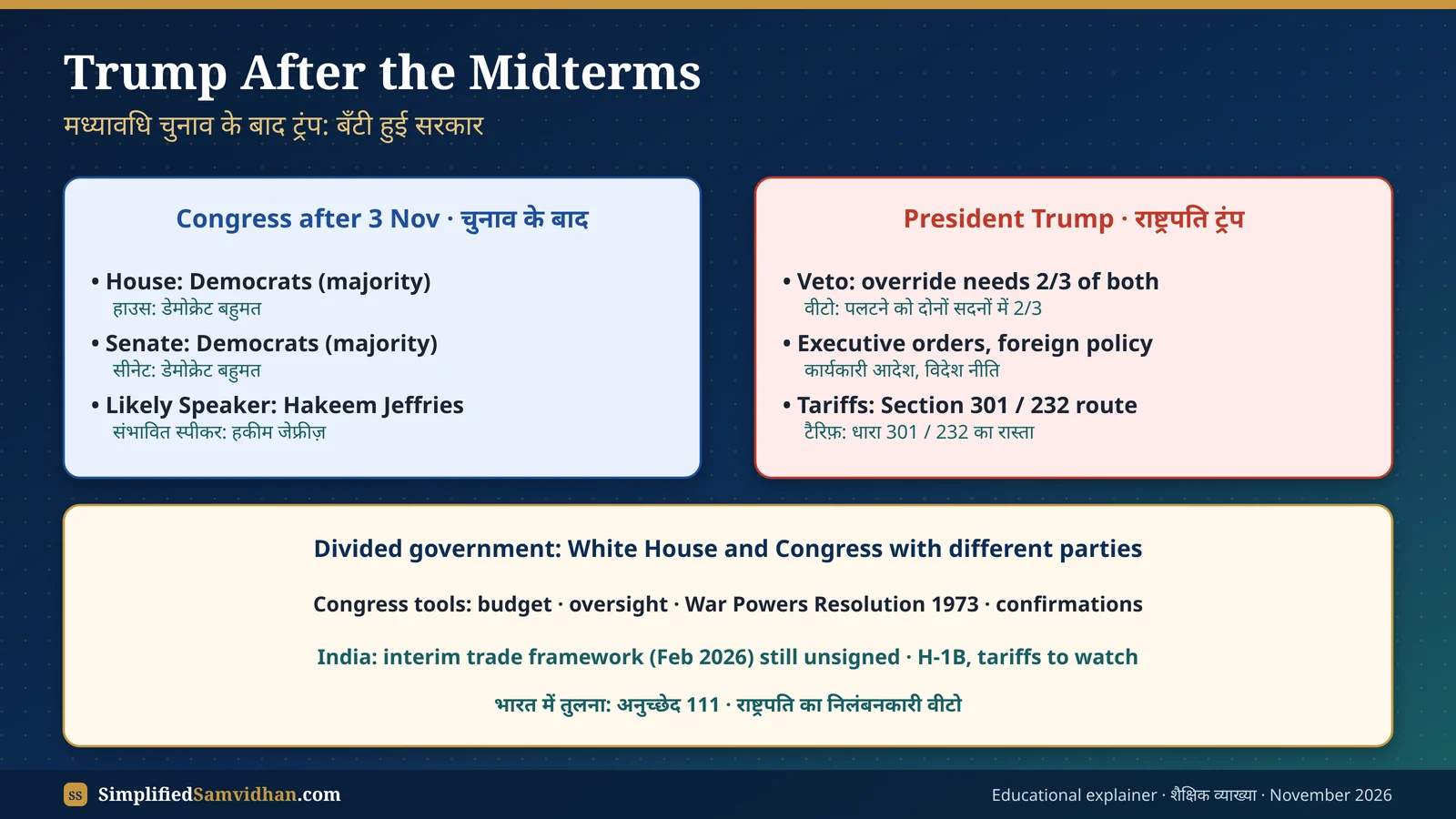
In the 3 November 2026 midterms the Democrats won a majority in the House of Representatives, which networks called on election night, and the Senate, which the Associated Press called for them shortly before midnight. A few races, such as Alaska and Mississippi, were still being counted, so final seat totals may change. House Democratic leader Hakeem Jeffries is expected to become Speaker when the new Congress meets in January 2027.
Trump told The New York Times he was "absolutely willing to accept those results" and would work with Democrats, but made clear he would use his veto against their proposals and said he did not see the result as "a hit" on him. Analysts expect him to rely more on executive orders and trade law.
At a GlanceTrump and the New Congress: Key Facts
| Point | Fact |
|---|---|
| Election | US midterms, 3 November 2026 |
| House | Democrats win majority (218 needed) |
| Senate | Democrats win majority (AP call); a few races still counting |
| New Congress meets | January 2027 |
| Expected Speaker | Hakeem Jeffries (Democrat) |
| President | Donald Trump, term to January 2029 |
| Trump's stated response | Accepts the result; will work with Democrats but use his veto |
| Veto override | Two-thirds of both Houses |
In America the President and Congress are chosen separately, so one party can hold the White House while the other holds Congress. That is a divided government. Trump still runs the government and commands the army, but he cannot pass laws or a budget alone. Democrats cannot remove his policies alone either, because he can veto their bills. So both sides must bargain, or each uses the powers it has on its own.
🏠 Everyday analogy
It is like a joint family where the eldest member runs the house but the family council controls the money. He can still give daily orders, but any big purchase needs the council's yes.
🇮🇳 Real Indian example
If Democrats pass a bill to cancel some tariffs, Trump can veto it. They would then need two-thirds in both Houses to override, which is very hard.
Who Controls WhatTrump's Tools vs Congress's Tools
| Trump can still | Congress can now |
|---|---|
| Veto bills (override needs two-thirds of both Houses) | Refuse to pass his bills and budget plans |
| Issue executive orders | Control government spending (the 'power of the purse') |
| Use trade laws such as Section 301 to impose tariffs | Hold oversight hearings and issue subpoenas |
| Run foreign policy and command the armed forces | Use the War Powers Resolution (1973) to try to limit military action |
| Negotiate trade deals | Senate: confirm or reject top appointments; treaties need two-thirds |
India ComparisonArticle 111: How India's President Deals with Bills
Constitution of India, Article 111. Assent to Bills.
When a Bill has been passed by the Houses of Parliament, it shall be presented to the President, and the President shall declare either that he assents to the Bill, or that he withholds assent therefrom:
Provided that the President may, as soon as possible after the presentation to him of a Bill for assent, return the Bill if it is not a Money Bill to the Houses with a message requesting that they will reconsider the Bill or any specified provisions thereof and, in particular, will consider the desirability of introducing any such amendments as he may recommend in his message, and when a Bill is so returned, the Houses shall reconsider the Bill accordingly, and if the Bill is passed again by the Houses with or without amendment and presented to the President for assent, the President shall not withhold assent therefrom.
- The US President's veto is a qualified veto: Congress can override it by two-thirds of both Houses.
- India's President has a suspensive veto: he can return a non-Money Bill once, but must assent if Parliament passes it again by a simple majority.
- India's President acts on the advice of the Council of Ministers (Article 74), so India cannot have a US-style divided government: the PM must keep the Lok Sabha's confidence.
- Read more: Separation of powers.
India AngleWhat a Divided Washington Means for India
Could help India
- Congressional checks on sudden tariff moves
- Bipartisan support for India as a partner stays strong
- More scrutiny of sanctions that could hit Indian buyers of Russian oil
- Democrats tend to be friendlier on skilled-worker visas
Could hurt or delay
- Trump may push India harder for a quick trade deal using executive powers
- Gridlock can stall laws on visas and trade
- Tariffs under existing trade laws can continue
- A distracted Washington can slow big defence and tech deals
UPSC CornerTrump and Divided Government for UPSC
- Prelims: A US presidential veto can be overridden by a two-thirds vote in both Houses of Congress.
- Prelims: The Indian President has a suspensive veto over ordinary Bills and no power to return a Money Bill (Article 111).
- Prelims: In the US, treaties need the advice and consent of two-thirds of the Senate; in India, treaty-making is an executive power.
- Mains (GS II): "Divided government tests the US system of checks and balances." Compare with the fusion of powers in India's parliamentary system.
Practice MCQTest Yourself: Trump vs a Democratic Congress
Consider the following statements: (1) A US presidential veto can be overridden by a two-thirds majority in both Houses of Congress. (2) The President of India can return a Money Bill to Parliament for reconsideration. (3) If Parliament passes a returned Bill again, the President of India must give assent. Which of the statements given above is/are correct?
Doubts ClearedFrequently Asked Questions
Who won the 2026 US midterms?
The Democrats won control of both the House of Representatives and the Senate, according to network and AP projections; a few races were still being counted.
What did Trump say after the midterms?
He said he was 'absolutely willing to accept those results' and would work with Democrats, but would use his veto against their proposals.
Can Democrats cancel Trump's tariffs?
They can pass a bill, but Trump can veto it, and overriding a veto needs two-thirds of both Houses. Courts can also strike down tariffs.
What does a divided government mean for India?
Congress can scrutinise tariffs, visas and sanctions, but most trade decisions, including the pending India-US trade deal, still rest with the White House.
How is the US veto different from the Indian President's?
The US veto can be overridden by two-thirds of both Houses. The Indian President can only return a non-Money Bill once; if Parliament passes it again, he must assent.
Sources and further readingSources We Checked
Facts checked against the reports below on 5 November 2026. Seat totals are projections and a few races were still being counted; we will update the page when final results are certified.
- Fortune: Stock markets celebrate a 'stunning rebuke': Trump says he will accept midterm losses (4 Nov 2026)
- NBC News: Midterms 2026 highlights: Democrats win control of Congress
- Time: Midterm Elections 2026 live results and updates
- Al Jazeera: Can Democrats stop Iran war, reverse Trump's tariffs after midterms win? (4 Nov 2026)
- Euronews: US midterms: what Trump's defeat means for Europe and global markets (4 Nov 2026)
- Outlook India: India-US trade deal at a crossroads after Trump's midterm setback (4 Nov 2026)