Bare ActOfficial Text of Article 53
53. Executive power of the Union.—
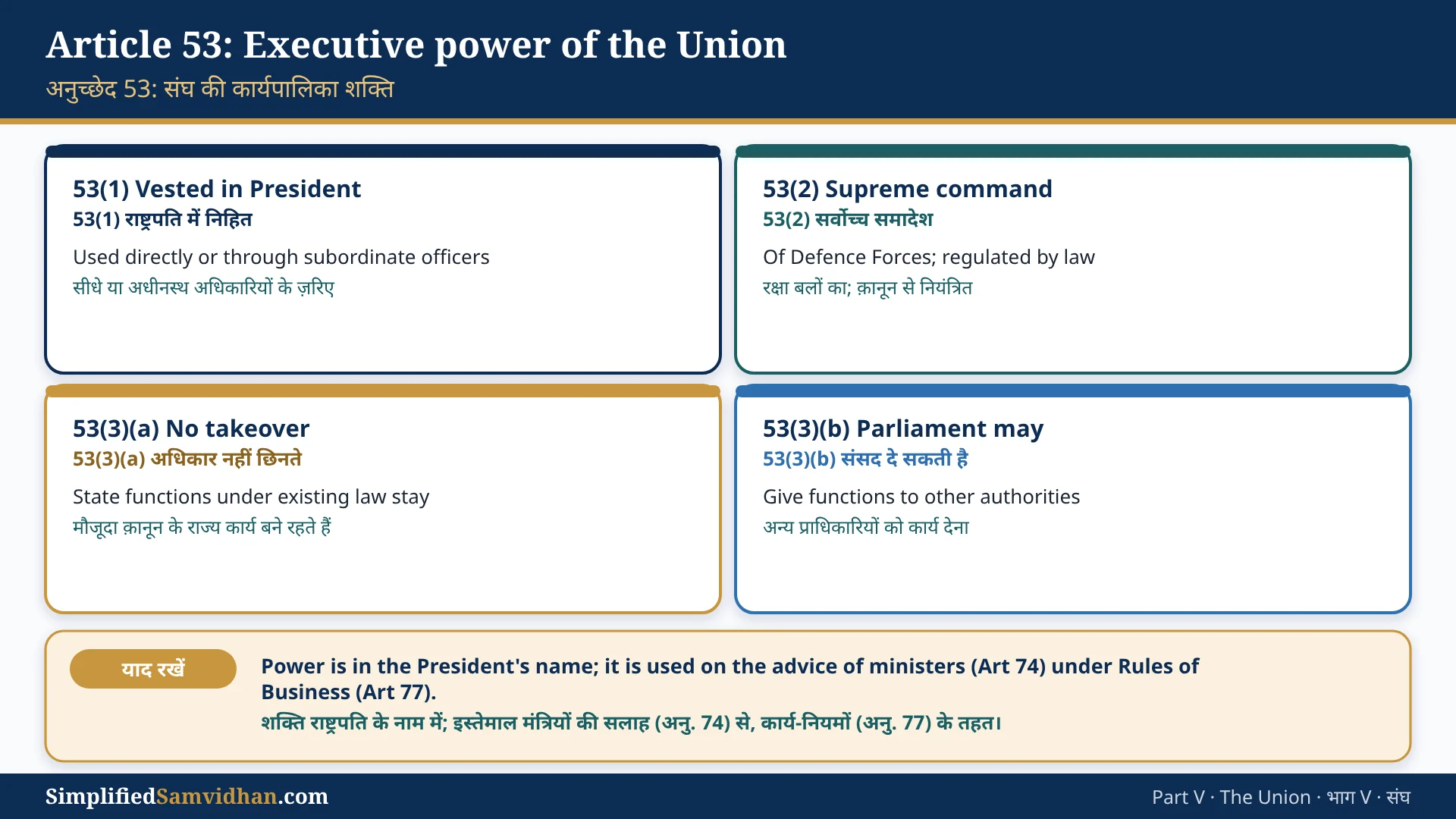
(1) The executive power of the Union shall be vested in the President and shall be exercised by him either directly or through officers subordinate to him in accordance with this Constitution.
(2) Without prejudice to the generality of the foregoing provision, the supreme command of the Defence Forces of the Union shall be vested in the President and the exercise thereof shall be regulated by law.
(3) Nothing in this article shall—
(a) be deemed to transfer to the President any functions conferred by any existing law on the Government of any State or other authority; or
(b) prevent Parliament from conferring by law functions on authorities other than the President.
Clause (1): The power to run the Union Government (enforce laws, appoint officers, run ministries) belongs to the President. It is used directly or through officers (ministers and civil servants), and always according to the Constitution.
Clause (2): The President is the Supreme Commander of the Defence Forces. But how this command is used is regulated by law made by Parliament (Army Act 1950, Navy Act 1957, Air Force Act 1950). The President cannot order a war alone; Parliament controls money and law.
Clause (3)(a): Functions that an older law gave to a State Government or another authority do not automatically move to the President.
Clause (3)(b): Parliament can still give powers to other authorities by law, for example to the Election Commission, the RBI or a regulator.
🏠 Everyday Analogy
A cricket team's captain is officially named in the scorebook, and every decision is announced in the captain's name. But field placements are planned with the coach and senior players, and the board's rules decide what the captain can and cannot do. Article 53 is the scorebook entry; Articles 74 and 77 are the team meeting and the rule book.
🇮🇳 Real Indian Example
When the Government of India appoints a new Cabinet Secretary or issues a notification, the order says "By order and in the name of the President". The decision is taken by the ministry concerned under the Government of India (Allocation of Business) and (Transaction of Business) Rules, 1961, made under Article 77.
MeaningArticle 53: What Is 'Executive Power'?
The Constitution does not define executive power. In Ram Jawaya Kapur v. State of Punjab (1955) the Supreme Court said it is broadly the power that remains after legislative and judicial functions are taken away: carrying out laws, running the administration and making policy. The executive can act even where no law exists yet, as long as it does not break any law or the Constitution.
| Article | How it shapes Article 53 |
|---|---|
| 73 | Extent: matters on which Parliament can make laws, plus treaty rights |
| 74 | Council of Ministers with PM at head aids and advises the President |
| 75 | PM appointed by President; ministers on PM's advice; collective responsibility to Lok Sabha |
| 77 | All action in the President's name; Rules of Business |
| 78 | PM keeps the President informed |
Supreme CommanderArticle 53(2): The President as Supreme Commander
- The President appoints the Chiefs of the Army, Navy and Air Force and the Chief of Defence Staff, on the advice of the Appointments Committee of the Cabinet.
- Commissions to officers are granted in the President's name.
- Declaring war or making peace is an executive act of the Union, decided by the Cabinet; Parliament controls it through laws and the budget.
- Because of the words "regulated by law", the President's command is not personal: it works through the Army Act 1950, the Navy Act 1957 and the Air Force Act 1950.
In the USA, the President is both Commander-in-Chief and head of government. In India, the Supreme Commander is a constitutional head, so military decisions are in practice taken by the elected government.
Key casesArticle 53: Key Supreme Court Cases
| Case | What it decided |
|---|---|
| Ram Jawaya Kapur v. State of Punjab (1955) | Meaning of executive power; India has a Cabinet system like Britain |
| Shamsher Singh v. State of Punjab (1974) | President and Governor act on ministerial advice except in rare cases |
| S. R. Bommai v. Union of India (1994) | Presidential power under Article 356 is open to judicial review |
| B. P. Singhal v. Union of India (2010) | Governors' removal 'at pleasure' still cannot be arbitrary |
Quick RevisionKey Points to Remember
- Executive power of the Union is vested in the President (Article 53(1)).
- It is used directly or through subordinate officers, always in line with the Constitution.
- The President has the supreme command of the Defence Forces, regulated by law.
- Article 53 has never been amended; Article 154 is its twin for State Governors.
UPSC · State PSC · JudiciaryArticle 53: Exam Corner
- Prelims trap: "The supreme command of the Defence Forces is vested in the Prime Minister." False. It is vested in the President (Article 53(2)).
- Prelims fact: Article 154 is the State-level copy: executive power of the State is vested in the Governor.
- Mains (GS II): "Executive power is vested in the President but exercised by the Council of Ministers." Explain with reference to Articles 53, 74 and 75.
Practice MCQTest Yourself: Article 53
Consider: (1) The executive power of the Union is vested in the President. (2) The supreme command of the Defence Forces is regulated by law. (3) Parliament cannot give executive functions to any authority other than the President. Which is/are correct under Article 53?
Doubts ClearedFrequently Asked Questions
What is Article 53 of the Indian Constitution?
Article 53 vests the executive power of the Union in the President and makes the President the Supreme Commander of the Defence Forces.
Who actually uses the executive power of the Union?
The Council of Ministers headed by the Prime Minister, whose advice binds the President (Article 74), through civil servants.
Can the President declare war alone?
No. The supreme command is regulated by law, and war and peace are decided by the Union Cabinet, answerable to Parliament.
Which Article is the State version of Article 53?
Article 154, which vests the executive power of a State in the Governor.