Bare ActOfficial Text of Article 54
54. Election of President.—
The President shall be elected by the members of an electoral college consisting of—
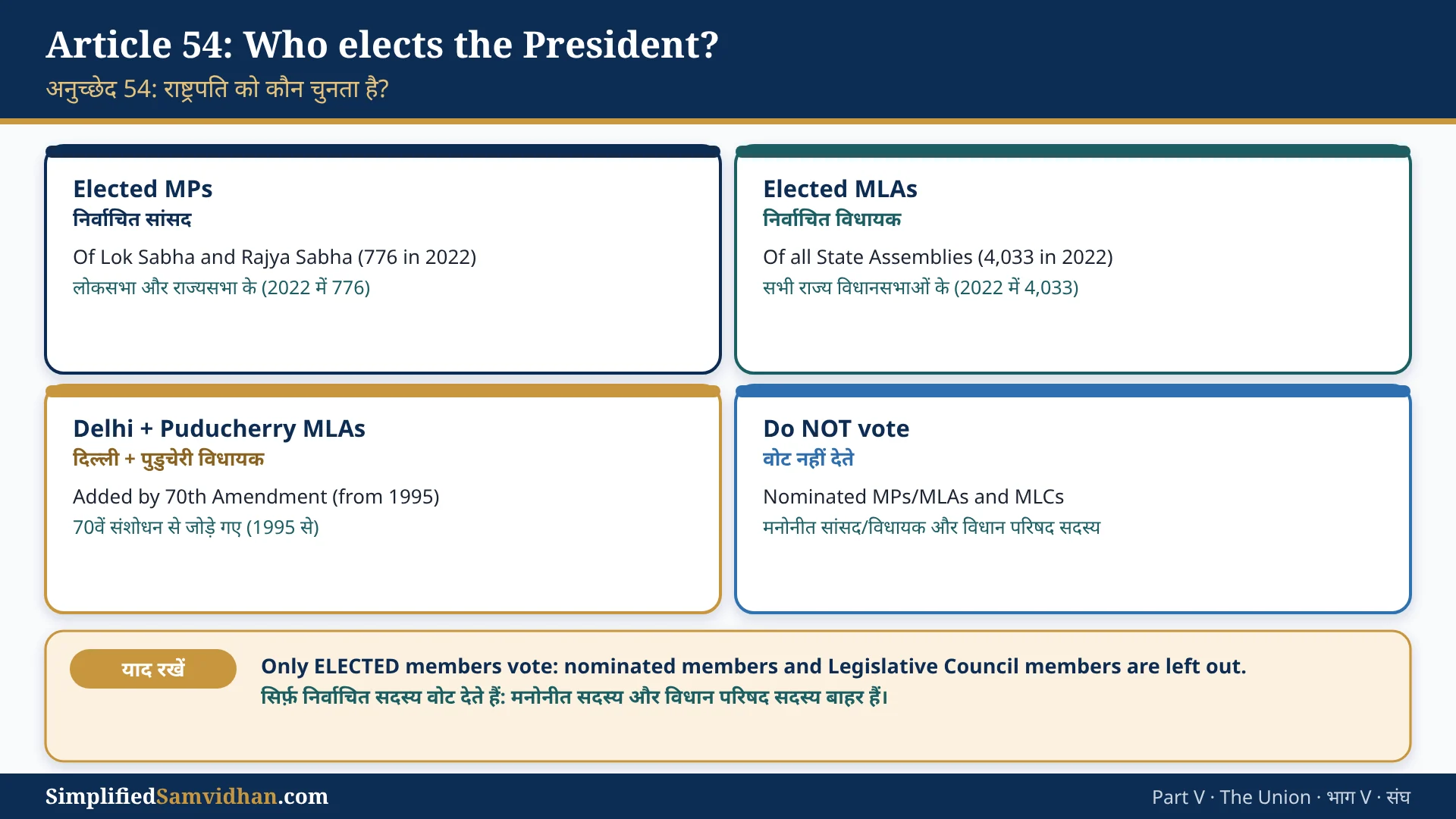
(a) the elected members of both Houses of Parliament; and
(b) the elected members of the Legislative Assemblies of the States.
Explanation.—In this article and in article 55, "State" includes the National Capital Territory of Delhi and the Union territory of Pondicherry.
The President is chosen by an electoral college, a special group of voters, not by all citizens.
It has two parts: (a) elected MPs of the Lok Sabha and Rajya Sabha, and (b) elected MLAs of the State Legislative Assemblies.
The Explanation, added by the 70th Amendment Act, 1992 (in force from 1 June 1995), counts the Assemblies of Delhi and Puducherry as States for this election.
Left out: nominated members of Parliament and Assemblies, and members of Legislative Councils (Vidhan Parishads).
🏠 Everyday Analogy
A big company does not ask every customer to choose its chairperson. Instead, elected representatives of each branch and the head office vote. Customers chose those representatives, so the chairperson still has an indirect link with everyone.
🇮🇳 Real Indian Example
In the 2022 election, 4,809 people could vote: 776 elected MPs and 4,033 elected MLAs. Rajasthan's 200 MLAs and its 25 Lok Sabha and 10 Rajya Sabha MPs were all in the college. A nominated Rajya Sabha member, such as a famous sportsperson, could not vote. Jammu and Kashmir had no Assembly then, so no J&K MLA voted.
Who votesArticle 54: Who Can and Cannot Vote for President
| Member | President's election (Art 54) | Vice-President's election (Art 66) | Impeachment (Art 61) |
|---|---|---|---|
| Elected MPs | Yes | Yes | Yes |
| Nominated MPs | No | Yes | Yes |
| Elected MLAs | Yes | No | No |
| MLCs (Legislative Council) | No | No | No |
| Delhi and Puducherry MLAs | Yes (70th Amendment) | No | No |
This table is a favourite Prelims question. Remember: the President's college is federal (Centre + States); the Vice-President's college is only Parliament.
Why indirectArticle 54: Why the People Do Not Elect the President Directly
- Nominal head: a President elected by crores of voters might claim to be more powerful than the Prime Minister. The Constituent Assembly wanted no rival power centre.
- Cost and time: a nationwide election only to choose a ceremonial head was seen as wasteful.
- Federal balance: MLAs make the President a choice of both the Union and the States, so the President represents the whole federation, not only the party ruling at the Centre.
- Some members wanted election by all adult citizens; Dr Ambedkar defended the indirect method as suited to a parliamentary system.
Rules and disputesArticle 54 in Practice: Rules, Vacancies and Disputes
- The Election Commission of India conducts the election (Article 324) under the Presidential and Vice-Presidential Elections Act, 1952.
- The Secretary-General of the Lok Sabha or the Rajya Sabha is appointed Returning Officer, by turns.
- Voting is in Parliament House and in each State Assembly building; MPs get green ballot papers and MLAs pink ones.
- Article 71(4) (added by the 11th Amendment, 1961): the election cannot be challenged on the ground that some seats in the electoral college were vacant, for example a dissolved Assembly.
- Disputes about the election are decided only by the Supreme Court (Article 71(1)).
Quick RevisionKey Points to Remember
- President is elected indirectly by an electoral college (Article 54).
- College = elected MPs of both Houses + elected MLAs of States.
- Delhi and Puducherry MLAs added by the 70th Amendment, 1992.
- Nominated members and MLCs do not vote.
- A vacancy in the college cannot stop or void the election (Article 71(4)).
UPSC · State PSC · JudiciaryArticle 54: Exam Corner
- Prelims (asked many times): "Elected members of the Legislative Councils take part in the election of the President." False.
- Prelims trap: "Nominated members of Parliament vote in the President's election." False; they vote in the Vice-President's election and in impeachment.
- Mains (GS II): "The method of electing the President reflects India's federal character." Examine.
Practice MCQTest Yourself: Article 54
Who among the following does NOT vote in the election of the President of India?
Doubts ClearedFrequently Asked Questions
What is Article 54 of the Indian Constitution?
Article 54 says the President is elected by an electoral college of elected MPs of both Houses and elected MLAs of the States, including Delhi and Puducherry.
How many electors were there in the 2022 Presidential election?
4,809: 776 elected MPs and 4,033 elected MLAs.
Do nominated Rajya Sabha members vote for the President?
No. They are not part of the electoral college under Article 54, though they vote for the Vice-President.
Which amendment added Delhi and Puducherry to the electoral college?
The 70th Constitutional Amendment Act, 1992, which came into force on 1 June 1995.