Powers of the President of India: RAS Notes
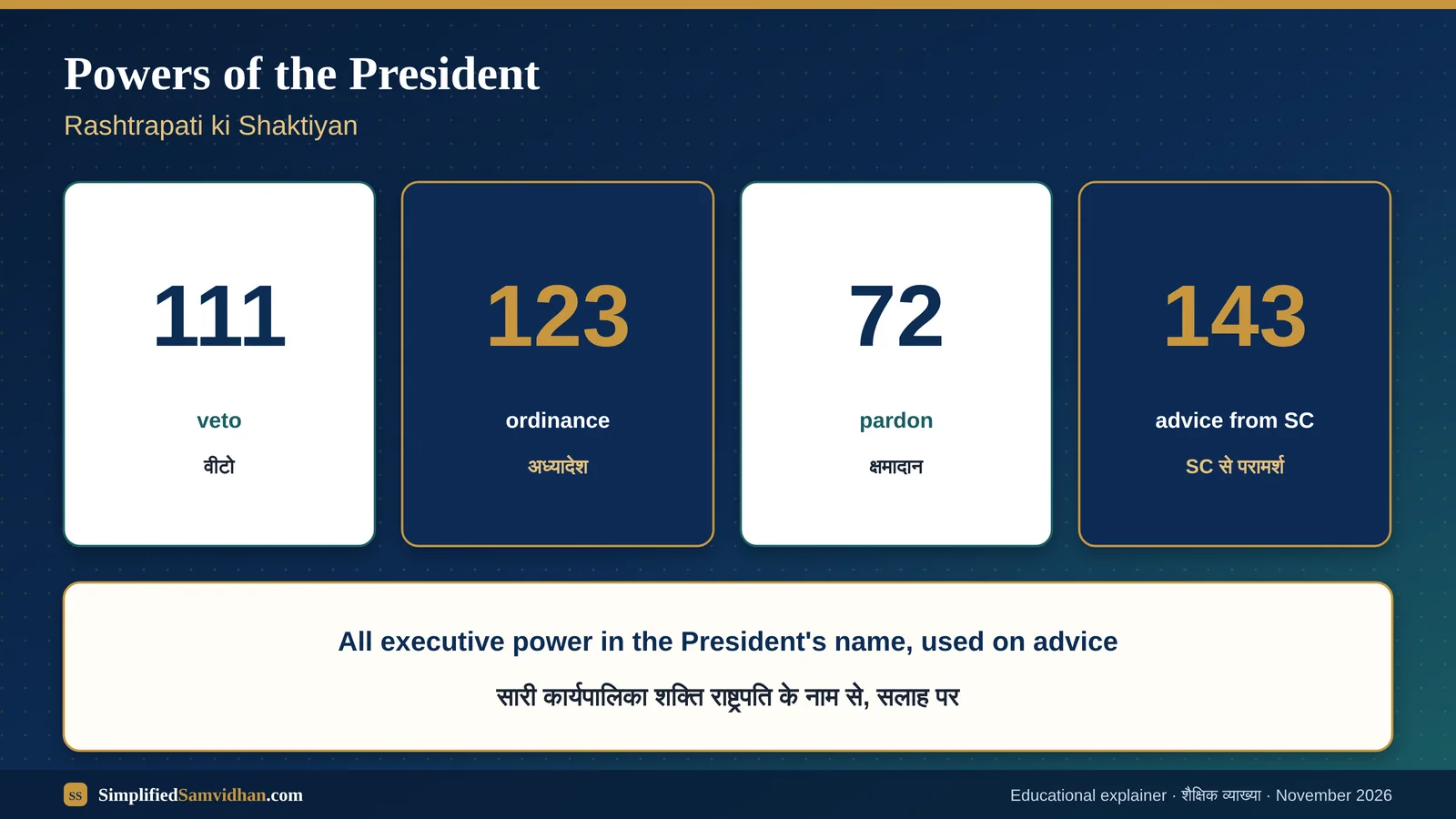
Executive, legislative, veto, ordinance, pardon, advisory and emergency powers in one place, with famous examples and practice MCQs.
Short answerPowers of the President in Simple Words
Short answer: all executive power of the Union is vested in the President (Art 53), but it is used on the advice of the Council of Ministers (Art 74). The big powers RAS asks about: veto over bills (Art 111: absolute, suspensive, pocket; no veto on a money bill or a constitutional amendment bill), ordinance when Parliament is not in session (Art 123; must be approved within 6 weeks of Parliament meeting), pardon and four lighter forms (Art 72; also for court-martial and death sentences), advisory reference to the Supreme Court (Art 143), and three emergencies (Arts 352, 356, 360). The President also appoints the PM, judges, Governors, CAG and Election Commissioners. Present President: Droupadi Murmu (since 25 July 2022).
🏠 Everyday analogy
The President is like the stamp of the nation: every big order carries the President's name, but the hand that writes it is the Cabinet's.
🇮🇳 Real Indian example
In May 2026, Parliament was not in session, so the President issued an ordinance raising the number of Supreme Court judges; Parliament later replaced it with an Act.
Prelims: types of veto; pocket veto 1986; ordinance: 6 weeks rule; pardon vs Governor's pardon; Art 143 reference 2025
Mains: is the President a rubber stamp?; ordinance-making and its misuse (D.C. Wadhwa 1987, Krishna Kumar Singh 2017)
Constitution textWhat the Constitution Says
Article 72(1). The President shall have the power to grant pardons, reprieves, respites or remissions of punishment or to suspend, remit or commute the sentence of any person convicted of any offence...
Article 123(1). If at any time, except when both Houses of Parliament are in session, the President is satisfied that circumstances exist which render it necessary for him to take immediate action, he may promulgate such Ordinances as the circumstances appear to him to require.
VetoThree Types of Veto (Article 111)
| Veto | What happens | Example |
|---|---|---|
| Absolute | President withholds assent; bill dies | PEPSU Appropriation Bill 1954 (Rajendra Prasad) |
| Suspensive | Returned once for reconsideration; must sign if passed again (not for money bills) | Office of Profit Bill 2006 (A.P.J. Abdul Kalam) |
| No time limit in Art 111, so the President simply sits on the bill | Indian Post Office (Amendment) Bill 1986 (Zail Singh) | |
| None | Constitutional amendment bills must get assent (24th Amendment, 1971) | - |
PardonFive Forms of the Pardoning Power
Pardon
Wipes out both sentence and conviction.
Commutation
Changes the type of punishment to a lighter one (death → life).
Remission
Reduces the period without changing the type.
Respite
Lighter sentence for a special reason, e.g. pregnancy or disability.
Reprieve
Temporary stay of a (death) sentence.
Art 72 vs 161President's vs Governor's Pardon
President (Art 72)
- Offences against Union laws
- Court-martial: yes
- Can pardon a death sentence
Governor (Art 161)
- Offences against state laws
- Court-martial: no
- Cannot pardon death sentence (can suspend/commute)
Current affairsCurrent Affairs of the Last One Year
- Presidential Reference (Art 143), opinion of 20 November 2025: President Murmu asked the Supreme Court 14 questions after its April 2025 Tamil Nadu ruling had fixed time limits for Governors. The five-judge bench said courts cannot fix timelines for the Governor or President to act on bills and there is no 'deemed assent', but Governors cannot sit on bills endlessly.
- Ordinance, May 2026: the Supreme Court (Number of Judges) Amendment Ordinance (16 May 2026) raised the strength to 38; Parliament replaced it with an Act in the monsoon session.
- Already on this site (President series): President of India series (Part V) · How the President is elected · Impeachment of the President (Art 61)
- Related: Governor of Rajasthan (Art 200) · Emergency provisions (352, 356, 360) · RAS polity syllabus
Mains answerRAS Mains: How to Write the Answer
- Q. 'The President of India is not a mere rubber stamp.' Discuss. (10 marks) Frame: nominal head (53, 74) → situational discretion (choosing PM in a hung House, returning advice once, pocket veto, Art 78 information) → examples (Rajendra Prasad 1954, Zail Singh 1986, Kalam 2006, Art 143 reference 2025) → limits → conclusion: conscience-keeper of the Constitution.
Quick revisionOne-Line Revision Points (Exam Ready)
- Executive power vested in the President (53), used on advice (74).
- Veto 111: absolute, suspensive, pocket (Zail Singh 1986).
- Ordinance 123: lapses 6 weeks after Parliament reassembles.
- Pardon 72 (incl. court-martial, death); Governor 161.
- Advisory reference 143; 2025 opinion: no court-fixed timelines.
Practice MCQPractice MCQs (with Answers): Powers of the President
Which President used the pocket veto in 1986?
An ordinance must be approved by Parliament within:
Which form of pardon changes a death sentence into life imprisonment?
The President cannot exercise any veto over:
Who can pardon a sentence given by a court-martial?
Under which Article did President Murmu seek the Supreme Court's opinion on timelines for Governors in 2025?
The 2025 Supreme Court opinion on the Presidential Reference held that:
Who is the present President of India?
A President returned the Office of Profit Bill in 2006. Who?
Which case held that re-promulgating ordinances again and again is a fraud on the Constitution?
Doubts ClearedFrequently Asked Questions
What are the three types of veto of the President?
Absolute (withholding assent), suspensive (returning once for reconsideration) and pocket (not acting on the bill, as Art 111 sets no time limit).
Can the President pardon a death sentence?
Yes, under Article 72; a Governor cannot pardon a death sentence but can suspend, remit or commute it.
Sources and further readingSources We Checked
Checked on 11 November 2026 against the Constitution (Articles 53, 72, 74, 111, 123, 143) and reports of the Supreme Court's 20 November 2025 opinion.