Bare ActOfficial Text of Article 55
55. Manner of election of President.—
(1) As far as practicable, there shall be uniformity in the scale of representation of the different States at the election of the President.
(2) For the purpose of securing such uniformity among the States inter se as well as parity between the States as a whole and the Union, the number of votes which each elected member of Parliament and of the Legislative Assembly of each State is entitled to cast at such election shall be determined in the following manner:—
(a) every elected member of the Legislative Assembly of a State shall have as many votes as there are multiples of one thousand in the quotient obtained by dividing the population of the State by the total number of the elected members of the Assembly;
(b) if, after taking the said multiples of one thousand, the remainder is not less than five hundred, then the vote of each member referred to in sub-clause (a) shall be further increased by one;
(c) each elected member of either House of Parliament shall have such number of votes as may be obtained by dividing the total number of votes assigned to the members of the Legislative Assemblies of the States under sub-clauses (a) and (b) by the total number of the elected members of both Houses of Parliament, fractions exceeding one-half being counted as one and other fractions being disregarded.
(3) The election of the President shall be held in accordance with the system of proportional representation by means of the single transferable vote and the voting at such election shall be by secret ballot.
Explanation.—In this article, the expression "population" means the population as ascertained at the last preceding census of which the relevant figures have been published:
Provided that the reference in this Explanation to the last preceding census of which the relevant figures have been published shall, until the relevant figures for the first census taken after the year 2026 have been published, be construed as a reference to the 1971 census.
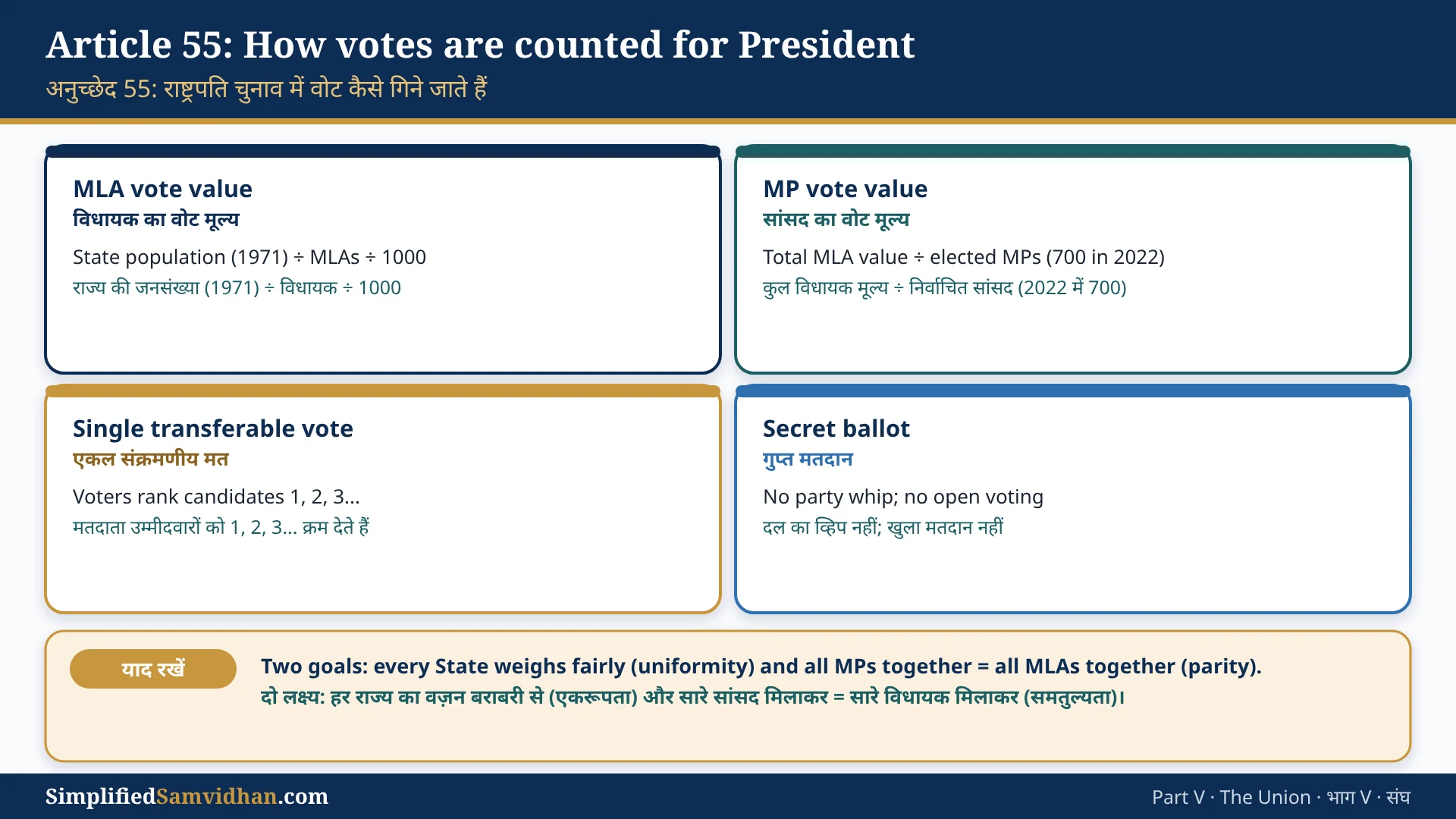
Clause (1) Uniformity: a big State should not get the same say as a tiny one. Each MLA's vote is weighted by how many people he or she represents.
Clause (2) Parity: the total value of all MPs' votes is made equal to the total value of all MLAs' votes, so the Union and the States have an equal voice.
Clause (3) Method: proportional representation by single transferable vote. Each voter marks preferences 1, 2, 3 against candidates. Voting is secret, so parties cannot issue a binding whip and anti-defection law does not apply.
Explanation: "population" means the 1971 census figures until the first census after 2026 is published (42nd Amendment 1976, extended by the 84th Amendment 2001).
🏠 Everyday Analogy
Imagine a school election where each class monitor's vote is multiplied by the number of students in the class: a class of 60 counts more than a class of 20. Then the teachers' votes together are given the same total weight as all monitors together. That is Article 55 in a nutshell.
🇮🇳 Real Indian Example
Rajasthan: 1971 population 2,57,65,806 ÷ 200 MLAs = 1,28,829. Divide by 1,000 = 128.8, so 128 votes; the remainder 829 is not less than 500, so add 1. Each Rajasthan MLA's vote is worth 129. In 2022 all MLAs together were worth 5,43,231; divided by 776 elected MPs = 700.04, so each MP's vote was worth 700.
Vote valueArticle 55: Value of an MLA's and an MP's Vote (2022)
| Voter | Value of one vote (2022) | Why |
|---|---|---|
| UP MLA | 208 | Largest population per MLA |
| Maharashtra MLA | 175 | Large State |
| Rajasthan MLA | 129 | 2.58 crore people (1971) ÷ 200 MLAs |
| Sikkim MLA | 7 | Smallest value |
| Any elected MP | 700 | 5,43,231 ÷ 776 MPs |
Total value of the electoral college in 2022: 10,86,431 (5,43,231 MLAs + 5,43,200 MPs). In 2017 an MP's vote was worth 708, because the Jammu and Kashmir Assembly was then part of the college.
CountingArticle 55(3): How the Single Transferable Vote Finds the Winner
- Each elector writes 1 against the first choice and may write 2, 3... for others. Marking the first preference is compulsory; the others are optional.
- Quota to win = (total value of valid votes ÷ 2) + 1, i.e. more than half.
- If no candidate reaches the quota on first preferences, the candidate with the lowest value is eliminated and his or her ballots go to the next preference marked. This repeats until someone wins.
- Only once, in 1969, was the count decided on second preferences: V. V. Giri beat N. Sanjiva Reddy after transfers.
In 2022, Droupadi Murmu won on the first count with votes worth 6,76,803 against Yashwant Sinha's 3,80,177.
1971 censusArticle 55 Explanation: Why the 1971 Census Still Counts
- In 1976 the 42nd Amendment froze the population base at the 1971 census until 2000, so that States which controlled population growth would not lose weight.
- The 84th Amendment, 2001 extended the freeze until the first census after 2026 is published.
- The same freeze applies to Lok Sabha seats (Article 81) and Assembly seats (Article 170). The coming census and delimitation will therefore change MLA and MP vote values too.
- The number of seats used in the formula is the current number of elected members.
Quick RevisionKey Points to Remember
- Article 55 aims at uniformity among States and parity between States and Union.
- MLA vote value = State population (1971) ÷ elected MLAs ÷ 1,000.
- MP vote value = total MLA value ÷ elected MPs (700 in 2022).
- Election by proportional representation through single transferable vote; secret ballot.
- 1971 census used until the first census after 2026 (84th Amendment).
UPSC · State PSC · JudiciaryArticle 55: Exam Corner
- Prelims trap: "The President is elected by the first-past-the-post system." False. It is proportional representation by single transferable vote.
- Prelims trap: "The value of an MP's vote differs from State to State." False. Every elected MP's vote has the same value; MLA values differ by State.
- Mains (GS II): "The formula in Article 55 balances federalism and democracy." Discuss, with the impact of the next census.
Practice MCQTest Yourself: Article 55
The President of India is elected by which system?
Doubts ClearedFrequently Asked Questions
What is Article 55 of the Indian Constitution?
Article 55 lays down how the President is elected: the value of each MLA's and MP's vote, and voting by single transferable vote with secret ballot.
What is the value of an MP's vote in the Presidential election?
700 in 2022 (708 in 2017). It equals the total value of all MLAs' votes divided by the number of elected MPs.
Which census is used to calculate vote values?
The 1971 census, until the figures of the first census after 2026 are published (84th Amendment, 2001).
Can a party issue a whip in the Presidential election?
No binding whip: voting is by secret ballot under Article 55(3), so the anti-defection law (Tenth Schedule) does not apply.