Bare ActOfficial Text of Article 52
52. The President of India.—
There shall be a President of India.
Article 52 creates the office of the President. India must always have one; the post can never stay empty for long (Article 62 and Article 65 make sure of that).
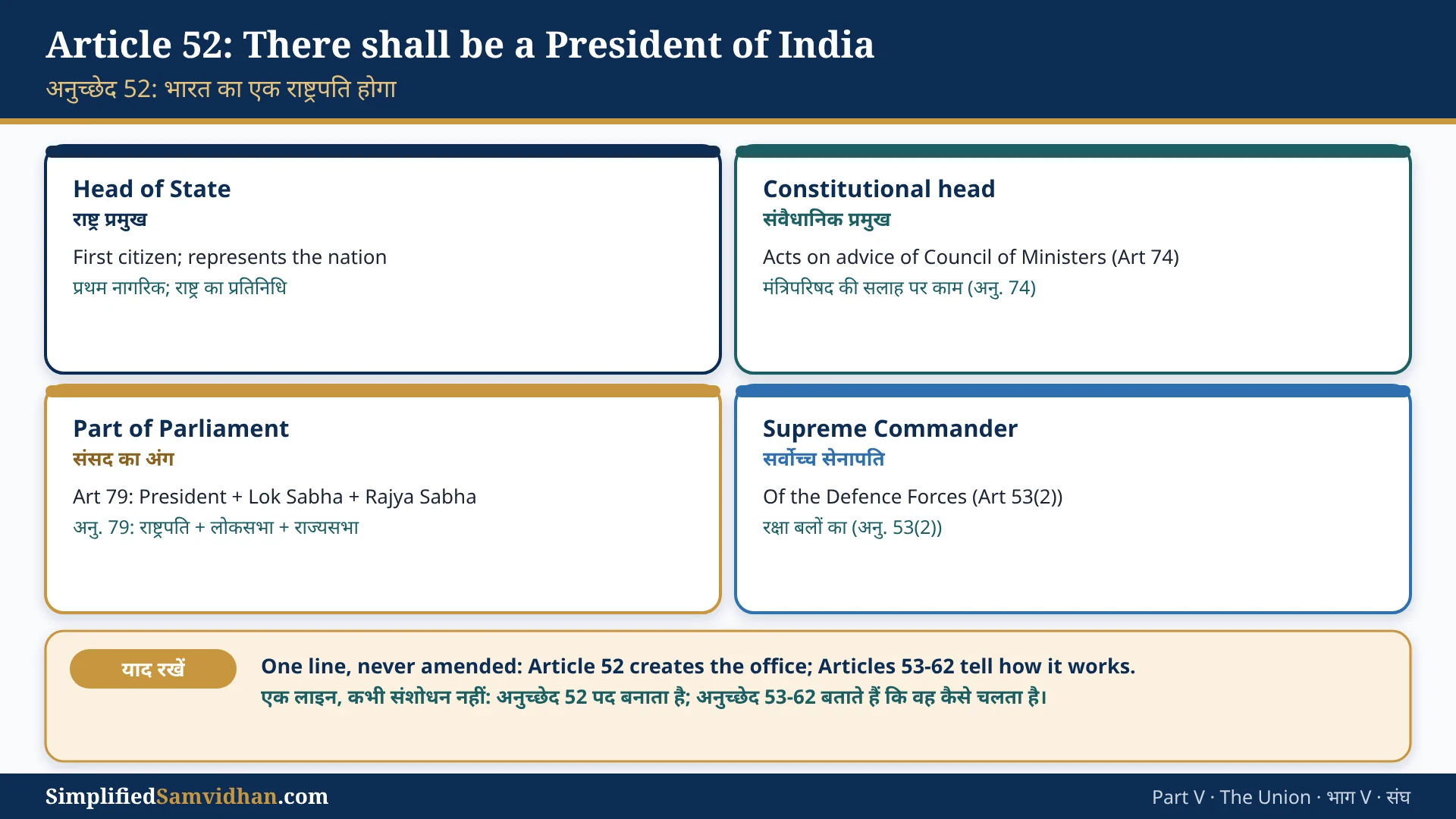
The President is the head of the State and the first citizen of India. All executive action of the Union is taken in the President's name (Article 77).
But India follows the parliamentary system. The President is a constitutional (nominal) head; the real executive is the Council of Ministers headed by the Prime Minister (Article 74).
Article 52 itself has never been amended. Articles 53 to 62 add the details: powers, election, term, oath, impeachment and vacancy.
🏠 Everyday Analogy
Think of a big school. The Principal's name is on every certificate and every notice, and the Principal presides over the annual function. But the day-to-day decisions are taken by the staff committee, and the Principal signs what the committee decides, though she can ask them to think again once.
🇮🇳 Real Indian Example
When a new law is passed, it becomes an Act only after the President gives assent (Article 111). When a Governor or a Chief Justice is appointed, the warrant is signed by the President. Each of these is done on the advice of the Union Government, which is why we say the President 'reigns but does not rule'.
How it cameArticle 52: How the Constituent Assembly Chose a President
In the draft Constitution this was Article 41. The Constituent Assembly had to choose between the American model (a powerful elected President who also runs the government) and the British model (a ceremonial head and a Cabinet answerable to Parliament). India knew the British system from the Government of India Act, 1935, and wanted a government that answers to the Lok Sabha every day.
Dr B. R. Ambedkar explained the choice on 4 November 1948: the President "occupies the same position as the King under the English Constitution. He is the head of the State but not of the Executive. He represents the Nation but does not rule the Nation."
- A King would not suit a Republic, so the head had to be elected, not born.
- A directly elected President might clash with an elected Prime Minister, so the Assembly chose an indirect election by MPs and MLAs (Articles 54-55), an idea taken from the Irish Constitution.
- Dr Rajendra Prasad became the first President on 26 January 1950; he is the only one elected twice (1952 and 1957).
Nominal or realArticle 52 and Article 74: Is the President Only a Rubber Stamp?
| Point | What the Constitution says |
|---|---|
| Executive power | Vested in the President (Article 53), used directly or through officers |
| Advice | Council of Ministers aids and advises; the President "shall" act on it (Article 74(1), 42nd Amendment, 1976) |
| Second look | President may send advice back once for reconsideration; then must accept (44th Amendment, 1978) |
| Courts | Courts cannot ask what advice was given (Article 74(2)) |
| Real power | Prime Minister and Council of Ministers, collectively responsible to Lok Sabha (Article 75(3)) |
Where the President still uses judgment
- Choosing a Prime Minister when no party or alliance has a clear majority in the Lok Sabha.
- Sending a Bill or advice back once for reconsideration (Articles 74 and 111).
- Pocket veto: the Constitution sets no time limit for assent to an ordinary Bill (used by President Zail Singh on the Indian Post Office (Amendment) Bill, 1986).
- Seeking the Supreme Court's advisory opinion under Article 143.
In Ram Jawaya Kapur v. State of Punjab (1955) and Shamsher Singh v. State of Punjab (1974) the Supreme Court held that the President (and the Governor) are constitutional heads who act on ministerial advice, just like in Britain.
Map of Articles 52-62Article 52 and the President's Chapter: Articles 52 to 62 at a Glance
| Article | Subject |
|---|---|
| 52 | There shall be a President |
| 53 | Executive power of the Union |
| 54 | Election: who votes |
| 55 | Manner of election: vote value, single transferable vote |
| 56 | Term of office: five years |
| 57 | Eligible for re-election |
| 58 | Qualifications |
| 59 | Conditions of office, salary |
| 60 | Oath |
| 61 | Impeachment |
| 62 | Time for elections to fill vacancy |
Fifteen people have held the office since 1950. Droupadi Murmu took oath as the 15th President on 25 July 2022, the first person from a Scheduled Tribe and the second woman (after Pratibha Patil) in the post. The next election is due before her term ends in July 2027 (Article 62).
Quick RevisionKey Points to Remember
- Article 52 is the first Article of Part V and of Chapter I (The Executive).
- It has never been amended.
- The President is the head of State, not the head of government.
- The real executive is the Council of Ministers headed by the Prime Minister (Article 74).
- Parliament = President + Lok Sabha + Rajya Sabha (Article 79).
UPSC · State PSC · JudiciaryArticle 52: Exam Corner
- Prelims trap: "Article 52 says the President shall be the head of the Union Government." False. It only says there shall be a President; the head of government is the Prime Minister.
- Prelims fact: The election method of the President is borrowed from Ireland; the nominal head idea comes from Britain.
- Mains (GS II, 150 words): "The President of India is more than a rubber stamp." Discuss with reference to Articles 52, 74 and 111.
Practice MCQTest Yourself: Article 52
Which Article of the Constitution says "There shall be a President of India"?
Doubts ClearedFrequently Asked Questions
What is Article 52 of the Indian Constitution?
Article 52 says "There shall be a President of India." It creates the office of the President and opens Part V.
Is the President the real head of the Indian government?
No. The President is the head of State and a constitutional head. Real executive power is used by the Prime Minister and the Council of Ministers (Article 74).
Who was the first President of India?
Dr Rajendra Prasad, from 26 January 1950 to 13 May 1962. He is the only President elected twice.
Has Article 52 ever been amended?
No. Article 52 has stayed the same since 1950. Changes about the President's position came in Article 74.