How Is the President of India Elected? Explained Simply, with Diagrams
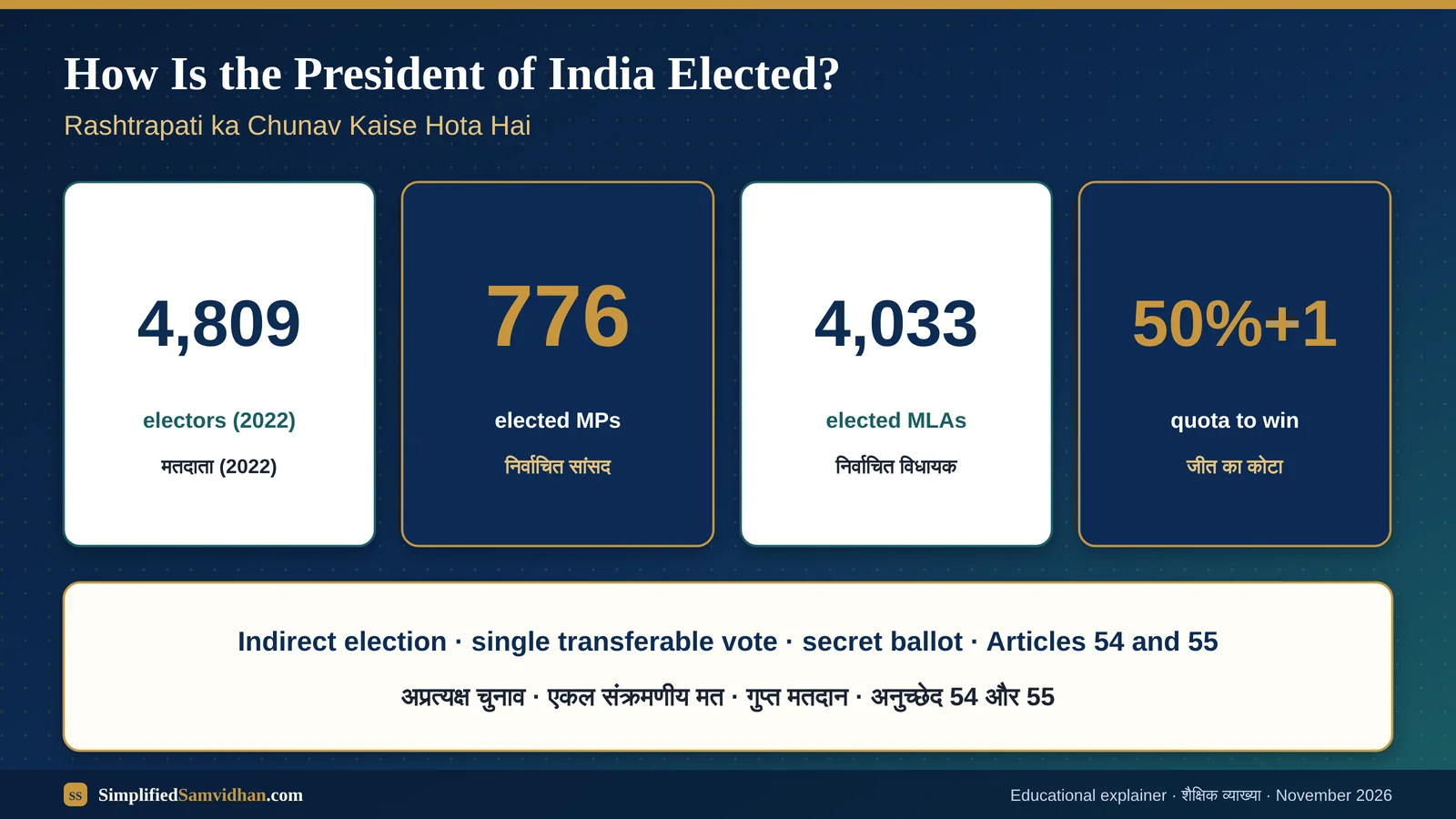
Who votes, why an MP's vote counts 700 and a Sikkim MLA's only 7, how the ballot is marked 1-2-3, and how the winner crosses the line, all in plain words with diagrams.
Short answerHow Is the President of India Elected? The Answer in Simple Words
Short answer: you and I do not vote for the President directly. We elect our MPs and MLAs, and the elected MPs of both Houses plus the elected MLAs of all States, Delhi and Puducherry together form an electoral college (Article 54). Each of them marks 1, 2, 3... against the candidates on a secret ballot. Each vote has a value (an MP's vote counts 700, a UP MLA's 208, a Sikkim MLA's 7), and the winner must cross half of the total valid value plus one (Article 55). If nobody does, the lowest candidate is removed and his ballots move to the next preference.
🏠 Everyday analogy
Think of a school head-girl election where the class monitors vote, not every student. But a monitor of a big class (UP) carries more weight than a monitor of a tiny class (Sikkim), because he speaks for more students.
🇮🇳 Real Indian example
In July 2022, 4,809 MPs and MLAs could vote. Droupadi Murmu got votes worth 6,76,803 against Yashwant Sinha's 3,80,177 and was declared elected in the first count itself.
Electoral collegeWho Votes: The Electoral College under Article 54 (with Diagram)
Article 54. Election of President. The President shall be elected by the members of an electoral college consisting of— (a) the elected members of both Houses of Parliament; and (b) the elected members of the Legislative Assemblies of the States.
Explanation.—In this article and in article 55, "State" includes the National Capital Territory of Delhi and the Union territory of Pondicherry.
Article 55(3). The election of the President shall be held in accordance with the system of proportional representation by means of the single transferable vote and the voting at such election shall be by secret ballot.
✅ Who CAN vote
- Elected members of Lok Sabha
- Elected members of Rajya Sabha
- Elected MLAs of every State
- Elected MLAs of Delhi and Puducherry (since the 70th Amendment)
❌ Who CANNOT vote
- 12 nominated members of Rajya Sabha
- Nominated MLAs (for example in Puducherry)
- Members of State Legislative Councils (MLCs)
- Ordinary citizens directly
Step by stepThe Presidential Election Step by Step: From Notice to Oath
- 1Notification by the Election Commission
Under Article 324 and the Presidential and Vice-Presidential Elections Act, 1952, the Commission issues the notice not earlier than 60 days before the term ends (in 2022 it came on 15 June). The Secretary-General of the Lok Sabha or the Rajya Sabha (by turns) is the Returning Officer.
- 2Nomination
Each candidate needs 50 electors as proposers and 50 as seconders, and a security deposit of Rs 15,000. These limits were raised in 1997 to stop non-serious candidates.
- 3Polling day
MPs vote in Parliament House (green ballot paper), MLAs in their State Assembly building (pink ballot paper). Only the special violet-ink pen given at the booth may be used.
- 4Marking preferences
The voter writes 1 against his first choice; 2, 3 and so on are optional. A ballot without a valid first preference is rejected. There is no party whip, and the anti-defection law does not apply.
- 5Counting in New Delhi
All ballot boxes are flown to Parliament House. Votes are converted into value, the quota is fixed, and if needed lower candidates are eliminated round by round.
- 6Result and oath
The Returning Officer declares the result. The new President takes oath before the Chief Justice of India (Article 60), usually on 25 July.
CountingSingle Transferable Vote and the Quota, Explained with the 1969 Example
The winning line (quota) = total value of valid votes ÷ 2, then + 1 (ignore any fraction). In 2022 the valid value was 10,56,980, so the quota was 5,28,491. Murmu's 6,76,803 crossed it in the first count.
If nobody crosses the quota, the candidate with the lowest value is eliminated. His ballots are not wasted: each one goes to the candidate marked 2 on it. This repeats until someone crosses the line. That is what single transferable vote means: your one vote can travel.
🏠 Everyday analogy
Like choosing a picnic spot: if 'zoo' gets the fewest hands, the zoo fans are asked their second choice and their hands move there, until one place has more than half the class.
🇮🇳 Real Indian example
This happened only once, in 1969: no one crossed the quota of 4,18,169 in the first count, so second preferences were counted and V.V. Giri won.
All rulesAll the Rules in One Table: Articles 54, 55, 71 and 324
| Point | Rule | Where |
|---|---|---|
| Who votes | Elected MPs + elected MLAs (States, Delhi, Puducherry) | Art. 54 |
| Uniformity among States | MLA value depends on the State's 1971 population | Art. 55(1), (2) |
| Parity States vs Union | All MPs together = all MLAs together | Art. 55(2)(c) |
| Voting system | Proportional representation, single transferable vote, secret ballot | Art. 55(3) |
| Who conducts | Election Commission of India | Art. 324 |
| Disputes | Only the Supreme Court; vacancies in the electoral college cannot be used to challenge the election | Art. 71 |
| Details of the procedure | Nomination, deposit, polling and counting rules | 1952 Act + 1974 Rules |
Quick revisionOne-Line Revision Points (Exam Ready)
- Electoral college: elected MPs + elected MLAs (Art. 54).
- Delhi and Puducherry MLAs vote since the 70th Amendment, 1992.
- Nominated members and MLCs do not vote.
- STV + secret ballot (Art. 55(3)); no whip.
- Quota = valid value ÷ 2 + 1. Only 1969 needed 2nd preferences.
- 50 proposers + 50 seconders, Rs 15,000 deposit.
- Disputes: Supreme Court only (Art. 71).
Practice MCQPractice MCQs (with Answers): Election of the President
Which of the following is NOT a part of the electoral college for the President?
The President is elected by:
Which Amendment added the MLAs of Delhi and Puducherry to the electoral college?
Disputes about the election of the President are decided by:
In which year was a presidential election decided by counting second preferences?
Doubts ClearedFrequently Asked Questions
Do citizens vote for the President of India?
No. Citizens elect MPs and MLAs, and the elected MPs and MLAs elect the President. That is why it is called an indirect election.
Can a party issue a whip in the presidential election?
No. The ballot is secret and the anti-defection law (Tenth Schedule) does not apply, so members can vote as they wish. Cross-voting happens in almost every election.
When is the next presidential election?
President Droupadi Murmu's term ends on 24 July 2027, so the Election Commission must complete the next election before that date, most likely in July 2027.
Sources and further readingSources We Checked
Checked against the Constitution of India (Articles 54, 55, 62, 71, 324), the Presidential and Vice-Presidential Elections Act, 1952 and Election Commission figures for 2022 and 1969.