Value of an MP's and an MLA's Vote in the Presidential Election, Worked Out Step by Step
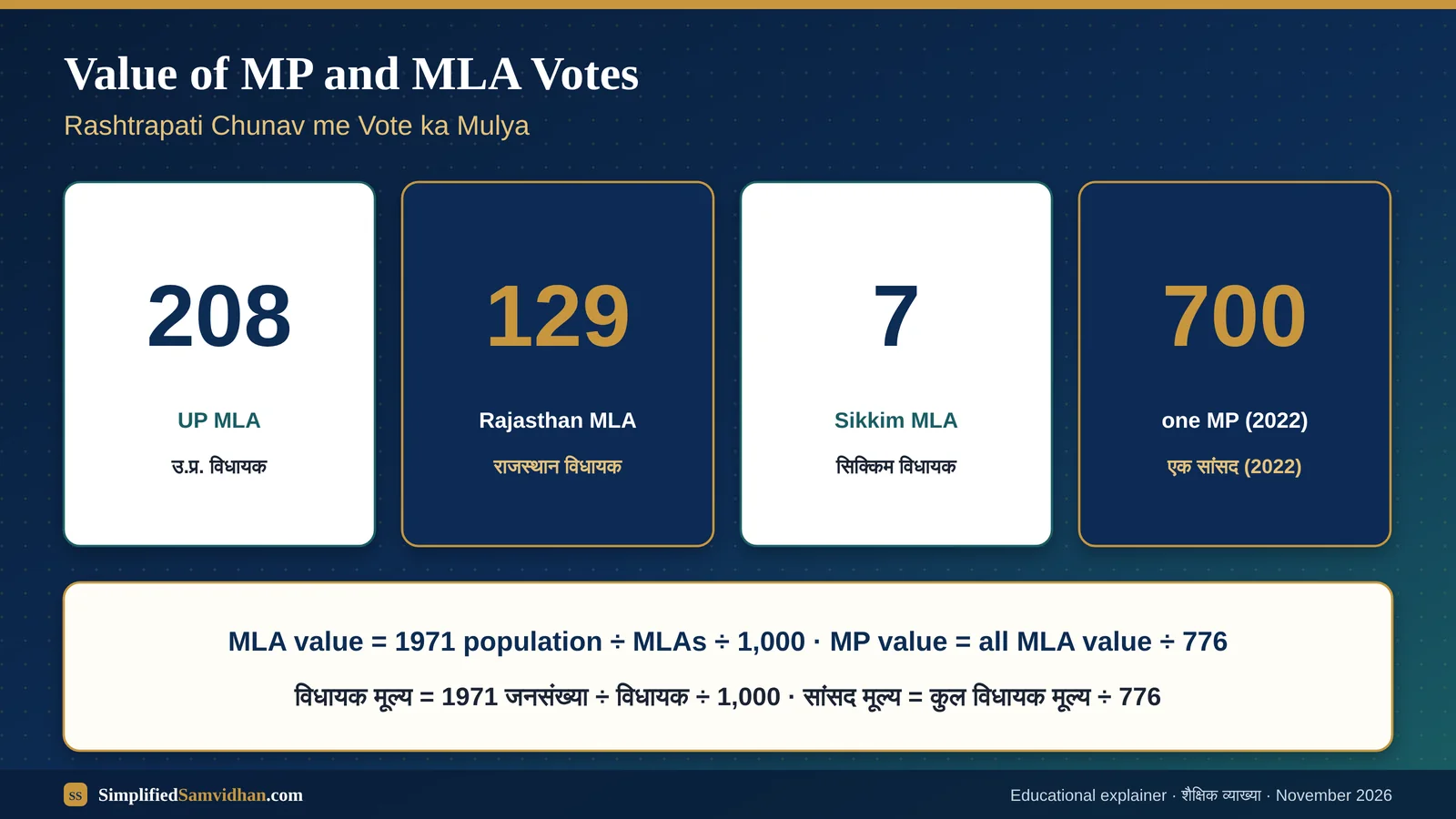
Why a UP MLA's vote counts 208 and a Sikkim MLA's only 7, how the MP value of 700 is reached, and why the 1971 census still decides it, with a Rajasthan example and diagrams.
Short answerValue of a Vote in the Presidential Election: The Answer in Simple Words
Short answer: in the presidential election every vote is weighted. An MLA's vote value = the State's 1971 population ÷ number of its MLAs ÷ 1,000. So an MLA from crowded Uttar Pradesh carries 208, one from Rajasthan 129, and one from tiny Sikkim just 7. Then all MLA values are added up and divided equally among the elected MPs, so that the MPs as a whole weigh the same as all the MLAs together. In 2022 each MP's vote was worth 700.
🏠 Everyday analogy
It is like a cooperative society where each member's vote counts by the number of shares he holds: an MLA who speaks for more people holds more 'shares'.
🇮🇳 Real Indian example
All 200 Rajasthan MLAs together carry 200 × 129 = 25,800 votes, less than UP's 83,824 but more than a hundred times Sikkim's 224.
Article 55Article 55: The Official Formula
Article 55(1). As far as practicable, there shall be uniformity in the scale of representation of the different States at the election of the President.
Article 55(2). For the purpose of securing such uniformity among the States inter se as well as parity between the States as a whole and the Union, the number of votes which each elected member of Parliament and of the Legislative Assembly of each State is entitled to cast at such election shall be determined in the following manner:—
(a) every elected member of the Legislative Assembly of a State shall have as many votes as there are multiples of one thousand in the quotient obtained by dividing the population of the State by the total number of the elected members of the Assembly;
(b) if, after taking the said multiples of one thousand, the remainder is not less than five hundred, then the vote of each member referred to in sub-clause (a) shall be further increased by one;
(c) each elected member of either House of Parliament shall have such number of votes as may be obtained by dividing the total number of votes assigned to the members of the Legislative Assemblies of the States under sub-clauses (a) and (b) by the total number of the elected members of both Houses of Parliament, fractions exceeding one-half being counted as one and other fractions being disregarded.
Explanation (extract). ...the expression "population" means the population as ascertained at the last preceding census ... until the relevant figures for the first census taken after the year 2026 have been published, have effect as if it were a reference to the 1971 census.
MLA valueHow an MLA's Vote Value Is Calculated (Rajasthan Example and State Table)
| State / UT | Elected MLAs | Value of one vote | Total value |
|---|---|---|---|
| Uttar Pradesh | 403 | 208 | 83,824 |
| Maharashtra | 288 | 175 | 50,400 |
| West Bengal | 294 | 151 | 44,394 |
| Bihar | 243 | 173 | 42,039 |
| Tamil Nadu | 234 | 176 | 41,184 |
| Madhya Pradesh | 230 | 131 | 30,130 |
| Rajasthan | 200 | 129 | 25,800 |
| Delhi | 70 | 58 | 4,060 |
| Puducherry | 30 | 16 | 480 |
| Sikkim | 32 | 7 | 224 |
MP valueHow an MP's Vote Value Is Calculated: Why 708 Became 700
2017 election
- MP value: 708
- Total value: 10,98,903
- J&K Assembly was part of the college
2022 election
- MP value: 700
- Total value: 10,86,431
- No J&K Assembly in 2022 (it had been dissolved in 2018), so the MLA total fell
Why weightsWhy Votes Are Weighted: Uniformity, Parity and the 1971 Freeze
- Uniformity: without weights, 32 Sikkim MLAs speaking for about 2 lakh people would count almost as much as 32 UP MLAs speaking for about 66 lakh. Weighting makes one person's say roughly equal everywhere.
- Parity: because the MPs' share equals the MLAs' share, neither the Centre nor the States alone can pick the President. A party needs support in Parliament and in the States.
- Why 1971? States that controlled population growth (Kerala, Tamil Nadu) should not lose weight for doing well, so the base is frozen at 1971 till the first census after 2026. When it is updated, northern States will gain weight; this is part of the delimitation debate. See results of every election.
Quick revisionOne-Line Revision Points (Exam Ready)
- MLA value = 1971 population ÷ MLAs ÷ 1,000 (Art. 55(2)(a)).
- Remainder 500 or more → add 1 (Art. 55(2)(b)).
- MP value = total MLA value ÷ elected MPs (Art. 55(2)(c)).
- UP 208 highest, Sikkim 7 lowest; Rajasthan 129.
- MP value 708 (2017) → 700 (2022).
- 1971 base frozen by the 84th Amendment till the first census after 2026.
Practice MCQPractice MCQs (with Answers): Value of votes
The value of an MLA's vote in the presidential election is based on the population of the State as per the census of:
The MLAs of which State have the highest vote value?
In the 2022 presidential election, the value of one MP's vote was:
Consider: (1) All MPs together carry about the same value as all MLAs together. (2) Nominated MPs have a vote value of half an elected MP. Which is correct?
Doubts ClearedFrequently Asked Questions
Why does a Sikkim MLA's vote count only 7?
Because Sikkim's 1971 population was only about 2.1 lakh, shared by 32 MLAs. Each MLA speaks for about 6,557 people, so the value is 7.
Why did the MP vote value fall from 708 to 700?
Jammu and Kashmir had no Legislative Assembly in 2022, so the total MLA value went down and, divided by 776 MPs, gave 700.
What is the value of a Rajasthan MLA's vote?
129. Rajasthan's 1971 population of 2,57,65,806 divided by 200 MLAs and by 1,000 gives 128.83, which rounds up to 129. All 200 MLAs together carry 25,800.
Sources and further readingSources We Checked
Formula from Article 55 of the Constitution; values are those used by the Election Commission for the 2022 election.