Impeachment of the President of India under Article 61, Explained with a Diagram
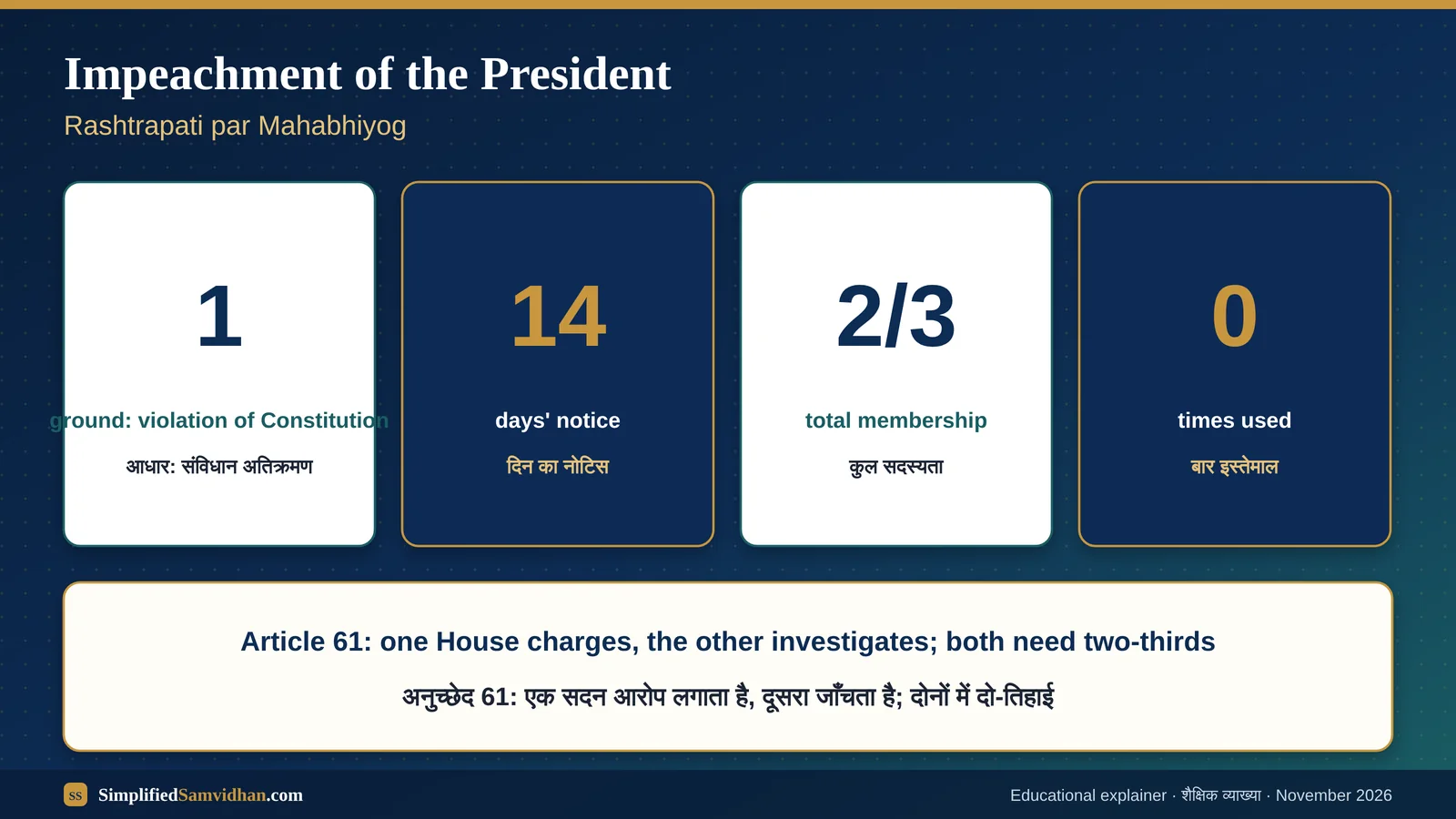
The only ground, the 14-day notice, the two-thirds rule in both Houses, why nominated MPs vote here but not in the election, and why it has never been used.
Short answerHow Can the President of India Be Removed? The Answer in Simple Words
Short answer: the President can be removed before his five years end only by impeachment, and only for "violation of the Constitution" (Articles 56(1)(b) and 61). One House of Parliament frames the charge (after 14 days' notice signed by at least one-fourth of its members, then a vote of two-thirds of its total membership). The other House investigates, and if it too agrees by two-thirds of its total membership, the President is removed that very day. No President of India has ever faced an impeachment motion.
🏠 Everyday analogy
It is like removing the principal of a school: one committee must write the charge sheet with strong backing, and a second committee must check it and agree by a big majority. A simple majority, or the principal's unpopularity, is not enough.
🇮🇳 Real Indian example
Lok Sabha has 543 elected and Rajya Sabha 245 members. Two-thirds of total membership means at least 362 votes in Lok Sabha (on a full House of 543) and 164 in Rajya Sabha, no matter how many are present.
Article 61Article 61: The Official Text
Article 61(1). When a President is to be impeached for violation of the Constitution, the charge shall be preferred by either House of Parliament.
Article 61(2). No such charge shall be preferred unless— (a) the proposal to prefer such charge is contained in a resolution which has been moved after at least fourteen days' notice in writing signed by not less than one-fourth of the total number of members of the House has been given of their intention to move the resolution, and (b) such resolution has been passed by a majority of not less than two-thirds of the total membership of the House.
Article 61(3). When a charge has been so preferred by either House of Parliament, the other House shall investigate the charge or cause the charge to be investigated and the President shall have the right to appear and to be represented at such investigation.
Article 61(4). If as a result of the investigation a resolution is passed by a majority of not less than two-thirds of the total membership of the House by which the charge was investigated or caused to be investigated, declaring that the charge preferred against the President has been sustained, such resolution shall have the effect of removing the President from his office as from the date on which the resolution is so passed.
ProcessImpeachment Process Step by Step (with Diagram)
Election of the President
- Elected MPs vote
- Elected MLAs vote
- Nominated MPs do NOT vote
Impeachment of the President
- All MPs vote, including nominated
- MLAs have no role
- Each House needs 2/3 of total membership
ComparisonRemoval of President vs Vice-President vs Judge, and the US Model
| Point | President (Art. 61) | Vice-President (Art. 67(b)) | Supreme Court judge (Art. 124(4)) |
|---|---|---|---|
| Name of process | Impeachment | Removal resolution (not called impeachment) | Removal (popularly 'impeachment') |
| Ground | Violation of the Constitution | No ground stated | Proved misbehaviour or incapacity |
| Where it starts | Either House | Rajya Sabha only | Either House |
| Majority | 2/3 of total membership in each House | Effective majority in RS, simple majority agreement in LS | Majority of total membership + 2/3 of present and voting in each House |
| Ever succeeded? | Never moved | Never | Never (motions failed or lapsed) |
ImmunityImmunity under Article 361 and Why Impeachment Is Rare
- Article 361 immunity: the President is not answerable to any court for the exercise of his powers. No criminal case can be started or continued against him during his term, and no arrest can be ordered. Civil cases about personal acts need two months' notice.
- Why impeachment is still needed: because courts cannot touch the President, Parliament's impeachment power is the only check if a President acts against the Constitution, for example by refusing to act on Cabinet advice that Article 74 makes binding.
- Why it has never been used: the President acts on the Cabinet's advice, so a clash with the Constitution is rare, and the two-thirds rule in both Houses makes it very hard to use for party politics.
Quick revisionOne-Line Revision Points (Exam Ready)
- Ground: violation of the Constitution (Art. 61).
- Notice 14 days, signed by 1/4 of the House.
- 2/3 of total membership in each House.
- Nominated MPs vote; MLAs do not.
- VP removal starts only in Rajya Sabha (Art. 67(b)).
- Never used in India.
Practice MCQPractice MCQs (with Answers): Impeachment of the President
The only ground for impeaching the President of India is:
Who takes part in the impeachment of the President but NOT in his election?
The impeachment resolution must be passed in each House by:
How many Presidents of India have been impeached so far?
Doubts ClearedFrequently Asked Questions
Has any President of India been impeached?
No. Since 1950 no impeachment motion has even been moved against any President.
Can the President be arrested?
Not during the term. Article 361 bars any criminal case or arrest process against the President while in office.
Do State legislatures take part in impeachment?
No. Although MLAs help elect the President, only the two Houses of Parliament can impeach him.
Sources and further readingSources We Checked
Checked against Articles 56, 61, 67, 124 and 361 of the Constitution of India. The Hindi text of Article 61(3) and (4) is a simple rendering.