Bare ActOfficial Text of Article 60
60. Oath or affirmation by the President.—
Every President and every person acting as President or discharging the functions of the President shall, before entering upon his office, make and subscribe in the presence of the Chief Justice of India or, in his absence, the senior-most Judge of the Supreme Court available, an oath or affirmation in the following form, that is to say—
"I, A.B., do swear in the name of God / solemnly affirm that I will faithfully execute the office of President (or discharge the functions of the President) of India and will to the best of my ability preserve, protect and defend the Constitution and the law and that I will devote myself to the service and well-being of the people of India."
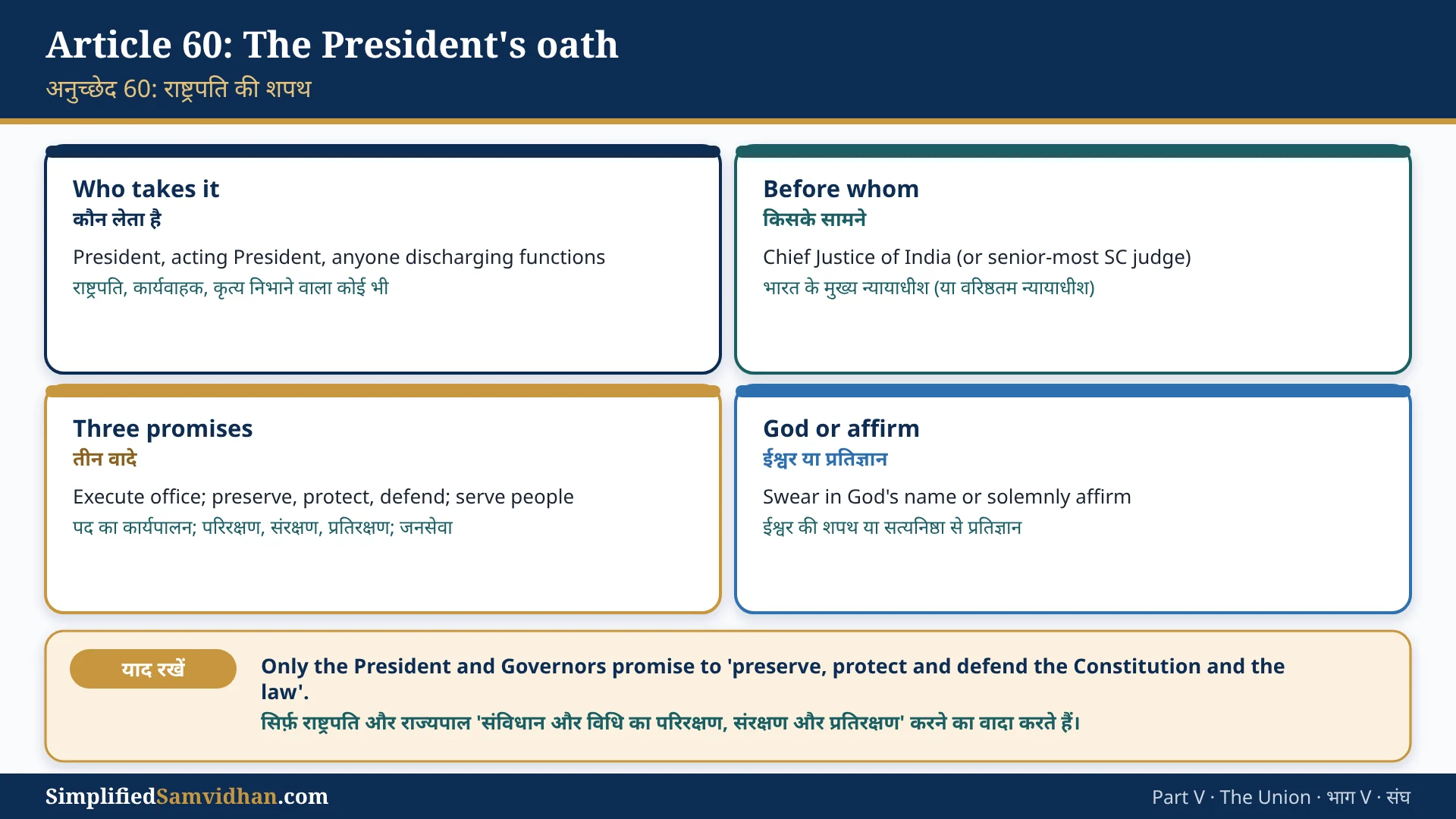
Who: every elected President, and also anyone acting as President (the Vice-President under Article 65) or discharging the President's functions (for example, the Chief Justice under the 1969 Act).
When: before entering office. Until the oath is taken, the person cannot use any power of the President.
Before whom: the Chief Justice of India; if the Chief Justice is absent, the senior-most available judge of the Supreme Court.
How: the person "makes and subscribes" the oath, i.e. says it aloud and then signs it.
God or affirmation: a believer may swear in the name of God; anyone may instead solemnly affirm. Both have the same legal effect.
Three promises: (1) faithfully execute the office, (2) preserve, protect and defend the Constitution and the law, (3) devote himself or herself to the service and well-being of the people of India.
🏠 Everyday Analogy
A ship's new captain signs the ship's log and promises, in front of the harbour master, to keep the ship, its rules and its passengers safe before taking the wheel. The President's oath is that promise for the nation, and the Chief Justice, guardian of the Constitution, is the witness.
🇮🇳 Real Indian Example
On 25 July 2022, Droupadi Murmu took the oath as the 15th President in the Central Hall of Parliament, administered by Chief Justice N. V. Ramana, followed by a 21-gun salute. In 2017 Chief Justice J. S. Khehar administered the oath to Ram Nath Kovind, and in 2012 Chief Justice S. H. Kapadia to Pranab Mukherjee.
Key wordsArticle 60 Word by Word: What Each Promise Means
| Words in the oath | Meaning |
|---|---|
| Faithfully execute the office | Use the powers honestly, as the Constitution intends, on the advice of the Council of Ministers (Art 74) |
| Preserve | Keep the Constitution as it is; do not let it be undermined |
| Protect | Shield it from attack, for example by using the power to return a Bill (Art 111) or seek the Supreme Court's opinion (Art 143) |
| Defend | Stand up for it as Supreme Commander and Head of State |
| The Constitution and the law | Not only the Constitution but also laws made under it |
| Service and well-being of the people | The office exists for the people, not for any party |
Breaking these promises is what Article 61 calls "violation of the Constitution", the only ground for impeachment. The oath and the removal process are thus two sides of one coin.
Other oathsArticle 60 Compared With Other Constitutional Oaths
| Office | Where the form is | Administered by | Core promise |
|---|---|---|---|
| President | Art 60 | Chief Justice of India | Preserve, protect and defend the Constitution and the law |
| Governor | Art 159 | Chief Justice of the High Court | Preserve, protect and defend the Constitution and the law |
| Vice-President | Art 69 | President (or person appointed) | Bear true faith and allegiance to the Constitution |
| Union Minister | Third Schedule | President | Bear true faith and allegiance; uphold sovereignty and integrity; secrecy |
| Supreme Court Judge | Third Schedule (Art 124(6)) | President (or person appointed) | Uphold the Constitution and the laws |
So the oath of the President and Governors is not in the Third Schedule; it is written in the Article itself, and it alone uses the words "preserve, protect and defend".
Acting PresidentArticle 60 and the Acting President
- When the office falls vacant (death, resignation, removal), the Vice-President acts as President under Article 65(1); when the President is merely absent or ill, the Vice-President discharges the functions under Article 65(2).
- In both cases the Vice-President must first take the oath in the Article 60 form, with the words "discharge the functions of the President" where needed.
- In 1969, after President Zakir Husain died and acting President V. V. Giri resigned, Chief Justice M. Hidayatullah discharged the President's functions from 20 July to 24 August 1969, and he too took the Article 60 oath.
- Ceremony details such as the venue (usually the Central Hall of Parliament) and the 21-gun salute are tradition, not requirements of Article 60.
Quick RevisionKey Points to Remember
- Oath by every President, acting President and person discharging the President's functions, before entering office.
- Administered by the Chief Justice of India; in his or her absence, the senior-most available SC judge.
- Promises: faithfully execute the office; preserve, protect and defend the Constitution and the law; serve the people.
- Form is in Article 60 itself, not in the Third Schedule; the Governor's oath (Art 159) is similar.
- Breaking the oath = "violation of the Constitution", the ground for impeachment (Art 61).
UPSC · State PSC · JudiciaryArticle 60: Exam Corner
- Prelims trap: "The President's oath is in the Third Schedule." False. It is in Article 60 itself.
- Prelims trap: "The Vice-President administers the oath to the President." False. The Chief Justice of India does.
- Prelims: The words "preserve, protect and defend the Constitution and the law" appear in the oaths of the President and Governors only.
- Mains (GS II): "The President's oath makes him or her the guardian of the Constitution." Discuss with Articles 60, 74 and 111.
Practice MCQTest Yourself: Article 60
In the absence of the Chief Justice of India, who administers the oath to the President?
Doubts ClearedFrequently Asked Questions
What is Article 60 of the Indian Constitution?
Article 60 lays down the oath or affirmation that every President, and anyone acting as President, must take before the Chief Justice of India before entering office.
Who administers the oath to the President of India?
The Chief Justice of India; if absent, the senior-most available judge of the Supreme Court.
What does the President promise in the oath?
To faithfully execute the office, to preserve, protect and defend the Constitution and the law, and to devote himself or herself to the service and well-being of the people of India.
Is the President's oath in the Third Schedule?
No. The form is written in Article 60 itself. The Third Schedule has the oaths of Ministers, MPs, MLAs, judges and the CAG.