Bare ActOfficial Text of Article 61
61. Procedure for impeachment of the President.—
(1) When a President is to be impeached for violation of the Constitution, the charge shall be preferred by either House of Parliament.
(2) No such charge shall be preferred unless—
(a) the proposal to prefer such charge is contained in a resolution which has been moved after at least fourteen days' notice in writing signed by not less than one-fourth of the total number of members of the House has been given of their intention to move the resolution, and
(b) such resolution has been passed by a majority of not less than two-thirds of the total membership of the House.
(3) When a charge has been so preferred by either House of Parliament, the other House shall investigate the charge or cause the charge to be investigated and the President shall have the right to appear and to be represented at such investigation.
(4) If as a result of the investigation a resolution is passed by a majority of not less than two-thirds of the total membership of the House by which the charge was investigated or caused to be investigated, declaring that the charge preferred against the President has been sustained, such resolution shall have the effect of removing the President from his office as from the date on which the resolution is so passed.
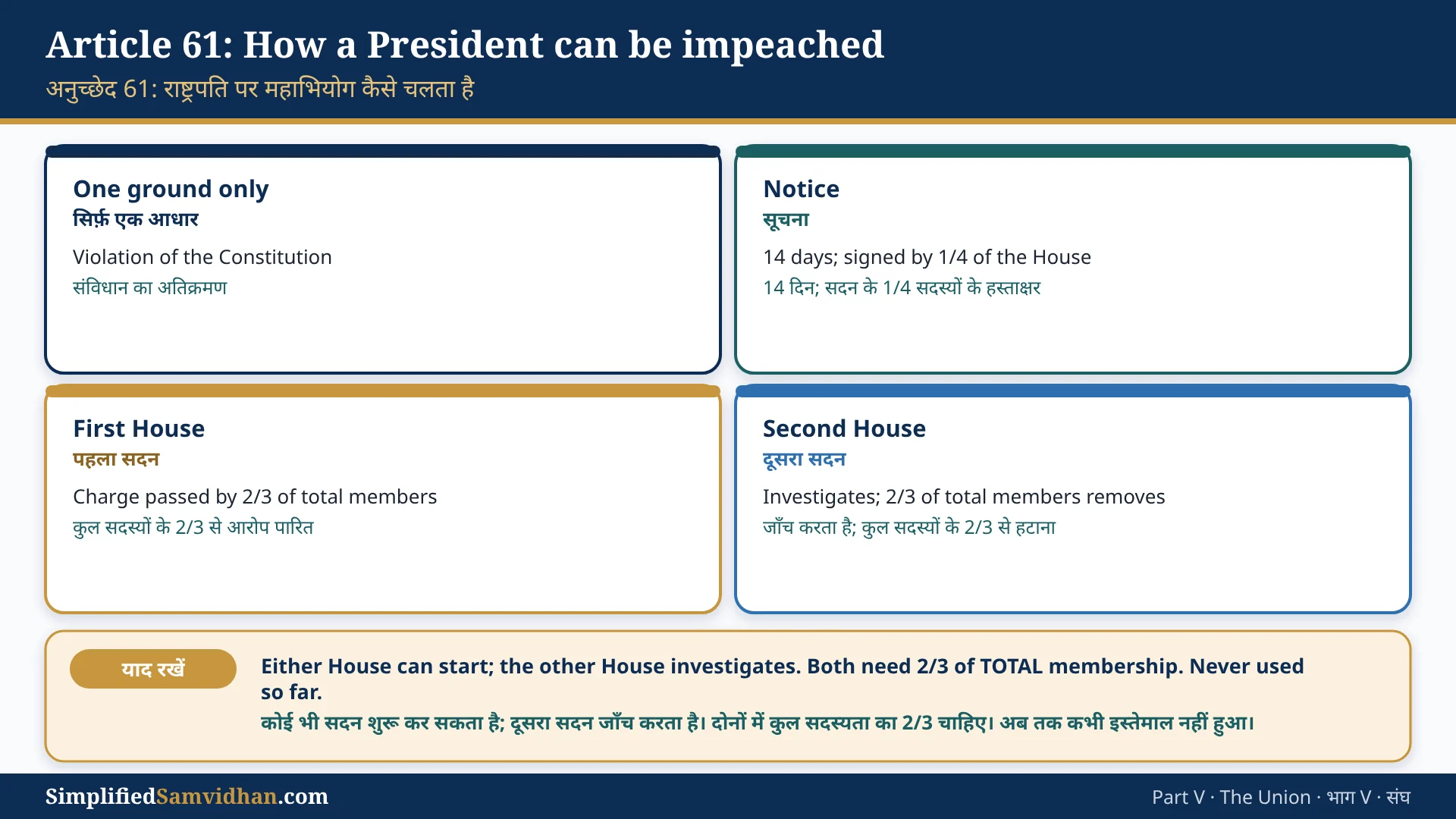
Ground: only "violation of the Constitution". The phrase is not defined; Parliament decides what it covers. Ordinary political disagreement is not enough.
Clause (1): the charge can start in either House, Lok Sabha or Rajya Sabha.
Clause (2)(a) Notice: at least one-fourth of the total members of that House must sign a written notice, and the resolution can be moved only 14 days later. The gap gives the President time to respond.
Clause (2)(b) Charge: the House passes the resolution by two-thirds of its total membership (not just of those present).
Clause (3) Investigation: the other House investigates, itself or through a body it appoints. The President can appear and be represented, for example by a lawyer.
Clause (4) Removal: if the investigating House declares the charge sustained by two-thirds of its total membership, the President is removed from that date. No further approval is needed.
🏠 Everyday Analogy
Think of a cricket board that wants to remove its own chairman. One committee frames the charge with a big majority, a second committee holds a hearing where the chairman can bring a lawyer, and only if that second committee also agrees by a big majority is he or she out. The high bar stops a simple majority from removing the head for political reasons.
🇮🇳 Real Indian Example
Suppose the charge starts in the Rajya Sabha (245 members). At least 62 members (one-fourth) sign the notice; after 14 days the resolution needs 164 votes (two-thirds of 245). The Lok Sabha (543 seats) then investigates and needs 362 votes to declare the charge sustained. Vacant seats still count in "total membership" as per parliamentary practice, which makes the bar even higher.
Step by stepArticle 61 Step by Step: From Notice to Removal
| Step | What happens | Clause |
|---|---|---|
| 1. Notice | Written notice signed by ≥ 1/4 of the House's total members | 61(2)(a) |
| 2. Waiting period | At least 14 days before the resolution is moved | 61(2)(a) |
| 3. Charge | Resolution passed by ≥ 2/3 of total membership of that House | 61(2)(b) |
| 4. Investigation | Other House investigates or has it investigated; President may appear and be represented | 61(3) |
| 5. Verdict | Resolution that the charge is sustained, by ≥ 2/3 of total membership of the investigating House | 61(4) |
| 6. Removal | President stands removed from the date of that resolution; Vice-President acts (Art 65) | 61(4) |
After removal, a new President must be elected within six months under Article 62(2).
Key featuresArticle 61: Key Features UPSC Asks About
- Quasi-judicial: one House acts like a prosecutor, the other like a court, and the President has a right to be heard.
- Nominated members take part: the 12 nominated Rajya Sabha members can vote on impeachment, though they have no vote in the President's election (Article 54).
- State MLAs have no role in impeachment, even though elected MLAs vote in the election.
- Total membership: both two-thirds majorities are of the House's total membership, a harder test than the 'special majority' for constitutional amendments under Article 368.
- No court review of the merits is written into Article 61; the decision belongs to Parliament.
- Never used: no impeachment motion against a President has been moved in Parliament since 1950.
ComparisonArticle 61 Compared: President vs Vice-President vs Judges vs US President
| Point | President (Art 61) | Vice-President (Art 67(b)) | SC/HC Judge (Art 124(4)) | US President |
|---|---|---|---|---|
| Ground | Violation of the Constitution | None stated | Proved misbehaviour or incapacity | Treason, bribery, high crimes |
| Starts in | Either House | Rajya Sabha only | Either House (100 LS / 50 RS signatures) | House of Representatives |
| Majority | 2/3 of total membership in both Houses | RS: majority of all members; LS agrees | Majority of total + 2/3 present and voting, both Houses | House: simple; Senate: 2/3 present |
| Used? | Never | Never | Motions moved, none removed | Johnson, Clinton, Trump (twice) impeached; none convicted |
Quick RevisionKey Points to Remember
- Only ground: violation of the Constitution (undefined).
- Either House frames the charge after 14 days' notice signed by 1/4 of its total members.
- Charge and verdict each need 2/3 of the total membership of the House concerned.
- Other House investigates; President has the right to appear and be represented.
- Nominated MPs vote; State MLAs do not. Never used since 1950.
UPSC · State PSC · JudiciaryArticle 61: Exam Corner
- Prelims trap: "Impeachment of the President can begin only in the Lok Sabha." False. Either House.
- Prelims trap: "Nominated members cannot take part in impeachment." False. They take part, though they do not vote in the election.
- Prelims trap: "Elected MLAs take part in impeachment." False. Only Parliament is involved.
- Mains (GS II): "The impeachment process makes the President accountable without making the office unstable." Discuss.
Practice MCQTest Yourself: Article 61
Which of the following take part in the impeachment of the President but NOT in the President's election?
Doubts ClearedFrequently Asked Questions
What is Article 61 of the Indian Constitution?
Article 61 lays down the procedure to impeach the President for violation of the Constitution: a charge by one House and an investigation by the other, each needing two-thirds of total membership.
Has any President of India been impeached?
No. No impeachment motion against a President has ever been moved in Parliament.
What majority is needed to impeach the President?
Not less than two-thirds of the total membership of each House: the House that frames the charge and the House that investigates it.
Can the President defend himself or herself during impeachment?
Yes. Article 61(3) gives the President the right to appear and to be represented at the investigation.