Bare ActOfficial Text of Article 58
58. Qualifications for election as President.—
(1) No person shall be eligible for election as President unless he—
(a) is a citizen of India,
(b) has completed the age of thirty-five years, and
(c) is qualified for election as a member of the House of the People.
(2) A person shall not be eligible for election as President if he holds any office of profit under the Government of India or the Government of any State or under any local or other authority subject to the control of any of the said Governments.
Explanation.—For the purposes of this article, a person shall not be deemed to hold any office of profit by reason only that he is the President or Vice-President of the Union or the Governor of any State or is a Minister either for the Union or for any State.
59. Conditions of President's office.—
(1) The President shall not be a member of either House of Parliament or of a House of the Legislature of any State, and if a member of either House of Parliament or of a House of the Legislature of any State be elected President, he shall be deemed to have vacated his seat in that House on the date on which he enters upon his office as President.
(2) The President shall not hold any other office of profit.
(3) The President shall be entitled without payment of rent to the use of his official residences and shall be also entitled to such emoluments, allowances and privileges as may be determined by Parliament by law and, until provision in that behalf is so made, such emoluments, allowances and privileges as are specified in the Second Schedule.
(4) The emoluments and allowances of the President shall not be diminished during his term of office.
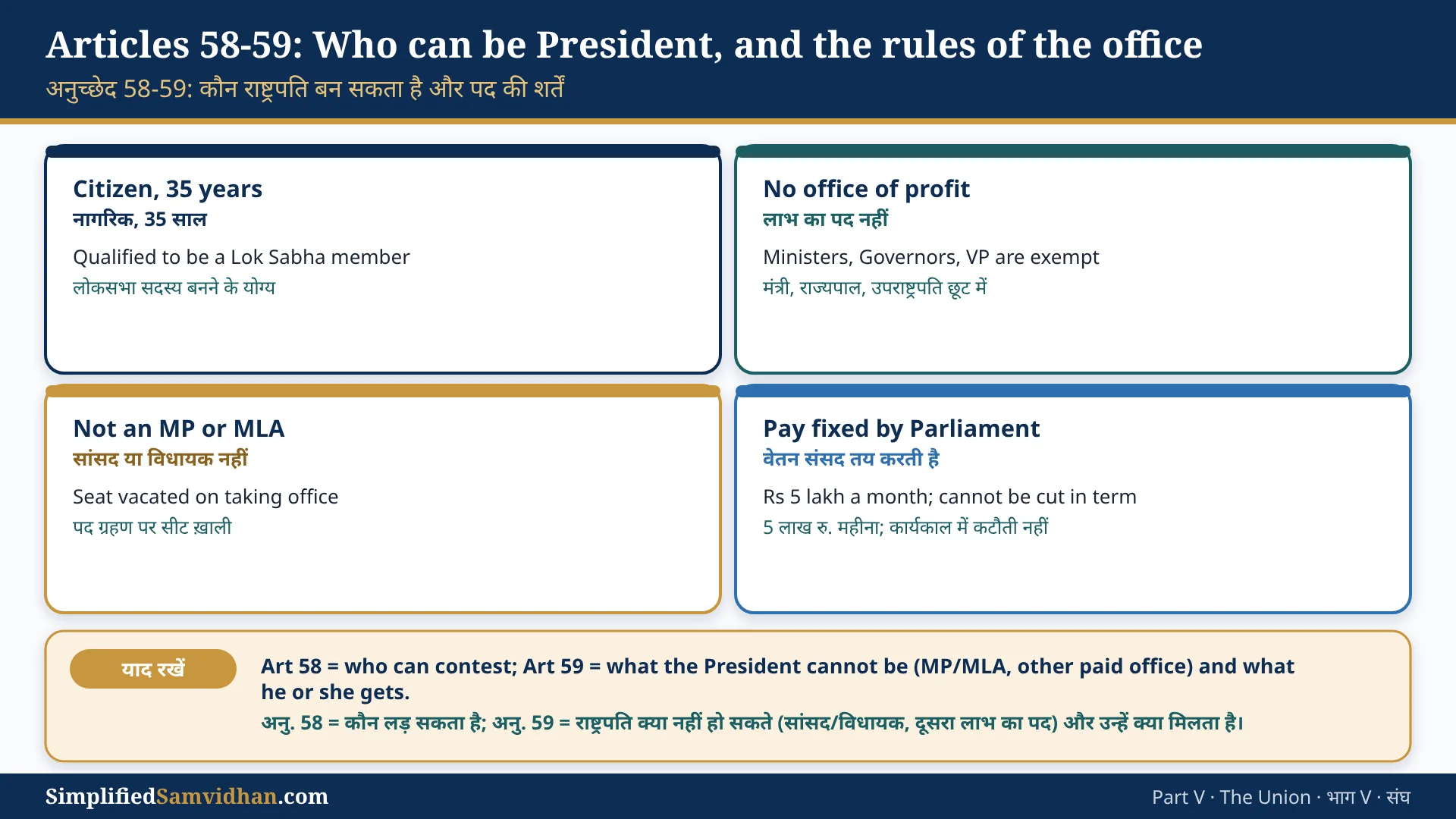
Article 58(1): three conditions: citizen of India, 35 years completed, and qualified to be elected to the Lok Sabha (in practice, a registered voter in some parliamentary constituency who is not disqualified under Article 102 or the election laws).
Article 58(2): a person holding an office of profit under the Union, a State, or a local or other authority controlled by them cannot contest. Resign first, then file the nomination.
Explanation: a sitting President, Vice-President, Governor or Minister is not treated as holding an office of profit, so these people can contest without resigning.
Article 59(1): the President cannot be an MP or MLA/MLC. If an MP or MLA is elected, the seat becomes vacant on the day he or she takes office as President, not on the day of the result.
Article 59(2): no other office of profit while President.
Article 59(3)-(4): rent-free official residences, and pay, allowances and privileges fixed by Parliament by law; these cannot be reduced during the term.
🏠 Everyday Analogy
Think of the referee of a football match. The referee must be qualified (Article 58), cannot play for either team (Article 59(1)), cannot be paid by one side (Article 59(2)), and gets a fixed fee that no team can cut mid-match (Article 59(4)), so that every decision stays neutral.
🇮🇳 Real Indian Example
In 2022 Droupadi Murmu was a former Governor of Jharkhand and held no office of profit, so she was eligible. Her rival Yashwant Sinha had resigned from party posts before filing. In 2017 Ram Nath Kovind resigned as Governor of Bihar on 20 June 2017, a day after he was named a candidate. A sitting Governor may contest because of the Explanation to Article 58, but cannot hold that post as President (Article 59(2)).
Nomination rulesBeyond Article 58: Nomination Rules Under the 1952 Act
| Requirement | Rule | Source |
|---|---|---|
| Citizen, 35 years, Lok Sabha qualification | Constitutional bar | Art 58(1) |
| No office of profit | Resign before filing | Art 58(2) |
| Proposers | At least 50 electors | Presidential and Vice-Presidential Elections Act, 1952 (as amended 1997) |
| Seconders | At least 50 electors | Same Act |
| Security deposit | Rs 15,000 (forfeited below one-sixth of the votes needed) | Same Act |
| Returning Officer | Secretary-General of Lok Sabha or Rajya Sabha, by rotation | Election Commission practice |
The proposer and seconder rule was added in 1997 after several non-serious candidates filed nominations; before that only 10 proposers and 10 seconders were needed and the deposit was Rs 2,500.
Office of profitArticle 58(2): What Is an 'Office of Profit'?
- The Constitution does not define it. Courts ask: who appoints, who can remove, who pays, and whether the post gives money or power.
- The idea is that a person who depends on the government for pay or post should not become its head, as that would hurt independence.
- The same test appears for MPs (Article 102) and MLAs (Article 191); the Supreme Court explained it in cases like Jaya Bachchan v. Union of India (2006): if an office carries pecuniary gain, it is an office of profit even if the person never took the money.
- Exempt by the Explanation: President, Vice-President, Governor, Union and State Ministers. The words "Rajpramukh or Uprajpramukh" were removed by the 7th Amendment, 1956, when Part B States ended.
Pay and residenceArticle 59(3)-(4): Salary, Pension and Official Residences
| Item | Fact |
|---|---|
| Law | President's Emoluments and Pension Act, 1951 (made under Art 59(3)) |
| Salary | Rs 5 lakh per month (raised by the Finance Act, 2018, from 1 January 2016) |
| Charged on | Consolidated Fund of India, not voted by Parliament (Art 112(3)(a)) |
| Pension | 50% of salary, plus a furnished residence and staff, under the 1951 Act |
| Residences | Rashtrapati Bhavan (New Delhi), Rashtrapati Nilayam (Secunderabad), The Retreat (Mashobra, Shimla) |
| Protection | Cannot be reduced during the term (Art 59(4)) |
Because the salary is charged on the Consolidated Fund, Parliament can discuss it but cannot vote to cut it. This protects the President from pressure by the government of the day.
ComparisonArticle 58 Compared: President vs Vice-President vs Lok Sabha Member
| Point | President (Art 58) | Vice-President (Art 66) | Lok Sabha MP (Art 84) |
|---|---|---|---|
| Minimum age | 35 | 35 | 25 |
| Must qualify for | Lok Sabha | Rajya Sabha | Being an elector |
| Office of profit bar | Yes | Yes | Yes (Art 102) |
| Can be a legislator? | No (Art 59) | No (Art 66(2)); chairs Rajya Sabha | Is one |
Quick RevisionKey Points to Remember
- Qualifications (Art 58): citizen, 35 years, qualified for Lok Sabha, no office of profit.
- President, Vice-President, Governor and Ministers are not treated as holding an office of profit.
- Nomination: 50 proposers + 50 seconders, deposit Rs 15,000 (1952 Act, amended 1997).
- Conditions (Art 59): not an MP/MLA (seat vacated on taking office), no other office of profit.
- Rent-free residence; salary Rs 5 lakh/month, charged on the Consolidated Fund, not reducible during the term.
UPSC · State PSC · JudiciaryArticles 58-59: Exam Corner
- Prelims trap: "A candidate for President must be qualified for election to the Rajya Sabha." False. It is the Lok Sabha; the Rajya Sabha test applies to the Vice-President.
- Prelims trap: "A sitting Union Minister must resign before contesting." False. The Explanation to Article 58 exempts Ministers.
- Prelims trap: "An MP elected President loses the seat on the date of the result." False. The seat is vacated on the date of taking office.
- Mains (GS II): "The conditions in Article 59 secure the President's independence." Discuss.
Practice MCQTest Yourself: Articles 58-59
Under the Explanation to Article 58, which of these is NOT deemed to hold an office of profit?
Doubts ClearedFrequently Asked Questions
What is Article 58 of the Indian Constitution?
Article 58 lists the qualifications to be elected President: citizen of India, at least 35 years old, qualified to be a Lok Sabha member, and holding no office of profit.
What is Article 59 of the Indian Constitution?
Article 59 sets the conditions of the President's office: not a member of any legislature, no other office of profit, rent-free residence, and pay fixed by Parliament that cannot be reduced during the term.
What is the salary of the President of India?
Rs 5 lakh per month, under the President's Emoluments and Pension Act, 1951, as amended by the Finance Act, 2018.
What is the minimum age to become President of India?
35 years (Article 58(1)(b)). The same age applies to the Vice-President.