Bare ActOfficial Text of Article 56
56. Term of office of President.—
(1) The President shall hold office for a term of five years from the date on which he enters upon his office:
Provided that—
(a) the President may, by writing under his hand addressed to the Vice-President, resign his office;
(b) the President may, for violation of the Constitution, be removed from office by impeachment in the manner provided in article 61;
(c) the President shall, notwithstanding the expiration of his term, continue to hold office until his successor enters upon his office.
(2) Any resignation addressed to the Vice-President under clause (a) of the proviso to clause (1) shall forthwith be communicated by him to the Speaker of the House of the People.
57. Eligibility for re-election.—
A person who holds, or who has held, office as President shall, subject to the other provisions of this Constitution, be eligible for re-election to that office.
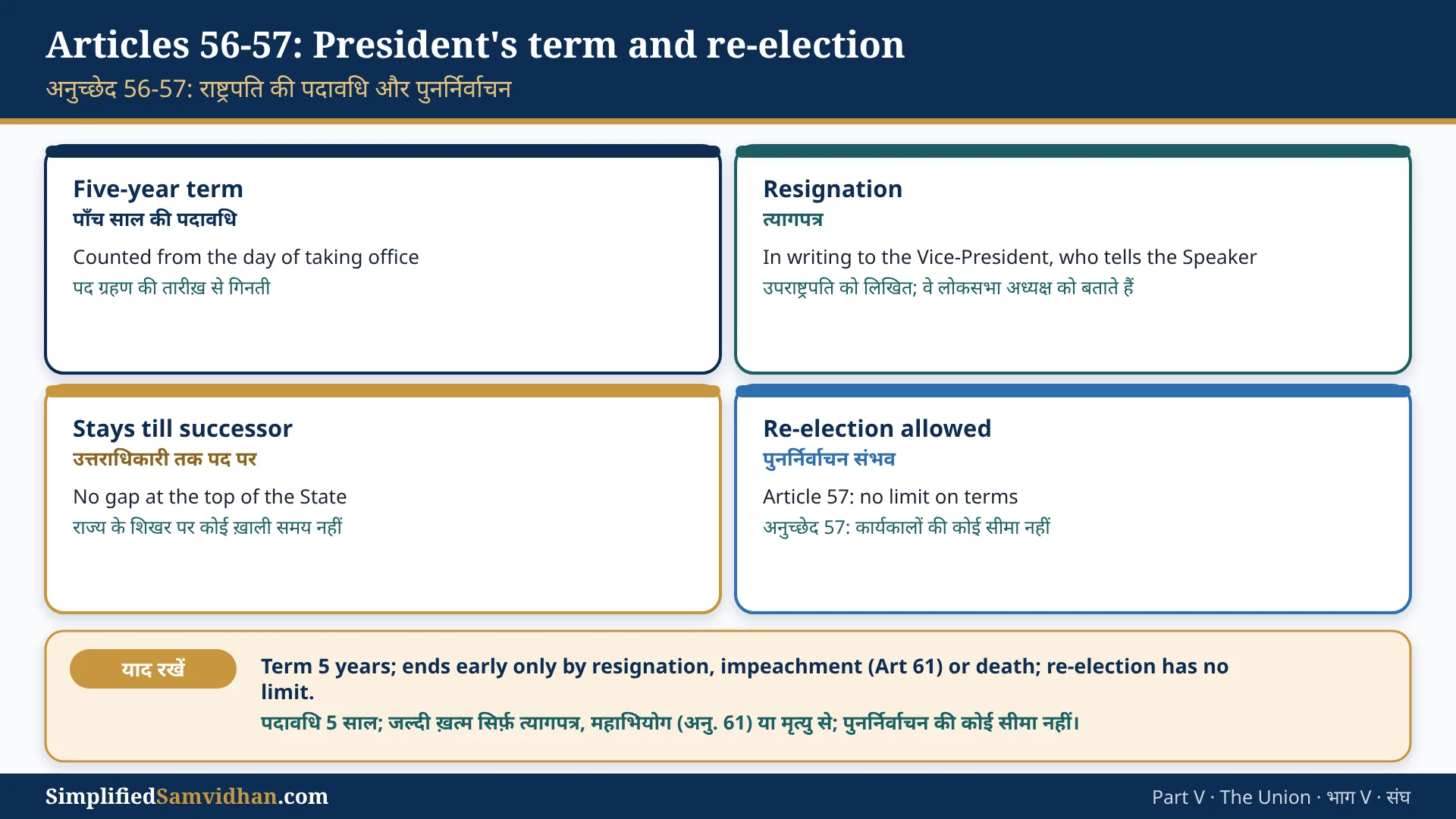
Article 56(1) Term: five years, counted from the day the President takes the oath and enters office, not from the day of the election result.
Proviso (a) Resignation: the President can resign by a signed letter addressed to the Vice-President.
Proviso (b) Removal: the only way to remove a President is impeachment under Article 61, and the only ground is violation of the Constitution.
Proviso (c) Continuity: if the five years end before a new President takes over, the old President continues. There is never an empty chair.
Article 56(2): the Vice-President must immediately inform the Speaker of the Lok Sabha about the resignation.
Article 57 Re-election: a sitting or former President can contest again, any number of times, subject to the qualifications in Article 58.
🏠 Everyday Analogy
Think of a school principal appointed for five years. If the new principal has not joined when the five years end, the old one keeps the keys till the handover. The principal can resign by writing to the vice-principal, and can be removed only by a special vote of the school board for breaking the school's constitution.
🇮🇳 Real Indian Example
President Droupadi Murmu took the oath on 25 July 2022. Her five-year term therefore runs till 24 July 2027. Under Article 62(1), the election for the next President must be completed before that date; if the new President is not in office by then, she continues under Article 56(1)(c).
How a term endsArticle 56: Four Ways a President's Term Can End
| Way | Provision | What happens next |
|---|---|---|
| Five years complete | Art 56(1) | Successor elected before expiry (Art 62(1)); old President stays till successor takes over |
| Resignation | Art 56(1)(a), 56(2) | Letter to Vice-President, who informs the Speaker; Vice-President acts (Art 65) |
| Impeachment | Art 56(1)(b), Art 61 | Removal from the date the second House passes the resolution |
| Death | Art 62(2) | Vice-President acts; election within six months |
The Constitution has no other way to remove a President: no recall, no vote of no-confidence and no removal by the courts. A dispute about the election itself goes to the Supreme Court under Article 71; if the Court sets the election aside, acts already done by the President stay valid.
HistoryArticles 56-57 in Practice: Real Cases Since 1950
- Rajendra Prasad is the only President elected twice (1952 and 1957). He served from 26 January 1950 to 13 May 1962, the longest so far. No one else has won a second term.
- Two Presidents died in office: Dr Zakir Husain (3 May 1969) and Fakhruddin Ali Ahmed (11 February 1977). Each time the Vice-President acted as President and a fresh election followed.
- In 1969, Vice-President V. V. Giri, who was acting as President, resigned to contest the election. Chief Justice M. Hidayatullah then discharged the President's functions under the President (Discharge of Functions) Act, 1969. Giri won the election.
- No President has resigned after a full election to the office, and no President has ever been impeached.
- Since N. Sanjiva Reddy took office on 25 July 1977, every President has been sworn in on 25 July, because each full five-year term has started on that date.
Article 62 linkArticle 56 with Article 62: Elections on Time, Full Term for a New President
- Article 62(1): the election to fill a vacancy caused by the end of the term must be completed before the term expires.
- Article 62(2): a vacancy caused by death, resignation, removal or otherwise must be filled by an election held as soon as possible, and in no case later than six months.
- A President elected in such a by-election gets a full five-year term from the date of taking office, not just the remainder of the old term.
- The Vice-President acts as President in the meantime under Article 65; if that office is also vacant, the Chief Justice of India (or the senior-most available Supreme Court judge) acts, under the 1969 Act.
This is why India's presidential calendar shifted in 1969 and 1977, and why the next election is due before 24 July 2027.
ComparisonArticle 57 Compared: India vs the USA on Re-election
| Point | India (Arts 56-57) | USA |
|---|---|---|
| Term | 5 years | 4 years |
| Limit on terms | None (Art 57) | Two elected terms (22nd Amendment, 1951) |
| Resignation to | Vice-President | Secretary of State |
| Removal | Impeachment for violation of the Constitution (Art 61) | Impeachment for treason, bribery, high crimes and misdemeanours |
| After term ends | Continues till successor takes office | Term ends at noon on 20 January |
Quick RevisionKey Points to Remember
- Term: 5 years from the date of entering office (Art 56(1)).
- Resignation: in writing to the Vice-President, who informs the Speaker of the Lok Sabha (Art 56(2)).
- Removal: only by impeachment for violation of the Constitution (Arts 56(1)(b), 61).
- Continues in office till the successor enters office (Art 56(1)(c)).
- Re-election: allowed with no limit (Art 57); only Rajendra Prasad has been elected twice.
UPSC · State PSC · JudiciaryArticles 56-57: Exam Corner
- Prelims trap: "The President sends the resignation to the Chief Justice of India." False. It goes to the Vice-President, who informs the Lok Sabha Speaker.
- Prelims trap: "A President can serve only two terms." False. Article 57 sets no limit; the two-term rule is American.
- Prelims trap: "A President elected after a mid-term vacancy serves only the remaining term." False. He or she gets a full five years.
- Mains (GS II): "The Constitution ensures continuity in the office of the Head of State." Examine with Articles 56, 62 and 65.
Practice MCQTest Yourself: Articles 56-57
To whom does the President of India address the letter of resignation?
Doubts ClearedFrequently Asked Questions
What is Article 56 of the Indian Constitution?
Article 56 fixes the President's term at five years from the date of entering office and covers resignation, removal by impeachment and continuing till the successor takes over.
What is Article 57 of the Indian Constitution?
Article 57 says that a person who holds or has held the office of President is eligible for re-election, subject to the other provisions of the Constitution.
How many times can a person become President of India?
There is no limit. So far only Dr Rajendra Prasad has been elected twice (1952 and 1957).
When does President Droupadi Murmu's term end?
She took office on 25 July 2022, so her five-year term ends on 24 July 2027; the next election must be completed before that.