President of India: Eligibility, Nomination, Term, Oath and Vacancy
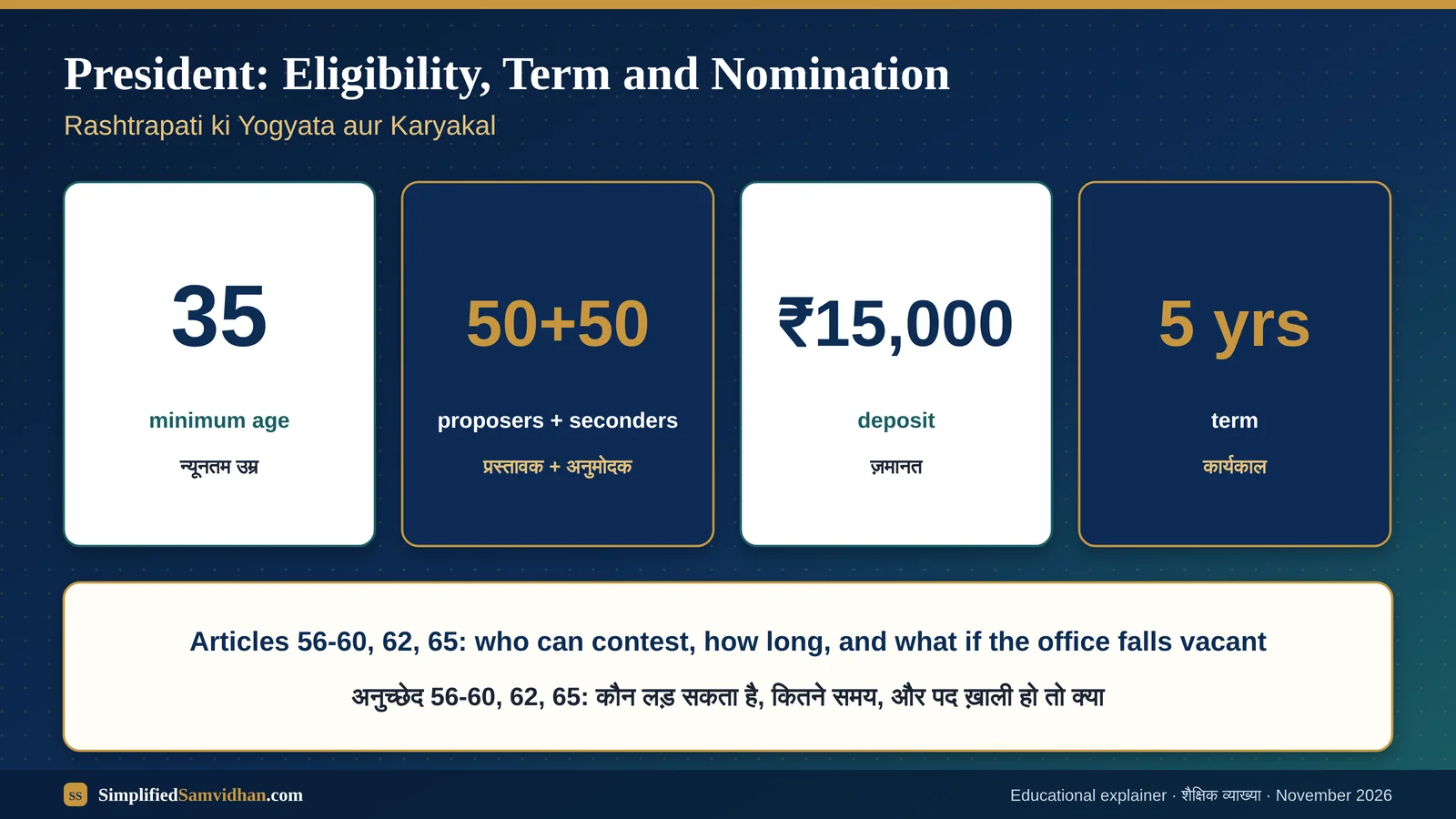
The four conditions to contest, the 100 signatures and deposit needed, the five-year term, the oath before the Chief Justice, and who runs the office if it falls vacant.
Short answerWho Can Become President of India? The Answer in Simple Words
Short answer: to become President you must be (1) a citizen of India, (2) at least 35 years old, (3) qualified to be a Lok Sabha member, and (4) not holding any government office of profit (Article 58). Your nomination needs 50 proposers + 50 seconders from the electoral college and a Rs 15,000 deposit. If elected, you take oath before the Chief Justice of India (Article 60) and serve five years (Article 56), and you can be elected again (Article 57).
🏠 Everyday analogy
Like applying for a big job: first the basic eligibility (age, citizenship), then a strong recommendation (100 signatures), then a fee (deposit), and finally the joining ceremony (oath).
🇮🇳 Real Indian example
A sitting Governor or Union Minister can contest, because the Constitution says those posts are not 'offices of profit' for this purpose. But a government officer or a judge must leave the post first, as Chief Justice K. Subba Rao did in 1967.
Articles 56-58Articles 56, 57 and 58: Term, Re-election and Eligibility
Article 56(1). The President shall hold office for a term of five years from the date on which he enters upon his office: Provided that— (a) the President may, by writing under his hand addressed to the Vice-President, resign his office; (b) the President may, for violation of the Constitution, be removed from office by impeachment in the manner provided in article 61; (c) the President shall, notwithstanding the expiration of his term, continue to hold office until his successor enters upon his office.
Article 57. A person who holds, or who has held, office as President shall, subject to the other provisions of this Constitution, be eligible for re-election to that office.
Article 58(1). No person shall be eligible for election as President unless he— (a) is a citizen of India, (b) has completed the age of thirty-five years, and (c) is qualified for election as a member of the House of the People.
Article 58(2). A person shall not be eligible for election as President if he holds any office of profit under the Government of India or the Government of any State or under any local or other authority subject to the control of any of the said Governments.
Explanation (extract). ...a person shall not be deemed to hold any office of profit by reason only that he is the President or Vice-President of the Union or the Governor of any State or is a Minister either for the Union or for any State.
EligibilityFour Eligibility Conditions and the Conditions of Office (Article 59)
Citizen of India
By birth or otherwise; unlike the USA, India does not demand 'natural-born'.
35 years or more
Must have completed 35 years; a Lok Sabha member needs only 25.
Fit for Lok Sabha
Must be on a voter list and not disqualified under the Representation of the People Act, 1951.
No office of profit
Except President, Vice-President, Governor, Union or State Minister.
| Condition | Rule | Where |
|---|---|---|
| Cannot be an MP or MLA | If an MP/MLA is elected, the seat falls vacant on the day he becomes President | Art. 59(1) |
| No other office of profit | Must not hold any office of profit while President | Art. 59(2) |
| Rent-free residence | Rashtrapati Bhavan, plus allowances fixed by Parliament | Art. 59(3) |
| Salary protected | Cannot be reduced during the term; Rs 5 lakh a month since 2018 | Art. 59(4) |
NominationNomination: 50 Proposers, 50 Seconders and the Rs 15,000 Deposit
- 1Nomination paper (Form 2)
Filed with the Returning Officer in New Delhi, with a certified copy of the candidate's name in the voter list.
- 250 proposers + 50 seconders
All must be members of the electoral college; one elector can propose or second only one candidate.
- 3Security deposit Rs 15,000
Forfeited if the candidate gets less than one-sixth of the votes needed to be elected (the quota).
- 4Scrutiny and withdrawal
The Returning Officer checks papers; candidates can withdraw within the fixed date. If only one valid candidate remains, he is declared elected unopposed, as in 1977.
Before 1997
- 10 proposers + 10 seconders
- Deposit Rs 2,500
- Many non-serious candidates (15 in 1969)
Since 1997
- 50 proposers + 50 seconders
- Deposit Rs 15,000
- Usually just 2 serious candidates
Term and vacancyTerm, Oath and Vacancy: Articles 56, 60, 62 and 65 (with Diagram)
Oath (Article 60): the President swears to "preserve, protect and defend the Constitution and the law" and to devote himself to the service and well-being of the people of India. Note the words: Ministers swear to bear true faith to the Constitution; only the President (and Governors) promise to defend it.
Quick revisionOne-Line Revision Points (Exam Ready)
- Eligibility: citizen, 35, fit for Lok Sabha, no office of profit (Art. 58).
- Term 5 years (Art. 56); re-election allowed (Art. 57).
- Resignation addressed to the Vice-President.
- Oath before the CJI (Art. 60).
- 50 proposers + 50 seconders; deposit Rs 15,000 (since 1997).
- Vacancy: election within 6 months (Art. 62(2)); VP acts (Art. 65).
Practice MCQPractice MCQs (with Answers): Eligibility and term
The President of India addresses his resignation to:
Which of these can contest the presidential election without resigning first?
A President elected after the death of the previous President holds office for:
The minimum age to become President of India is:
Doubts ClearedFrequently Asked Questions
Can a person become President more than twice?
Yes, legally. Article 57 allows re-election without any limit. In practice only Rajendra Prasad has served two terms.
What is the salary of the President of India?
Rs 5 lakh a month since 2018, under the President's Emoluments and Pension Act as amended by the Finance Act, 2018. It cannot be reduced during the term.
Who administers the oath to the President?
The Chief Justice of India, or in his absence the senior-most available judge of the Supreme Court (Article 60).
Sources and further readingSources We Checked
Checked against Articles 56-62 and 65 of the Constitution and the Presidential and Vice-Presidential Elections Act, 1952 (as amended in 1997). The Hindi text of the Articles is a simple rendering.